accounting software
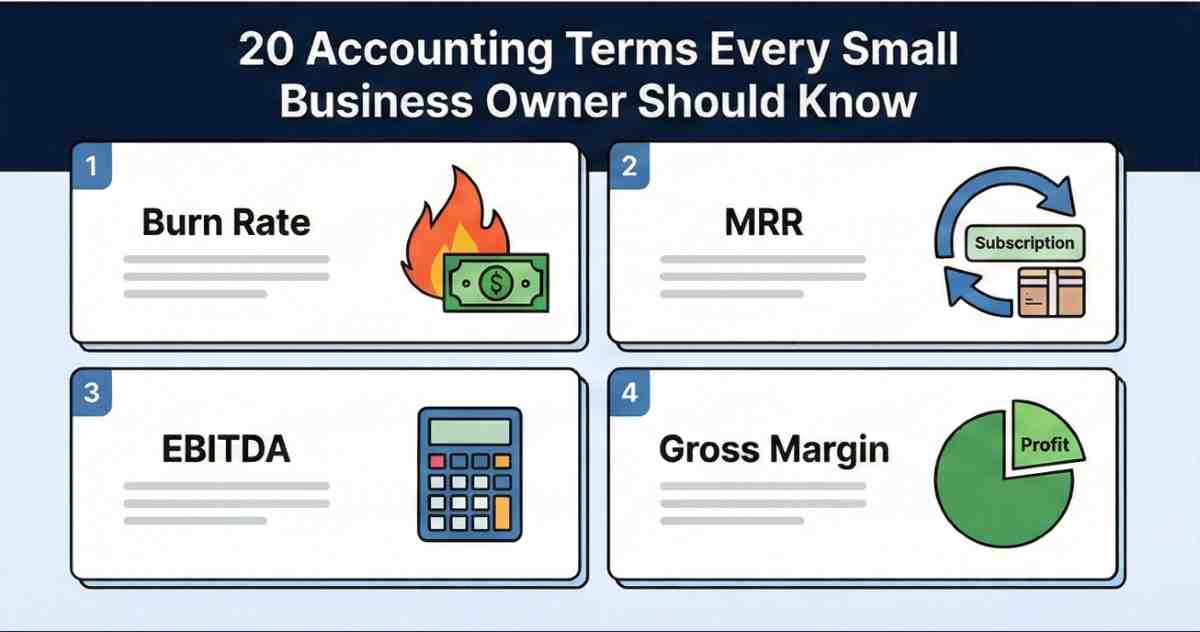
20 Accounting Terms Every Small Business Owner Should Know
S
SaaSPodium Team••Updated:
Advertisement
Accounting is the language of business. You don't need to be fluent to be a successful founder, but you do need to be conversational. If you confuse "Profit" with "Revenue" in a pitch meeting, you lose credibility instantly.
Whether you are managing a freelance design studio or scaling a SaaS platform, these are the 20 definitions that will help you understand exactly what your accountant—and your bank balance—is trying to tell you.
The "Big Three" Reports
1. Balance Sheet
A snapshot of your business at a specific moment in time. It follows the formula: Assets = Liabilities + Equity. It tells you what you own versus what you owe.
2. Income Statement (P&L)
Also called "Profit and Loss." This shows your financial performance over a period (e.g., last month). It tracks Revenue minus Expenses to show if you made money or lost it.
3. Cash Flow Statement
The reality check. It tracks actual cash moving in and out of your bank account. You can be "profitable" on paper (P&L) but still go bankrupt if you run out of cash (Cash Flow).
General Concepts
4. Accrual Accounting
Recording revenue when it is earned and expenses when they are incurred, regardless of when cash changes hands. (See our SaaS Accounting 101 guide).
5. Fiscal Year (FY)
Your business's reporting year. It doesn't have to match the calendar year. In India, the Fiscal Year runs from April 1st to March 31st.
6. Accounts Receivable (AR)
Money that customers owe you for work you have already delivered. If you send an invoice today with "Net 30" terms, that amount sits in AR for 30 days.
7. Accounts Payable (AP)
Money you owe to vendors. If you receive a bill for server hosting but haven't paid it yet, it sits in AP.
Profitability Metrics
8. Cost of Goods Sold (COGS)
The direct costs of producing your product. For a bakery, it's flour. For a SaaS company, it's server hosting and API fees.
9. Gross Margin
Revenue minus COGS. This is the most critical metric for investors because it shows the scalability of your product.
10. Operating Expenses (OpEx)
The costs of running the business that aren't tied to production. Examples: Rent, marketing spend, and legal fees.
11. EBITDA
Earnings Before Interest, Taxes, Depreciation, and Amortization. A fancy way of saying "Operating Profit" that removes accounting tricks to show raw performance.
Startup & SaaS Lingo
12. Burn Rate
The rate at which you are spending cash. If you start the month with $100k and end with $90k, your Burn Rate is $10k/month.
13. Runway
How much time you have left before you run out of money. Formula: Cash Balance / Burn Rate.
14. Deferred Revenue
Money you received upfront for services not yet delivered. In SaaS, annual subscriptions create a huge Deferred Revenue liability.
15. ARR / MRR
Annual or Monthly Recurring Revenue. The predictable income from subscriptions, excluding one-time setup fees.
16. Churn
The percentage of customers who cancel their subscription in a given period. High churn kills growth.
17. CAC (Customer Acquisition Cost)
How much you spend on sales and marketing to get one new customer. Formula: Total Sales & Marketing Spend / New Customers Acquired.
18. LTV (Lifetime Value)
The total profit you expect to make from a single customer before they churn.
Tax Concepts
19. Depreciation
Expensing an asset over time. Instead of expensing a $3,000 laptop in one month, you "depreciate" roughly $83/month over 3 years.
20. Reconciliation
The process of comparing your internal records (Accounting Software) with external records (Bank Statement) to ensure they match perfectly.
Advertisement