What is ASC 606? A Simple Guide to Revenue Recognition
Advertisement
Welcome to the world of Revenue Recognition. In the subscription economy, cash is not king—delivery is. ASC 606 (or IFRS 15 internationally) is the accounting standard that dictates exactly when and how you can claim that money as "Revenue" on your books. Getting this wrong doesn't just annoy your accountant; it can tank your valuation during due diligence.
The Core Concept: "Transfer of Control"
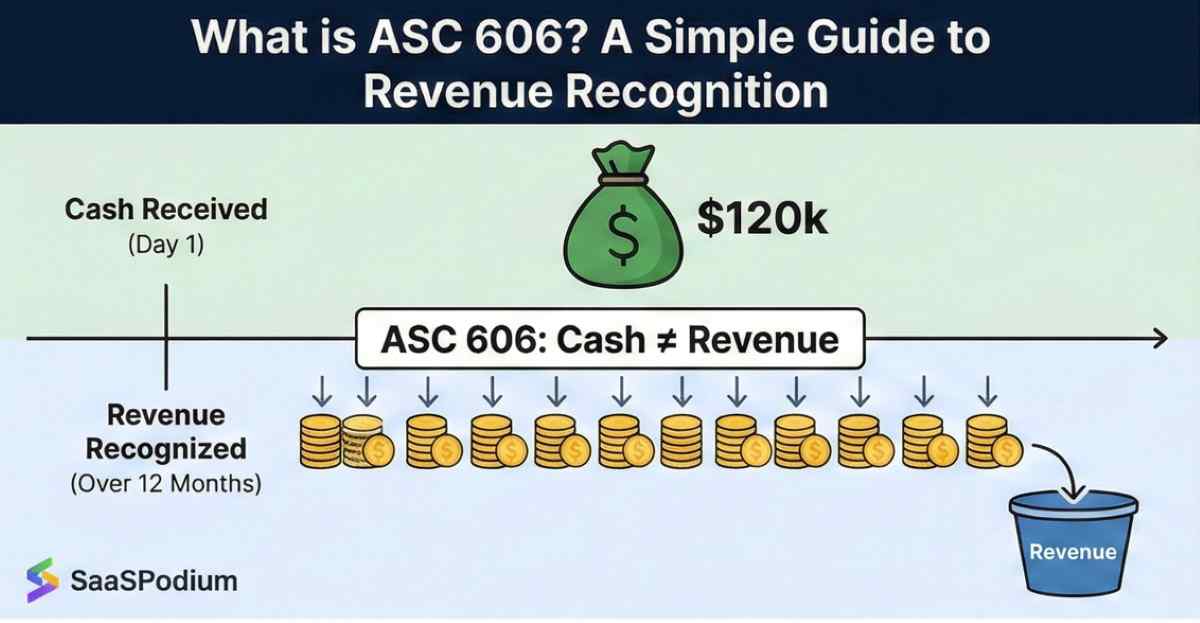
The golden rule of ASC 606 is simple: You recognize revenue when you transfer the service to the customer, not when they pay you.
For a SaaS company, "transferring" the service happens over time. If a customer pays for a year of access, you are "transferring" that access continuously every day. Therefore, you "earn" that revenue continuously every day.
The 5-Step Model Simplified
To comply with the standard, you must apply this 5-step logic to every contract you sign:
Step 1: Identify the Contract
This is the easy part. It’s the signed document or the Terms of Service agreed to at checkout.
Step 2: Identify Performance Obligations
What did you promise? In SaaS, this is tricky. Did you promise just the software? Or did you also promise 24/7 support and a dedicated onboarding manager? Each distinct promise is a "Performance Obligation."
Step 3: Determine Transaction Price
How much is the total deal worth? This includes the subscription fee, plus any setup fees, minus any discounts or potential refunds.
Step 4: Allocate the Price
If you sold a software license for $10,000 and a training session for $2,000, but bundled them for $11,000, you have to mathematically split (allocate) that discount across both items.
Step 5: Recognize Revenue
This is the finish line. You recognize the software revenue over the 12 months (over time), but you might recognize the training revenue the day the training happens (point in time).
A Real-World SaaS Example
Let's look at a typical scenario for a startup using AkMo Books or NetSuite:
- The Deal: Customer pays $12,000 upfront for a 1-year Plan.
- Day 1 (Cash): Bank account goes up by $12,000.
- Day 1 (Revenue): $0. The entire $12,000 sits in a liability account called Deferred Revenue.
- Month 1 End: You have delivered 1 month of service. You move $1,000 from Deferred Revenue to "Real" Revenue.
- The Result: Your P&L shows steady, predictable growth, even if your cash sales are "lumpy."
FAQs
Is ASC 606 mandatory for startups?
If you plan to be audited, raise venture capital, or sell your company, yes. Investors need to see your books in this format to trust your growth metrics.
Does this affect my taxes?
Generally, no. Tax reporting often follows different rules (cash basis) depending on your region, but ASC 606 is for your financial reporting (GAAP).
Do I need to calculate this manually?
Absolutely not. Tools like AkMo Books and Maxio have "Revenue Recognition" engines that automate Step 4 and Step 5 for you.
Advertisement