SaaS Accounting 101: Cash vs. Accrual Basis | Which Should You Choose?
Advertisement
The SaaS Financial Model
Choosing the right accounting method isn't just a "back-office" decision; it affects how investors see your growth and how you manage your daily burn rate. In 2026, the distinction between cash and accrual is the difference between seeing a bank balance and seeing a business trajectory.
1. Cash Basis Accounting
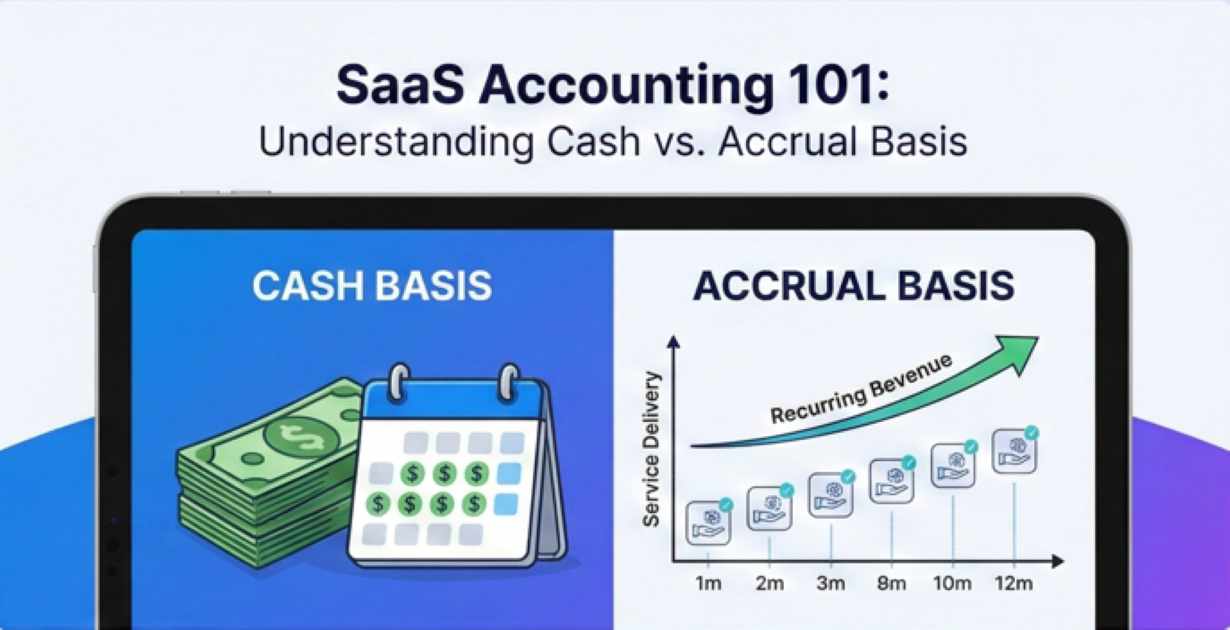
In cash accounting, transactions are recorded only when money actually changes hands. This is often the starting point for bootstrapped founders.
- When to record Revenue: When the cash hits your bank account.
- When to record Expenses: When the money leaves your bank account.
- The Pro: It’s incredibly simple. You know exactly how much "real" money you have at any given moment.
- The Con: It’s misleading for SaaS. If a customer pays $1,200 for an annual plan in January, your books show a massive spike in January and $0 for the next 11 months.
2. Accrual Basis Accounting
Accrual accounting records revenue and expenses when they are earned or incurred, regardless of when the cash moves. This is the standard for GAAP (Generally Accepted Accounting Principles).
- When to record Revenue: Proportionally as the service is provided (Revenue Recognition).
- When to record Expenses: When you receive the bill or the service, not necessarily when you pay it.
- The Pro: It provides a true "matching" of effort to reward. That $1,200 annual payment is recorded as $100 of revenue each month for 12 months.
- The Con: It requires more advanced bookkeeping and doesn't always reflect your immediate liquidity.
Key Differences for SaaS Companies
| Feature | Cash Basis | Accrual Basis |
|---|---|---|
| Complexity | Low | High |
| Investor Preference | Rarely accepted | Industry Standard |
| Revenue Accuracy | Poor for subscriptions | High (reflects MRR) |
| Tax Impact | Pay tax when cash is received | Pay tax when income is earned |
FAQs
Why do SaaS investors insist on Accrual accounting?
Investors care about Monthly Recurring Revenue (MRR) and predictability. Cash accounting creates "lumpy" financials that make it impossible to see the actual month-over-month growth trends.
What is Deferred Revenue in SaaS?
Deferred revenue is a liability on your balance sheet. It represents money you have received but haven't "earned" yet. As you provide the service, you move a portion to Recognized Revenue.
When should a SaaS startup switch from Cash to Accrual?
While very early startups might start with cash, you should switch once you cross $500k–$1M in ARR or when you begin seeking outside institutional investment.
Advertisement