Architecting Insights: The Best Business Intelligence Tools for Scaling B2B SaaS
Advertisement
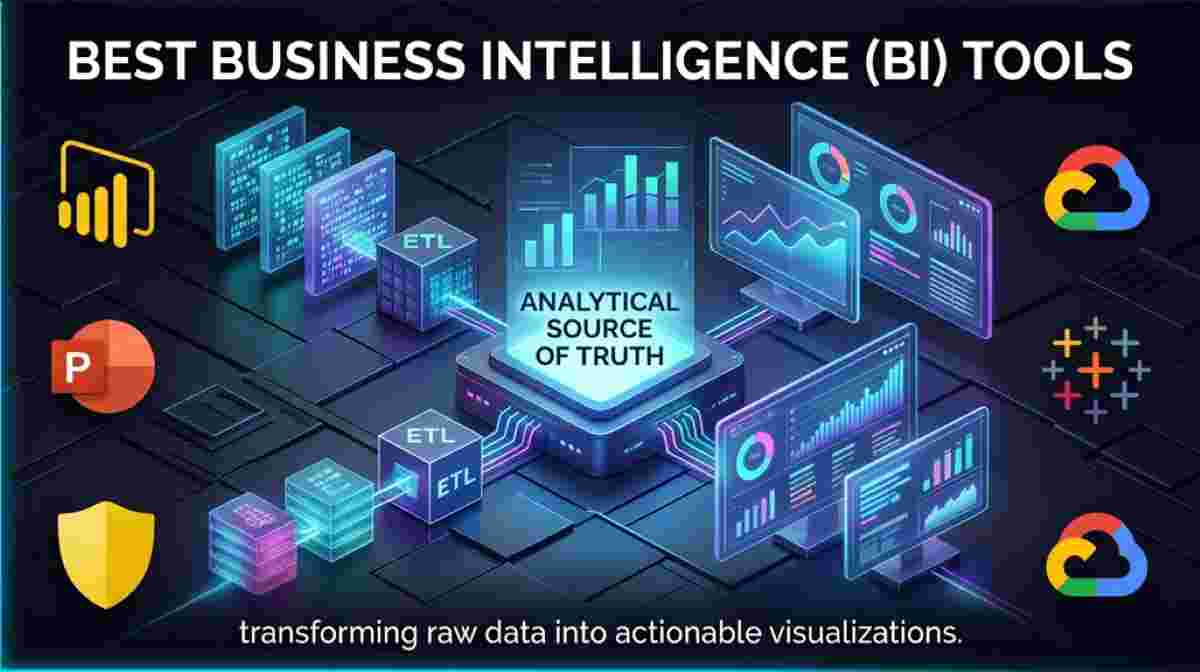
As SaaS enterprises scale, data silos inevitably form across different departments. The best business intelligence tools act as the central source of truth, utilizing sophisticated ETL (Extract, Transform, Load) pipelines to pull disparate data into a unified dashboard. For technical leaders, choosing the right BI platform means evaluating rendering performance, semantic modeling capabilities, and the ease of embedding these analytics natively within customer-facing applications.
Implementing enterprise BI requires strict adherence to data governance and rendering standards. Architectural planning often aligns with the ISO/IEC 38500 framework for the corporate governance of IT, ensuring data privacy and ethical analytics. Furthermore, front-end dashboard rendering must comply with W3C Graphics standards to guarantee smooth performance across web browsers using SVG and Canvas APIs. In predictive BI dashboards, tracking trends often utilizes time-series forecasting, such as the Exponential Moving Average (EMA), to smooth out CRM sales noise:
$EMA_t = \alpha \cdot X_t + (1 - \alpha) \cdot EMA_{t-1}$
where $\alpha$ represents the smoothing factor, $X_t$ is the value at time period $t$, and $EMA_{t-1}$ is the moving average of the previous period.
| BI Tool | Core Strength | Data Architecture | Best SaaS Integration |
|---|---|---|---|
| Microsoft Power BI | Enterprise Microsoft Ecosystem | DAX / DirectQuery | Dynamics 365, Azure |
| Tableau | Advanced Visual Analytics | Hyper Data Engine | Salesforce CRM |
| Looker | Code-Based Modeling (LookML) | In-Database Querying | Google Cloud, BigQuery |
| Qlik Sense | Associative Exploration | In-Memory Engine | ERP & Legacy Databases |
| Sisense | Embedded SaaS Analytics | Elastic Data Cubes | Custom SaaS Platforms |
| Domo | Executive Mobile Dashboards | Cloud-Native | Marketing Tech Stacks |
| Metabase | Open-Source & Lightweight | Direct SQL / No-Code GUI | PostgreSQL, MySQL |
1. Microsoft Power BI
Power BI is an enterprise-grade analytics powerhouse that deeply integrates with the Microsoft technology stack. It is the go-to solution for SaaS companies heavily invested in Azure data lakes and Office 365 environments.
- DAX Language: Utilizes Data Analysis Expressions (DAX) for complex data modeling and custom metric creation.
- DirectQuery Capability: Allows dashboards to query large datasets directly at the source without importing data into the Power BI engine, reducing latency.
- Row-Level Security (RLS): Granular security controls restrict data access for given users, critical for multi-tenant SaaS architectures.
2. Tableau
Tableau, a Salesforce company, sets the industry standard for intuitive, drag-and-drop visual analytics. It empowers data scientists and business users alike to discover hidden patterns in CRM data without writing complex SQL.
- Hyper Data Engine: An in-memory data engine technology designed for fast ingest and analytical query processing on large or complex datasets.
- VizQL Technology: Translates drag-and-drop actions into data queries and expresses the data visually, abstracting underlying database complexities.
- Salesforce Einstein Integration: Embeds native predictive AI and machine learning models directly into dashboard workflows.
3. Looker
Looker, now part of Google Cloud, takes a fundamentally different approach by operating entirely in-database and relying on a centralized semantic layer. This ensures that every department in a B2B SaaS company defines KPIs the exact same way.
- LookML: A proprietary, version-controlled modeling language that abstracts SQL to create reusable, agile data models.
- 100% In-Database Architecture: Does not extract data into its own engine, instead leveraging the native processing power of cloud warehouses like Snowflake or BigQuery.
- Git Integration: Supports CI/CD workflows for data teams, allowing version control and peer review of dashboard logic.
4. Qlik Sense
Qlik Sense differentiates itself with its unique Associative Engine, which allows users to explore data freely in any direction rather than being restricted to predefined, linear drill-down paths.
- Associative Data Indexing: Automatically manages all relationships in the data dynamically, uncovering connections that traditional SQL joins might miss.
- In-Memory Processing: Compresses data down to 10% of its original size to load massive datasets entirely into RAM for lightning-fast exploration.
- Augmented Analytics (Insight Bot): NLP-driven search functionalities allow users to ask conversational questions and generate immediate visual answers.
5. Sisense
Sisense is architected specifically for embedding white-labeled analytics directly into B2B SaaS products. It provides developers with highly customizable APIs to monetize data for their end-users.
- Elastic Data Hub: Utilizes both in-chip processing and live cloud connections to balance performance and storage overhead.
- API-First Design: Extensive REST APIs and JavaScript libraries (Sisense.js) allow UI/UX teams to build bespoke analytics experiences within native applications.
- BloX Framework: Allows developers to create actionable widgets where users can trigger external applications (like creating an ITSM ticket) directly from a chart.
6. Domo
Domo is a fully cloud-based, mobile-first BI platform designed to bring data to the executive suite. It connects instantly to hundreds of cloud applications to unify siloed marketing, sales, and HR data.
- Magic ETL: A visual drag-and-drop ETL tool that allows non-engineers to clean, join, and transform datasets before visualization.
- Pre-built API Connectors: Offers over 1,000 out-of-the-box connectors to instantly ingest data from platforms like HubSpot, Zendesk, and Stripe.
- Real-Time Alerting: Sophisticated triggered alerts notify stakeholders via SMS or Slack the moment a specific KPI deviates from statistical norms.
7. Metabase
Metabase is a fast, open-source BI tool that takes minutes to set up. It bridges the gap between technical data analysts writing complex SQL and non-technical staff needing quick, self-serve answers.
- Zero-Copy Architecture: Connects directly to existing PostgreSQL, MySQL, or MongoDB instances without requiring an intermediate data warehouse.
- Visual Query Builder: Allows non-technical users to filter and aggregate data via a clean GUI, which compiles down to optimized SQL on the backend.
- Containerized Deployment: Easily deployable via Docker or Kubernetes, making it a favorite for DevOps teams managing internal toolchains.
Frequently Asked Questions
What is the difference between Self-Service BI and Traditional BI?
Traditional BI heavily relies on IT departments or data engineers to write SQL queries and generate static reports, which can create bottlenecks. Self-Service BI platforms provide intuitive drag-and-drop interfaces that allow non-technical business users to generate their own custom reports and dashboards independently.
How do BI tools handle data security for multi-tenant SaaS applications?
Enterprise BI tools use Row-Level Security (RLS) and Column-Level Security to restrict data access at the database level based on the user's login credentials. This ensures that in a multi-tenant environment, Client A cannot see Client B's data, even if both are querying the same underlying dashboard template.
What is a Semantic Layer in Business Intelligence?
A semantic layer is an architectural abstraction that translates complex database schemas into familiar business terms. For example, instead of querying "dbo.tbl_usr_sls_09," a user simply selects "Q3 Total Revenue." Tools like Looker use this layer to ensure that metric definitions remain consistent across the entire organization.
Advertisement