BI vs. Data Analytics vs. Data Science: What is the Exact Difference?
Advertisement
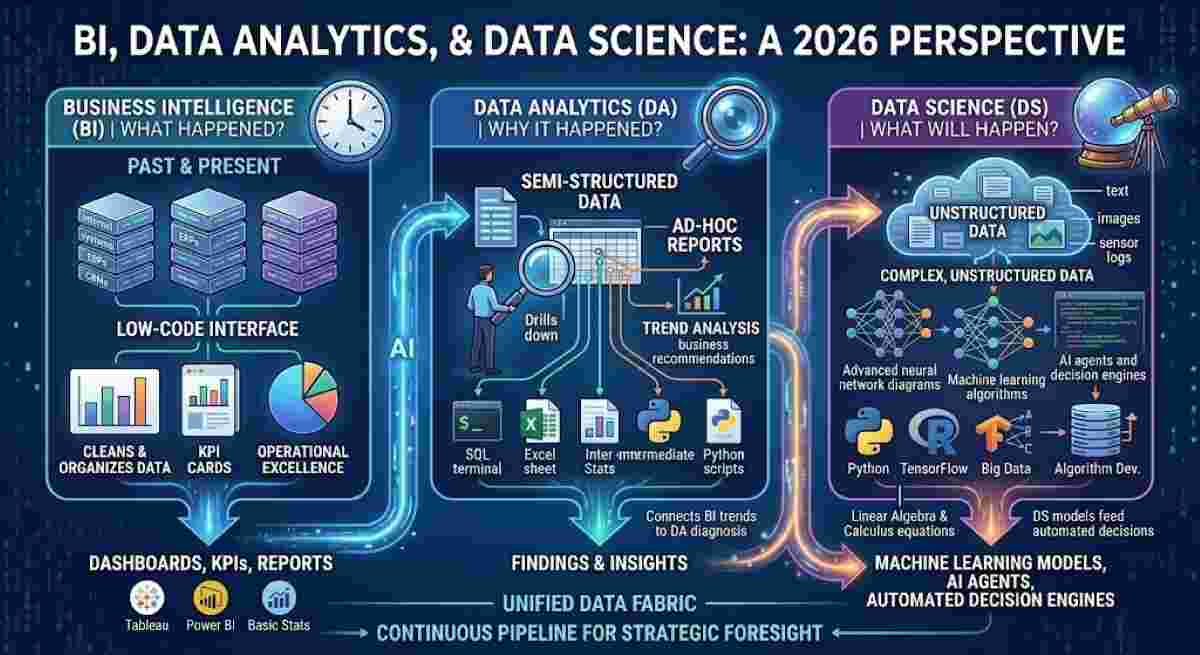
The difference between BI, Data Analytics, and Data Science lies in their temporal focus and the complexity of the questions they answer. Business Intelligence (BI) looks at the past to explain "what happened," Data Analytics (DA) inspects data to find "why it happened," and Data Science (DS) utilizes advanced algorithms to predict "what will happen." In the 2026 data landscape, these fields have converged into a continuous pipeline where raw data is transformed into strategic foresight. While they share a common foundation in data, their technical requirements and business outputs are distinct and complementary.
Quick Navigation: Mapping the Data Landscape
- The Analytical Continuum: From Hindsight to Foresight
- Deep Dive: Defining the Three Pillars
- Technical Stack Comparison: Tools of the Trade
- Which Function Does Your Business Need?
- Data Roles Comparison FAQs
The Analytical Continuum: From Hindsight to Foresight
To understand the exact difference, it is helpful to view these disciplines along a spectrum of complexity and value.
Business Intelligence (Descriptive): Focuses on retrospective reporting. It cleans and organizes data so stakeholders can see the current state of the business.
Data Analytics (Diagnostic): Moves into the "why." It uses statistical techniques to find the root causes of the trends identified by BI.
Data Science (Predictive & Prescriptive): The most advanced stage. It builds models that can anticipate future trends and automatically recommend the best course of action.
According to Coursera, the transition from "Analytics" to "Science" is defined by the move from analyzing existing data to creating new ways to capture and interpret data that hasn't been explored yet.
Deep Dive: Defining the Three Pillars
1. Business Intelligence (BI)
BI is the "check-up" for a company. It relies on structured data from internal systems like ERPs and CRMs. The goal is operational excellence. For example, a BI dashboard might show that sales in the Northeast region dropped by 12% last month.
Primary Question: What is our current status?
Output: Dashboards, KPIs, and static reports.
2. Data Analytics (DA)
Data Analytics is the bridge between BI and Data Science. It involves deeper statistical analysis to identify trends and patterns. If BI says sales are down, a Data Analyst will "drill down" into the data to find that the drop was caused by a specific competitor's discount or a supply chain delay.
Primary Question: Why is this happening?
Output: Ad-hoc reports, trend analysis, and business recommendations.
3. Data Science (DS)
Data Science is the "R&D" of the data world. It deals with unstructured data (text, images, sensor logs) and uses machine learning to build predictive systems. A Data Scientist doesn't just look at past sales; they build a recommendation engine that predicts what a customer will want to buy next, increasing the "customer lifetime value" (CLV).
Primary Question: What will happen next, and how can we optimize for it?
Output: Machine learning models, AI agents, and automated decision engines.
Technical Stack Comparison: Tools of the Trade
The tools used in 2026 reflect the differing levels of technical depth required for each role.
| Feature | Business Intelligence (BI) | Data Analytics (DA) | Data Science (DS) |
|---|---|---|---|
| Common Tools | Tableau, Power BI, Looker | SQL, Excel, SAS, Google Analytics | Python, R, PyTorch, TensorFlow |
| Data Types | Structured (Warehouse) | Semi-structured | Unstructured (Big Data) |
| Mathematics | Basic Statistics/Arithmetic | Intermediate Statistics | Linear Algebra, Calculus, Probability |
| Programming | Low-Code/No-Code | SQL, Python scripts | Deep Programming/Algorithm Dev |
As noted by IBM, while BI tools are becoming more "AI-powered," they still serve the purpose of making data accessible to non-technical users, whereas Data Science tools remain the domain of specialized engineers.
Which Function Does Your Business Need?
Choosing which function to invest in depends on your organization's data maturity.
Startup/Small Business: Start with BI. You need to know your burn rate, customer acquisition cost, and revenue growth before you can do anything else.
Growing Mid-Market: Invest in Data Analytics. Once you have data, you need to understand the drivers of your growth to optimize your marketing spend and operations.
Enterprise/Tech-First: Scale with Data Science. At a certain volume of data, human analysis is no longer enough. You need AI and ML to automate personalization, fraud detection, and supply chain logistics at scale.
In 2026, the most successful organizations utilize a "Unified Data Fabric." This approach ensures that the Data Scientist's models are fed by the same "clean" data used in the BI dashboards, preventing the "silo effect" where different departments report conflicting numbers. According to Gartner, the integration of these three roles into a single "Data Center of Excellence" is the top trend for digital transformation this year.
Data Roles Comparison FAQs
Can one person perform all three roles?
While "Full-Stack Data Professionals" exist, it is rare. The skillset for a BI developer (UX/UI and business logic) is very different from a Data Scientist (Advanced Calculus and Neural Networks). Forcing one person into all three roles often leads to a "jack-of-all-trades, master-of-none" scenario.
Which role is the most expensive to implement?
Data Science is generally the most expensive due to the high salaries of PhD-level researchers and the computing costs (GPUs) required to train large-scale machine learning models. BI is usually the most cost-effective "entry point" for a data-driven culture.
How has AI changed these differences in 2026?
AI has "blurred" the lines. Modern BI tools now have "Predictive" buttons that use basic Data Science models, and Data Science platforms now have "Auto-Viz" features that look like BI dashboards. However, the core purpose—reporting vs. predicting—remains the same.
Advertisement