How to Calculate the ROI of a Business Intelligence Software Investment
Advertisement
In 2026, Business Intelligence is no longer optional. It functions as the operating system behind modern decision making. As SaaS stacks expand and data sprawl increases, finance and operations teams demand measurable returns rather than vague promises of better insights.
Calculating the ROI of a BI tool such as Zoho Analytics, Microsoft Power BI, or Tableau requires moving beyond intuition. Organizations must quantify the manual reporting work currently consuming analyst time and measure how deterministic data improves revenue outcomes.
This guide outlines the structured approach required to justify a modern analytics investment.
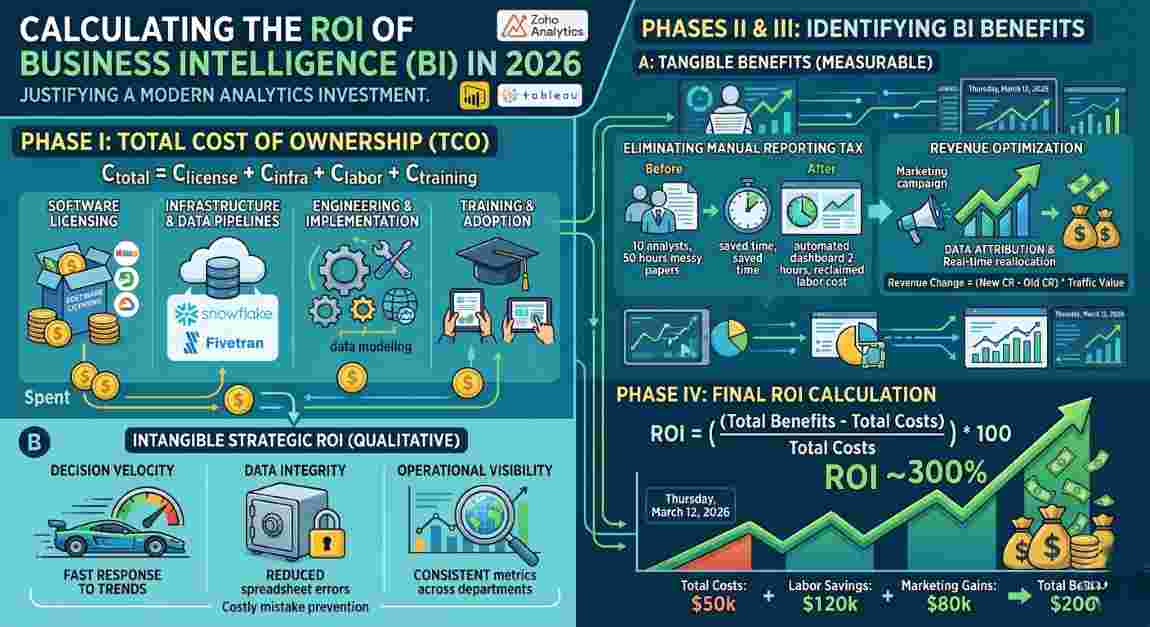
Phase I: Quantifying the Total Cost of Ownership (TCO)
Before calculating ROI, organizations must understand every cost associated with a BI implementation. In cloud native environments the software license typically represents only a portion of the real cost.
- Software Licensing The recurring subscription fee for the BI platform.
- Infrastructure and Data Pipelines Costs associated with data warehouses such as Snowflake or Google BigQuery, along with ETL tools such as Fivetran.
- Engineering and Implementation Time spent on system integration, data modeling, and dashboard development.
- Training and Adoption Employee training required to ensure teams consistently use the BI platform instead of fragmented spreadsheets.
Total cost of ownership can be estimated using the following formula.
Ctotal = Clicense + Cinfra + Clabor + Ctraining
Phase II: Identifying Tangible Benefits
The fastest ROI from BI typically comes from reclaiming time currently lost to manual reporting workflows.
Eliminating the Manual Reporting Tax
Many organizations still rely on analysts exporting CSV files, cleaning datasets in spreadsheets, and assembling slide presentations for weekly reporting.
- Example workflow without BI automation 10 analysts × 5 hours per week = 50 hours
- After BI automation Dashboard reporting reduces the process to approximately 2 hours per week
- Total time saved 48 hours per week multiplied by the analyst hourly rate
This reclaimed labor cost becomes an immediate measurable return.
Revenue Optimization Through Data Attribution
A modern BI environment allows organizations to analyze marketing attribution and customer behavior in near real time.
If a campaign generates higher lifetime value customers, marketing teams can reallocate budgets immediately.
Revenue Change = (New Conversion Rate − Old Conversion Rate) × Traffic Value
Phase III: Intangible Strategic ROI
Some benefits of BI are difficult to measure precisely but have significant long term impact.
- Decision Velocity Organizations no longer wait weeks for month end reports. Real time dashboards allow teams to respond immediately.
- Data Integrity Centralized analytics reduces the risk of errors from disconnected spreadsheets.
- Operational Visibility Leadership teams gain consistent metrics across departments.
A single costly mistake prevented through accurate reporting can justify the entire analytics investment.
Phase IV: The Final ROI Calculation
Once total benefits and costs are identified, ROI can be calculated using a standard investment formula.
ROI = ((Total Benefits − Total Costs) ÷ Total Costs) × 100
Example scenario:
- Annual BI implementation cost: 50,000 dollars
- Labor savings: 120,000 dollars
- Marketing optimization gains: 80,000 dollars
Total benefits equal 200,000 dollars. The resulting ROI equals approximately 300 percent.
FAQs: The Realities of BI ROI
How long does it take to see a positive ROI?
Most organizations reach breakeven within six to nine months. The first few months typically involve data ingestion, infrastructure configuration, and dashboard development.
What is the hidden cost of BI in 2026?
The most overlooked cost is data cleaning. If CRM or ERP systems contain inconsistent data structures, engineering teams may spend significantly more time preparing data than originally planned.
Can ROI be calculated for free tools such as Looker Studio?
Yes. Even when the analytics platform itself is free, organizations must still account for engineering time and compute resources used by backend systems such as BigQuery.
Advertisement