The Role of Generative AI and Machine Learning in Modern BI Platforms
Advertisement
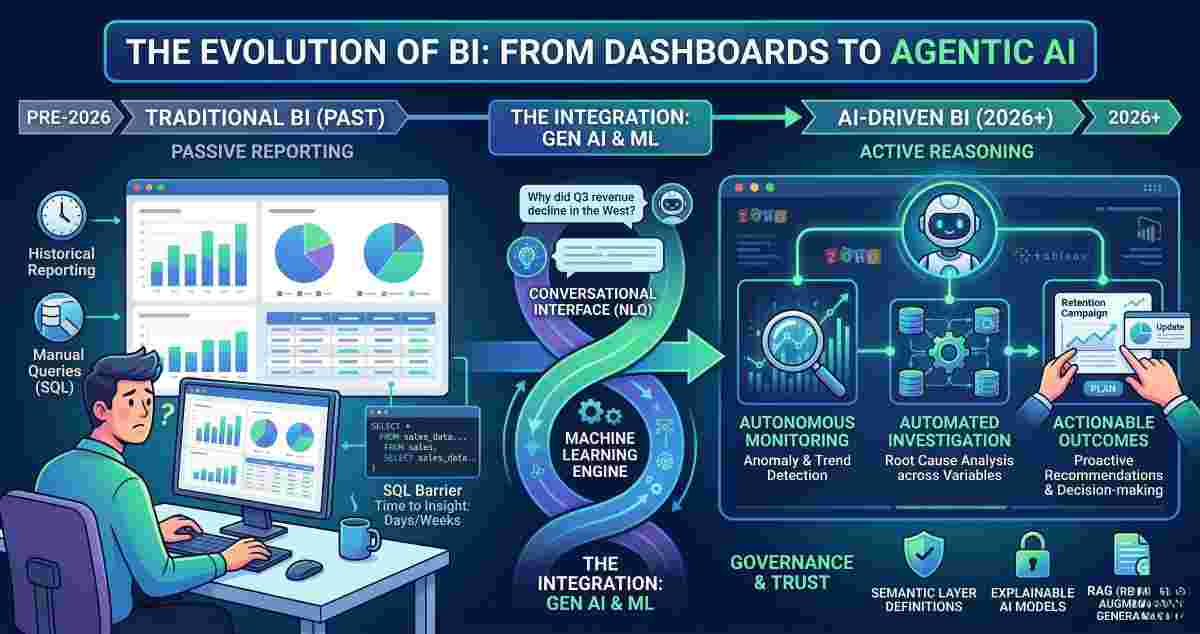
In 2026 a static dashboard is increasingly viewed as outdated. The original goal of business intelligence has always been to convert data into decisions, yet historically this required a human analyst to prepare queries, clean datasets, and interpret visualizations.
The integration of generative AI and machine learning has significantly reduced this friction. Modern analytics platforms such as Zoho Analytics, Microsoft Power BI, and Tableau have evolved from passive reporting tools into active reasoning engines.
This transformation is driven by two complementary technologies. Machine learning analyzes historical datasets to identify patterns, while generative AI provides a conversational interface and reasoning layer that allows users to interact with data naturally.
I. The End of the SQL Barrier: Natural Language Querying
One of the most visible changes in modern BI platforms is the rise of natural language querying. Historically self service analytics still required users to understand database concepts such as joins, measures, and dimensions.
Today users can ask complex questions in plain language.
Traditional SQL Query
SELECT region, SUM(sales) FROM sales_data WHERE year = 2025 GROUP BY region ORDER BY SUM(sales) DESC;
Natural Language Query
Show which regions exceeded their sales targets last year and highlight the top three contributors.
Generative AI systems do more than convert text into SQL. They interpret business context. If a user asks why quarterly revenue declined the system can perform automated root cause analysis and identify contributing factors across supply chain, marketing, and operational variables.
II. Predictive and Prescriptive Analytics
Machine learning continues to power the analytical backbone of BI platforms. Over time analytics has progressed through three stages.
- Descriptive analytics Explains what already happened using dashboards and reports.
- Predictive analytics Uses machine learning models to forecast future outcomes such as churn risk or revenue growth.
- Prescriptive analytics Provides recommendations on what actions should be taken based on predictive insights.
Modern platforms increasingly rely on automated machine learning. Instead of manually selecting algorithms, AutoML systems evaluate multiple models such as random forest or time series forecasting and automatically select the best performing approach.
The results are delivered with confidence scores that explain the reliability of each prediction.
III. Agentic BI: Autonomous Decision Systems
The next stage of analytics is often referred to as agentic BI. These systems continuously monitor operational data streams rather than waiting for manual queries.
- Autonomous monitoring AI agents detect anomalies such as unexpected spending spikes or unusual sales patterns.
- Automated investigation The system analyzes contributing variables across datasets.
- Actionable outcomes Agents can suggest or trigger responses directly within operational software.
For example an AI agent might detect increased churn risk within a region and automatically draft a targeted retention campaign for the affected customers.
IV. Governance and Ethical Guardrails
As AI systems gain influence in decision making environments governance becomes critical. Generative models occasionally produce incorrect interpretations if they rely solely on statistical associations.
Modern analytics platforms mitigate these risks through deterministic guardrails.
Semantic Data Layers
Platforms enforce structured semantic layers that define how metrics are calculated. Tools such as LookML or Zoho DataPrep ensure AI systems rely on approved business definitions rather than ambiguous database fields.
Explainable AI
Explainable AI features allow users to inspect how predictions are generated. When a trend or recommendation appears users can review the underlying data queries and model inputs.
FAQs: The AI Driven BI Landscape
Does generative AI make data analysts obsolete?
No. Instead of replacing analysts AI shifts their role toward data strategy. Analysts now focus on data quality governance semantic modeling and interpretation of insights produced by automated systems.
How can organizations prevent AI from hallucinating financial data?
Many platforms implement retrieval augmented generation where AI models query live enterprise databases rather than generating values from training data. This ensures analytics results come directly from systems such as Snowflake or Google BigQuery.
What is the cost of adopting AI driven BI?
Basic generative AI capabilities are increasingly included within standard SaaS analytics subscriptions. Advanced features such as custom machine learning training or continuous agentic monitoring typically require enterprise level licensing because of higher computing costs.
Advertisement