How to Choose the Right Data Analytics Platform for Your Business
Advertisement
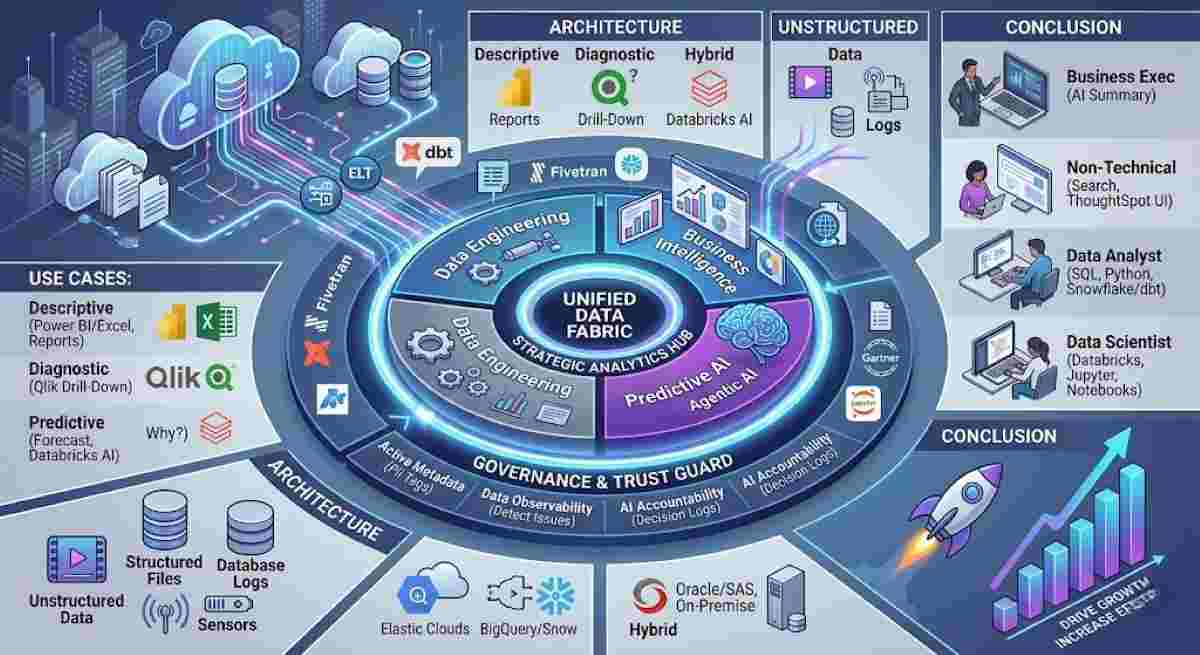
Choosing the right data analytics platform is a strategic decision that involves evaluating how a software solution will collect, process, and interpret your company's data to drive growth. In 2026, the selection process has shifted from looking for "fancy charts" to looking for Unified Data Fabrics—platforms that integrate data engineering, business intelligence, and predictive AI into a single ecosystem. With the global data analytics market projected to surpass $100 billion this year, the "right" choice is no longer about the most features, but the best alignment with your specific technical maturity and business outcomes.
Quick Navigation: The Selection Roadmap
- Step 1: Define Your Business Use Cases
- Step 2: Evaluate Technical Architecture & Scalability
- Step 3: Prioritize Data Governance & AI Trust
- Step 4: Assess User Personas and "Data Literacy"
- Data Platform Selection FAQs
Step 1: Define Your Business Use Cases
Before looking at vendor demos, you must identify the primary problem you are solving. According to ThoughtSpot, a "one-size-fits-all" approach often leads to expensive "shelfware."
- Descriptive Needs: If you just need to know "what happened" (e.g., monthly sales reports), a traditional BI tool like Microsoft Power BI or Excel with Power Query is sufficient.
- Diagnostic Needs: If you need to understand "why it happened" (e.g., why did conversion drop in March?), look for platforms with deep "drill-down" and associative capabilities like Qlik Sense.
- Predictive Needs: For forecasting demand or churn, you require a platform that supports Agentic AI and machine learning workflows, such as Databricks or Informatica's IDMC.
Step 2: Evaluate Technical Architecture & Scalability
In 2026, a platform’s ability to handle unstructured data (videos, PDFs, sensor logs) is a non-negotiable requirement for future-proofing.
Cloud-Native vs. Hybrid
Most modern leaders like Snowflake and Google BigQuery allow for "elastic compute," meaning you only pay for the processing power you use. For highly regulated industries like banking or healthcare, a hybrid setup (on-premise for sensitive data, cloud for processing) provided by vendors like Oracle or SAS may be necessary.
Integration and ELT
Your analytics are only as good as your data pipelines. Ensure the platform integrates seamlessly with your existing stack (CRM, ERP, Finance tools). Tools like Fivetran for ingestion and dbt for transformation are now industry standards for maintaining a clean, reliable data warehouse.
Step 3: Prioritize Data Governance & AI Trust
As AI agents become more autonomous, Data Governance has become the "brake" that allows your company to go fast safely. According to the Gartner Data Governance framework, top-tier platforms now include:
- Active Metadata Management: The platform should automatically "tag" sensitive data (like PII) to ensure GDPR and HIPAA compliance without manual intervention.
- Data Observability: Tools like Monte Carlo integrated into your platform can detect "stale data" or schema drifts before they ruin your executive dashboards.
- AI Accountability: The platform must log every model decision, allowing compliance teams to audit how an AI agent reached a specific business recommendation.
Step 4: Assess User Personas and "Data Literacy"
Who will actually be using the tool? The most expensive mistake is buying a high-code tool for a no-code team.
| User Persona | Recommended Feature Set | Example Tools |
|---|---|---|
| Business Executives | Mobile-first, "Push" notifications, AI summaries | Tableau Pulse, Domo |
| Non-Technical Staff | Search-based UI (Natural Language Query) | ThoughtSpot, Zoho Analytics |
| Data Analysts | SQL support, Python integration, dbt connectivity | Snowflake, Power BI |
| Data Scientists | Notebook environments, ML model hosting | Databricks, Python/Jupyter |
As noted by IBM, the successful implementation of an analytics platform requires more than just software; it requires a culture of Data Literacy where employees are trained to ask the right questions of the data.
Data Platform Selection FAQs
Should I choose a "Best-of-Breed" or "Unified" platform?
Unified platforms (like Microsoft Fabric) offer easier integration and lower management overhead. Best-of-breed (mixing Snowflake, dbt, and Tableau) offers more power and prevents vendor lock-in but requires a more skilled engineering team.
How long does a typical implementation take in 2026?
With modern cloud connectors, a basic setup can be live in 2–4 weeks. However, a full enterprise rollout involving data cleaning, governance policy setting, and staff training typically takes 3–6 months.
What is the hidden cost of free tools like Looker Studio?
While the visualization layer may be free, the underlying "data processing" costs (BigQuery costs) can scale rapidly. Always calculate the "Total Cost of Ownership" (TCO) including storage, compute, and third-party connector fees.
Advertisement