Best Cloud Data Warehouses for Modern BI (Snowflake vs. BigQuery vs. Redshift)
Advertisement
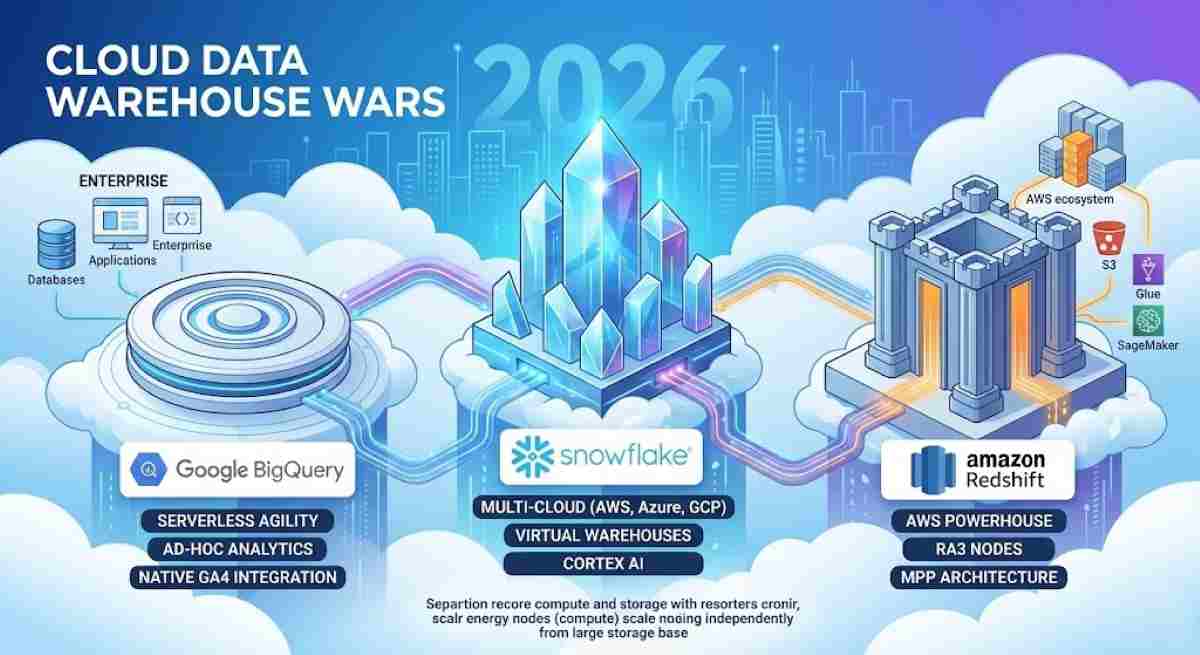
A cloud data warehouse is the central repository that consolidates data from across your enterprise to power business intelligence and advanced analytics. In 2026, the "Data Warehouse Wars" have moved beyond simple storage; the focus is now on AI-readiness and Serverless Agility. While Snowflake continues to lead for multi-cloud flexibility, BigQuery is the gold standard for zero-ops simplicity, and Amazon Redshift remains the powerhouse for those deeply embedded in the AWS ecosystem.
Quick Navigation: The 2026 Warehouse Guide
- The Top 3 Contenders at a Glance
- Architecture: How They Handle Your Data
- Pricing Models: Credits vs. Scans vs. Nodes
- Comparison Table: Which One Fits Your Business?
- Cloud Data Warehouse FAQs
The Top 3 Contenders at a Glance
1. Snowflake: The Multi-Cloud Specialist
Snowflake is a "neutral" platform that runs on AWS, Azure, or Google Cloud. Its defining feature is the Virtual Warehouse, which allows different teams (e.g., Finance and Marketing) to run their own compute clusters on the same data without slowing each other down. In 2026, its Cortex AI features allow you to run LLMs directly on your data.
2. Google BigQuery: The Serverless Speedster
BigQuery is truly serverless—there are no clusters to manage or nodes to scale. It excels at Ad-hoc Analytics and real-time streaming. If you are already using Google Ads or Google Analytics 4 (GA4), BigQuery's native integrations make it the most efficient choice for marketers.
3. Amazon Redshift: The AWS Workhorse
Redshift is the veteran of the group. While it historically required more tuning, the 2026 Redshift Serverless and RA3 nodes have made it nearly as automated as its rivals. It is the best choice for organizations that want deep integration with other AWS services like S3, Glue, and SageMaker.
Architecture: How They Handle Your Data
The primary architectural shift in 2026 is the separation of compute and storage. This allows you to scale your processing power without paying for more storage space.
- Snowflake: Uses a multi-cluster shared data architecture. It is famous for Zero-Copy Cloning, which lets you create a full copy of a database for testing instantly without extra storage costs.
- BigQuery: Uses a distributed query engine (Dremel). It is optimized for columnar storage, meaning it only reads the columns your query needs, which makes it incredibly fast for large-scale aggregations.
- Redshift: Uses Massively Parallel Processing (MPP). While it still allows for manual performance tuning, its modern AI-powered automation handles most optimization tasks for you.
Pricing Models: Credits vs. Scans vs. Nodes
In 2026, understanding your spend profile is more important than the sticker price.
| Platform | Pricing Logic | The Good | The Risk |
|---|---|---|---|
| Snowflake | Time-Based: You pay for Credits while the warehouse is running | Auto-suspend saves money during idle time | Minimum 60-second charge; costs grow if queries run frequently |
| BigQuery | Scan-Based: You pay per TB of data scanned | If you don't run queries you pay $0 for compute | One SELECT * on a massive table can cost hundreds instantly |
| Redshift | Node-Based or Serverless hourly capacity pricing | Predictable for steady 24/7 reporting workloads | You pay for capacity even if idle unless using Serverless |
Comparison Table: Which One Fits Your Business?
| Feature | Snowflake | BigQuery | Redshift |
|---|---|---|---|
| Cloud Strategy | Multi-Cloud (AWS/GCP/Azure) | GCP Only | AWS Only |
| Maintenance | Near-Zero Ops | Zero Ops | Low-to-Medium Ops |
| Best For | Multi-department isolation | Marketing and Ad-hoc SQL | Deep AWS integration |
| Semi-structured Data | Excellent (VARIANT type) | Excellent (JSON/Arrays) | Good (Super type) |
| Scalability | Instant and seamless | Infinite and automatic | Rapid via Serverless |
Cloud Data Warehouse FAQs
Which warehouse is the easiest to set up?
BigQuery is generally the easiest because it is fully serverless; you simply create a project and start querying. Snowflake is also straightforward because of its SaaS interface.
Can I switch between these platforms later?
While all three use ANSI SQL, they include proprietary features such as Snowpark and platform-specific optimizations. Migrating large warehouses usually requires ETL or ELT pipeline refactoring.
Is a Data Lakehouse better than a Data Warehouse?
In 2026 the distinction has blurred. Platforms like Databricks provide lakehouse architectures that combine storage flexibility with warehouse performance. However many BI-focused organizations still rely on a warehouse as their single source of truth.
Advertisement