The Role of AI, OCR, and Smart Search in Modern Document Management (2026)
Advertisement
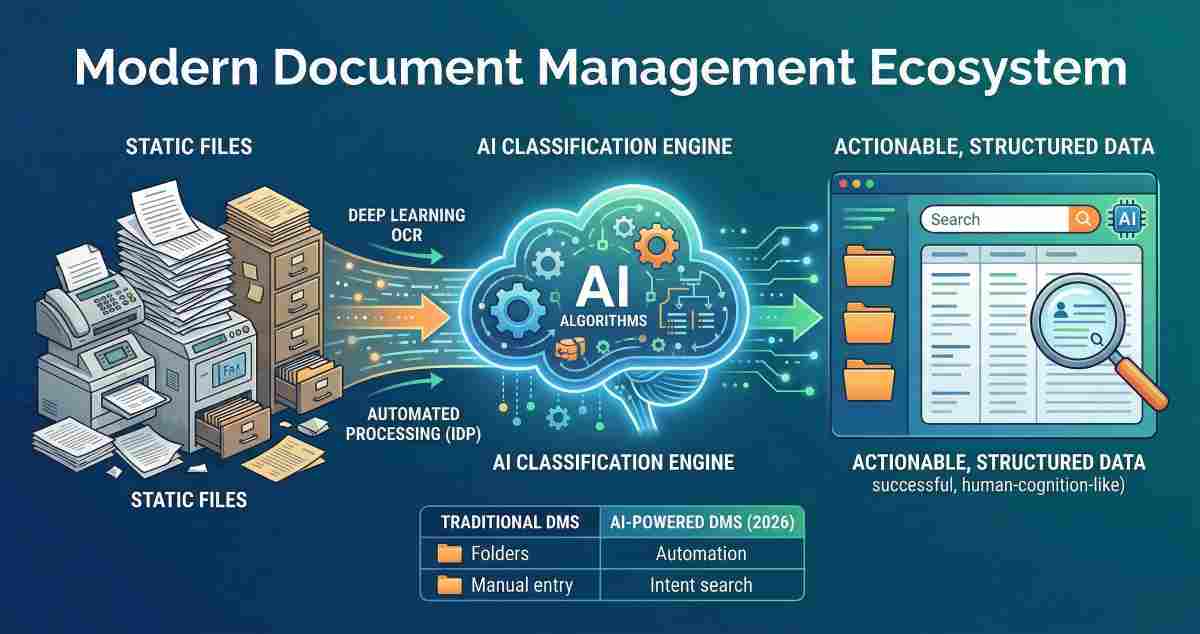
Modern document management is an intelligent ecosystem where Artificial Intelligence (AI), Optical Character Recognition (OCR), and Smart Search technologies converge to transform static files into actionable, structured data. In 2026, the traditional "digital filing cabinet" has been replaced by systems that not only store information but understand, classify, and retrieve it with near-human cognition.
Quick Navigation:
The Evolution of OCR: From Simple Text to Document Intelligence
AI-Driven Document Classification and Extraction
Smart Search: Moving Beyond Keywords to Intent
The Synergy of the Trifecta: Real-World Business Impact
Future-Proofing Your DMS for AI Agents
Comparing Traditional vs. AI-Powered Management
1. The Evolution of OCR: From Simple Text to Document Intelligence
Optical Character Recognition (OCR) was once a rigid tool used only to make PDFs searchable. In 2026, AI-powered OCR uses deep learning neural networks to achieve 99% accuracy, even on low-quality scans, handwritten notes, and complex multi-column layouts.
Contextual Character Recognition: Unlike legacy systems that might confuse "0" with "O," modern AI OCR analyzes surrounding text to determine the correct character based on context.
Preprocessing Automation: Systems now automatically "clean" documents—removing shadows, deskewing tilted pages, and adjusting contrast—before extraction begins, ensuring high data integrity.
Multilingual and Multimodal Support: Current OCR engines can simultaneously process documents containing multiple languages and mixed media (text, charts, and signatures) without manual configuration.
2. AI-Driven Document Classification and Extraction
The true "brain" of a modern DMS lies in its ability to categorize information without human intervention. This process, often called Intelligent Document Processing (IDP), utilizes Natural Language Processing (NLP) to understand what a document actually is.
Automated Classification: When a file is uploaded, the AI identifies it as an "Invoice," "NDA," or "Medical Record" by analyzing its structure and linguistic patterns.
Field-Level Extraction: Instead of just "reading" the page, the AI extracts specific data points—such as an invoice number, a due date, or a specific indemnity clause—and maps them directly into your database or ERP.
Confidence Scoring: Each extracted field comes with a confidence percentage. If the AI is only 80% sure about a handwritten date, it flags the file for a quick human review, ensuring that 100% accurate data enters the system.
3. Smart Search: Moving Beyond Keywords to Intent
Standard keyword search fails when a user doesn't know the exact name of a file. Smart Search (or Semantic Search) solves this by using vector embeddings to understand the meaning behind a query.
Intent Recognition: If you search for "staffing agreements," a Smart Search engine will return documents titled "Recruitment Contract" or "Employment Terms," even if they don't contain the exact word "staffing."
Natural Language Querying: Users can ask questions directly to their DMS, such as "Which contracts are expiring in June?" The system retrieves the relevant files and summarizes the answer using Retrieval-Augmented Generation (RAG).
Permission-Aware Results: Smart Search respects the organization's security hierarchy, ensuring that an employee only sees search results they are explicitly authorized to access.
4. The Synergy of the Trifecta: Real-World Business Impact
When AI, OCR, and Smart Search work together, they eliminate the manual bottlenecks that typically plague large organizations.
Finance: Automated accounts payable pipelines where invoices are received via email, read by OCR, classified by AI, and matched against purchase orders automatically.
Legal: Paralegals use Smart Search to find specific liability clauses across thousands of legacy contracts in seconds, rather than days.
HR: Onboarding documents are scanned and automatically tagged with employee IDs, expiration dates, and compliance status, triggering automated notifications for missing signatures.
5. Future-Proofing Your DMS for AI Agents
In 2026, document management is the foundation for AI Agents. These autonomous programs monitor your DMS to perform tasks like:
Proactive Compliance: An agent scans new documents for GDPR or HIPAA violations and automatically redacts sensitive information.
Anomaly Detection: The system flags an invoice that significantly deviates from a vendor's historical pricing patterns, preventing fraud or billing errors.
6. Comparing Traditional vs. AI-Powered Management
| Feature | Traditional DMS | Modern AI-Powered DMS (2026) |
|---|---|---|
| Data Entry | Manual tagging and filing | Automated extraction and classification |
| Search Method | Exact keyword matching | Semantic and intent-based search |
| Accuracy | Prone to human error | 99%+ accuracy with confidence flagging |
| Scalability | Requires more staff as volume grows | Scales infinitely with cloud-native AI |
| Compliance | Periodic manual audits | Real-time, automated governance |
Frequently Asked Questions (FAQs)
1. Is AI OCR safe for sensitive or regulated data?
Yes. In 2026, enterprise-grade AI OCR is typically deployed within a "Private AI" environment. This ensures that your data is not used to train public models (like ChatGPT) and stays within your secure cloud perimeter (e.g., Azure, AWS, or private servers).
2. Can smart search find information inside a handwritten note?
Absolutely. By combining high-accuracy OCR with semantic indexing, a modern DMS can "read" the handwriting, convert it to machine-readable text, and then allow it to be discovered through a natural language search.
3. Does implementing these technologies require a total replacement of our current system?
Not necessarily. Many modern solutions offer "AI-connectors" or APIs that can sit on top of your existing legacy storage, providing a layer of OCR and Smart Search without requiring a full data migration.
Advertisement