Best Secure Document Management Systems for Compliance and Data Governance
Advertisement
The digital landscape of 2026 has fundamentally shifted from traditional file storage to "intelligent content ecosystems." In an era where agentic AI and automated data processing are the norm, the stakes for document security and data governance have never been higher. For organizations navigating high-stakes regulatory environments—ranging from healthcare and finance to legal and government—a Document Management System (DMS) is no longer just a digital filing cabinet; it is a critical pillar of risk management.
The Evolution of the Secure DMS in 2026
The definition of "secure" has evolved. In 2026, we have moved past simple encryption-at-rest. Modern systems now employ "Adaptive Security Models" that use behavioral analytics to detect anomalies in real-time. If a user suddenly attempts to download a bulk of sensitive records at 3:00 AM from an unrecognized IP, the system doesn’t just log it—it autonomously revokes access and triggers an immediate compliance audit.
Furthermore, with the tightening of global regulations such as the GDPR, the Digital Personal Data Protection Act (DPDPA), and various industry-specific mandates like HIPAA, the "how" of document management has become as important as the "where." Data governance now requires a deep understanding of data lineage—knowing exactly where a document originated, who touched it, and how it has been modified over its entire lifecycle.
Why Data Governance is the New North Star
Data governance is the framework that ensures data is consistent, trustworthy, and used responsibly. In the context of a DMS, this means:
- Immutable Audit Trails: Ensuring that every action taken on a document is recorded in a way that cannot be altered, providing a "single source of truth" for regulators.
- Automated Retention Policies: Automatically purging or archiving documents based on legal requirements to minimize "data debt" and legal exposure.
- Granular Access Control: Moving beyond folder-level permissions to attribute-based access control (ABAC), where access is granted based on the user's role, the document's sensitivity, and the current environmental context.
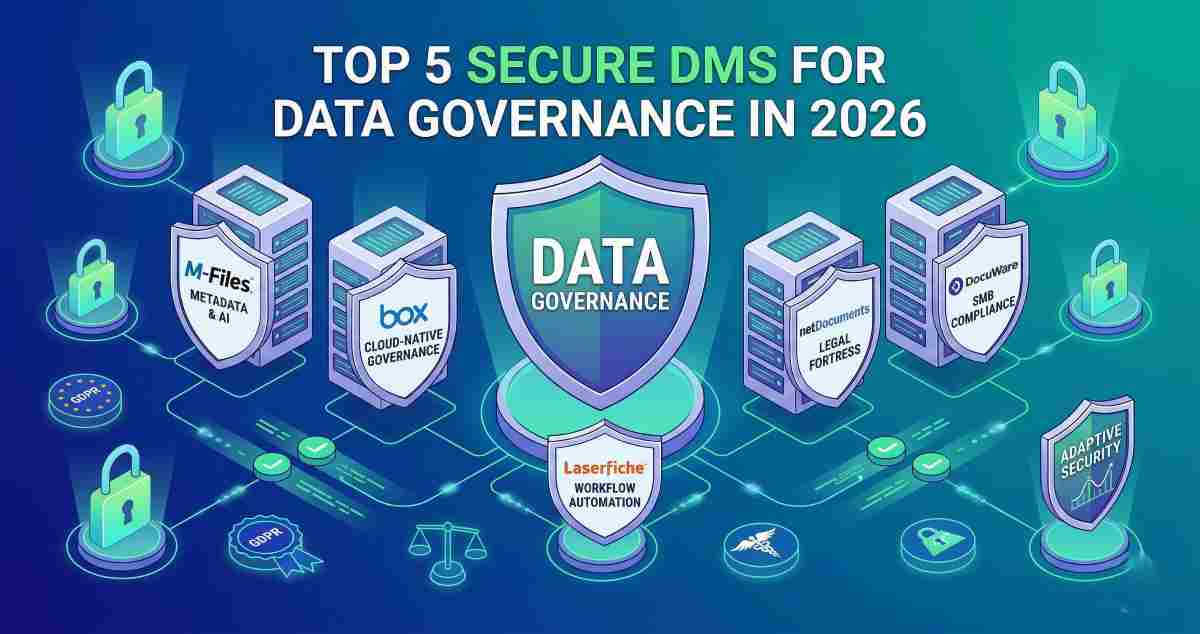
Top 5 Secure Document Management Systems for 2026
1. M-Files: The Metadata Powerhouse
M-Files continues to lead the market by abandoning the traditional folder structure entirely. It uses a "metadata-first" approach, organizing information based on what it is rather than where it is stored. In 2026, M-Files has integrated deep learning models that automatically tag and classify documents upon upload, ensuring that sensitive data is instantly governed by the correct security policies. Its ability to manage "orphaned data" across multiple repositories makes it a top choice for enterprises with fragmented data ecosystems.
2. Box Content Cloud: The Cloud-Native Governance Standard
Once known primarily for file sharing, Box has transformed into a sophisticated governance engine. Its "Box Shield" and "Box Governance" modules provide some of the best security controls in the cloud-native space. For organizations that must comply with FedRAMP, HIPAA, or FINRA, Box offers specialized zones with rigorous data residency controls. Its integration with Microsoft Purview allows for a seamless flow of security classifications across different platforms.
3. Laserfiche: Enterprise-Grade Automation
Laserfiche remains the gold standard for organizations that require heavy process automation alongside strict records management. It is particularly popular in government and education sectors due to its robust "Department of Defense (DoD) 5015.2-certified" records management capabilities. In 2026, its low-code workflow designer allows non-technical compliance officers to build complex approval chains that ensure no document is finalized without meeting every regulatory checkpoint.
4. NetDocuments: The Legal Fortress
For professional services where confidentiality is the primary currency, NetDocuments is unparalleled. Built from the ground up as a secure cloud platform for law firms, it features sophisticated encryption key management, allowing clients to hold their own keys (customer-managed encryption). This ensures that even the service provider cannot access the data, providing the ultimate layer of data sovereignty.
5. DocuWare: SMB-Focused Compliance
DocuWare bridges the gap between ease of use and high security, making it the ideal choice for small to mid-market organizations. It focuses on digitizing manual, paper-heavy workflows into secure, encrypted digital paths. Its built-in "Compliance-Ready" templates for HR and accounting help smaller teams achieve GDPR and SOC 2 readiness without needing a dedicated IT security department.
A Comparative Look at Key Governance Features
| Feature | M-Files | Box | Laserfiche | NetDocuments |
|---|---|---|---|---|
| Primary Strength | Metadata & AI | Cloud Collaboration | Workflow Automation | Legal Confidentiality |
| Security Model | Attribute-Based | Zero-Trust | Role-Based | Zero-Knowledge |
| Compliance Focus | Multi-Industry | HIPAA/GDPR/FedRAMP | Records Management | Legal & Professional |
| AI Integration | High (Auto-Tagging) | Medium (Shield AI) | High (OCR/IDP) | Medium (Search) |
Implementation Checklist for Compliance-Heavy Industries
- Conduct a Data Discovery Audit: Before migrating, identify where your "toxic data" (PII, PHI) lives.
- Define Your Retention Schedule: Consult legal counsel to establish exactly how long each document type must be kept.
- Implement Multi-Factor Authentication (MFA): This is no longer optional; it is the baseline for any secure system.
- Establish Data Sovereignty Rules: Determine if your data must stay within specific geographic boundaries (e.g., within India for DPDPA or the EU for GDPR).
- Regularly Test Your Audit Trails: Periodically run a "mock audit" to see if you can reconstruct the history of a sensitive document within minutes.
The Future: Zero-Trust and Sovereign Clouds
As we look toward the end of 2026 and into 2027, the trend toward "Sovereign Clouds" is accelerating. Organizations are increasingly looking for DMS providers that can offer hybrid models—keeping the most sensitive "crown jewel" data on-premises or in a private cloud while leveraging the public cloud for collaborative workflows. The integration of "Confidential Computing" at the hardware level will soon allow documents to be processed while still encrypted, providing a level of privacy previously thought impossible.
FAQs
1. Does using a secure DMS guarantee compliance with GDPR or HIPAA?
No. A DMS provides the tools for compliance, such as encryption and audit logs, but the organization is responsible for how those tools are configured and used. You must still establish internal policies and train staff to use the system correctly to remain compliant.
2. What is the difference between role-based access (RBAC) and attribute-based access (ABAC)?
RBAC assigns permissions based on a job title (e.g., "Manager" or "Accountant"). ABAC is more granular, granting access based on a combination of factors: who the user is, the classification of the document, the device being used, and the user's current location. ABAC is considered the superior choice for modern data governance.
3. Can a DMS prevent internal data theft by employees?
While no system is 100% foolproof, a secure DMS significantly reduces the risk. Features like "Download Prevention," "Watermarking," and "Anomaly Detection" (AI that flags unusual download patterns) make it much harder for an insider to exfiltrate data without detection.
Advertisement