The Role of AI, Automation, and Predictive Analytics in Modern ERP Platforms
Advertisement
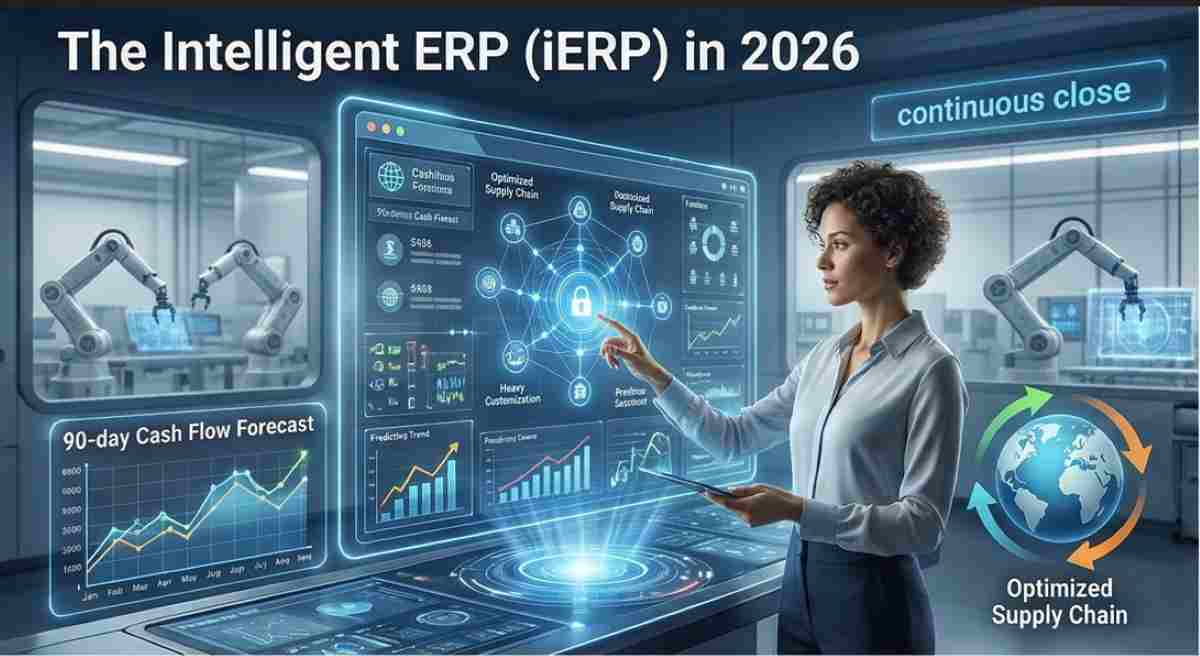
Modern ERP platforms are intelligent enterprise ecosystems that leverage the convergence of Artificial Intelligence (AI), Robotic Process Automation (RPA), and Predictive Analytics to transform traditional back-office systems into proactive decision-engines. In 2026, the ERP is no longer a passive repository for historical data; it is an active participant in business strategy, capable of identifying anomalies, forecasting market shifts, and executing complex workflows with minimal human intervention.
Quick Navigation:
From "System of Record" to "System of Intelligence"
Hyper-Automation: Engineering the Autonomous Back-Office
Predictive Analytics: Moving Beyond Historical Hindsight
AI-Powered Finance: Automated Closing and Fraud Detection
Intelligent Supply Chains: Demand Sensing and Logistics Optimization
Generative AI and the Death of the Traditional User Interface
The Technical Architecture of an iERP
1. From "System of Record" to "System of Intelligence"
For decades, Enterprise Resource Planning (ERP) software served as a digital filing cabinet—a necessary but static "System of Record." Data was entered manually, and reports were generated post-mortem. The current architectural shift introduces the Intelligent ERP (iERP).
This evolution is driven by the integration of machine learning (ML) models directly into the core database layer. Instead of waiting for a user to query the system, the iERP monitors data streams in real-time. It identifies heuristic patterns that deviate from the norm—such as a sudden spike in raw material lead times or a discrepancy in vendor billing—and alerts the relevant stakeholders before the issue impacts the bottom line. This transition shifts the IT department's focus from data maintenance to data strategy.
2. Hyper-Automation: Engineering the Autonomous Back-Office
Automation in modern ERP goes far beyond simple "if-this-then-that" rules. We are now in the era of Hyper-automation, which combines RPA with AI-driven Intelligent Document Processing (IDP).
Zero-Touch Invoicing: Modern systems use computer vision and NLP to extract data from unstructured invoices, match them against purchase orders, and schedule payments without a single human click.
Self-Healing Workflows: If a workflow breaks due to a missing data field, the AI can often infer the correct data from historical records or external APIs to keep the process moving.
Automated Regulatory Compliance: As tax laws or trade tariffs change, the ERP automatically updates its internal logic across all global subsidiaries, ensuring the business remains compliant without manual re-coding.
3. Predictive Analytics: Moving Beyond Historical Hindsight
Predictive analytics is the "crystal ball" of the modern enterprise. By analyzing vast quantities of historical data alongside external market signals, the ERP can forecast future outcomes with statistically significant accuracy.
Predictive Maintenance (PdM): For manufacturing firms, the ERP monitors IoT sensors on the shop floor. It predicts when a critical component will fail—based on vibration or heat signatures—and automatically generates a maintenance work order and orders the necessary replacement part before the breakdown occurs.
Cash Flow Forecasting: Instead of looking at what you spent last month, predictive models analyze current sales pipelines, historical payment behaviors of specific clients, and seasonal trends to provide a 90-day cash flow forecast.
Churn Prediction: By analyzing customer interaction data within the ERP’s CRM module, the system can flag accounts that exhibit "at-risk" behavior patterns, allowing the sales team to intervene proactively.
4. AI-Powered Finance: Automated Closing and Fraud Detection
The finance department is perhaps the biggest beneficiary of iERP capabilities. The goal for 2026 is the "Continuous Close."
Traditionally, the monthly close is a grueling process of reconciliation. AI-driven ERPs perform these reconciliations daily. They automatically match bank statements to ledger entries and flag discrepancies in real-time. Furthermore, AI models act as a 24/7 internal auditor. They scan every transaction for signs of fraud, such as duplicate payments, "split" transactions designed to bypass approval thresholds, or suspicious vendor bank account changes. This level of oversight is impossible for human teams to maintain at scale.
5. Intelligent Supply Chains: Demand Sensing and Logistics Optimization
Supply chain volatility is the "new normal." Modern ERPs combat this through Demand Sensing. Unlike traditional forecasting, which relies on past sales, demand sensing incorporates real-time data from social media trends, weather patterns, and geopolitical news.
Dynamic Re-routing: If a specific shipping lane is blocked or delayed, the ERP calculates the impact on the entire production schedule and suggests alternative suppliers or logistics providers.
Inventory Optimization: AI minimizes "safety stock" by precisely calculating the lead-time variability of every SKU. This frees up working capital that was previously tied up in excess inventory.
6. Generative AI and the Death of the Traditional User Interface
The way we interact with ERP software is fundamentally changing. The complex menus and "green screens" of the past are being replaced by Conversational UI powered by Large Language Models (LLMs).
An executive no longer needs to navigate five different screens to find a report. They simply ask the ERP's AI agent: "What was the margin impact of the shipping delay in the EMEA region last week?" The system performs the cross-functional data retrieval, generates the visualization, and provides a summary in natural language. This "democratization of data" ensures that insights are available to non-technical users across the organization.
7. The Technical Architecture of an iERP
To support these features, the underlying architecture must be cloud-native and API-first.
Data Lakes and Mesh: Modern ERPs often utilize a data lake architecture to store unstructured data (like emails and PDFs) alongside structured financial data.
Edge Computing: In manufacturing, some AI processing happens at the "edge" (on the shop floor) to ensure zero-latency responses for automated machinery, with the results then synced back to the central cloud ERP.
Vector Embeddings: For smart search and semantic retrieval, modern ERPs index their internal documentation and transactional data using vector embeddings, allowing the system to understand the relationship between different business entities.
Key Tools and Platforms:
SAP S/4HANA Cloud: Known for its "embedded AI" and robust predictive analytics powered by the HANA in-memory database.
Oracle NetSuite: Offers "SuiteIntelligence" for automated insights and has a strong focus on AI-driven financial anomaly detection.
Microsoft Dynamics 365: Leverages "Copilot" to integrate generative AI across the entire ERP and CRM stack.
Epicor Kinetic: Built specifically for manufacturers, with deep integration for IoT and predictive maintenance.
Frequently Asked Questions (FAQs)
1. Does AI in ERP mean we can fire our accounting and procurement teams?
No. The role of these teams shifts from "data entry and reconciliation" to "strategy and exception management." AI handles the 90% of transactions that are routine, allowing human experts to focus their energy on the 10% of complex cases that require professional judgment and relationship management.
2. How do we ensure the data used for predictive analytics is accurate?
This is known as the "Garbage In, Garbage Out" problem. A successful iERP implementation requires a rigorous Data Governance phase. This involves cleansing legacy data, standardizing naming conventions, and establishing automated validation rules to ensure that only "clean" data enters the system.
3. Is predictive analytics only for large enterprises?
Not anymore. Many mid-market cloud ERPs now offer "pre-trained" ML models for common use cases like cash flow forecasting or inventory optimization. Because these are delivered via the cloud, smaller businesses can access the same analytical power once reserved for the Fortune 500 without needing a team of data scientists.
Advertisement