Best Industry-Specific ERP Solutions for Manufacturing and Supply Chain
Advertisement
An industry-specific ERP for manufacturing and supply chain is a specialized suite of business applications designed to handle the unique complexities of production lifecycles, including Material Requirements Planning (MRP), shop floor control, warehouse management, and real-time supply chain visibility. Unlike generic ERPs that focus primarily on accounting and human resources, these systems are engineered to manage physical resources, machine capacity, and volatile global logistics.Quick Navigation:What Makes Manufacturing ERP Different?Discreet vs. Process Manufacturing: Choosing Your ArchitectureTop 5 ERP Solutions for Manufacturing and Supply ChainEssential Modules for Modern Supply Chain VisibilityThe Step-by-Step Implementation WorkflowFuture Trends: AI and IoT on the Shop Floor
What Makes Manufacturing ERP Different?
General-purpose ERPs often fail in manufacturing environments because they lack the "granular" logic required for production. A manufacturing-specific system integrates the financial ledger with the Manufacturing Execution System (MES) and MRP. This allows for "cost-of-goods-sold" (COGS) calculations that account for machine downtime, scrap rates, and labor variances—details that a standard accounting-first ERP would miss.Discreet vs. Process Manufacturing: Choosing Your ArchitectureBefore selecting a tool, you must define your production style.Discreet Manufacturing: Involves the assembly of distinct items (cars, electronics, furniture) that can be deconstructed into their bill of materials (BOM).Process Manufacturing: Involves formulas and recipes (chemicals, food, pharmaceuticals) that result in a product that cannot be easily reversed.Actionable Takeaway: If your business deals with "batches" and "potency," you need a process ERP like Infor or Plex. If you deal with "work orders" and "assemblies," look at Epicor or SYSPRO.
Top 5 ERP Solutions for Manufacturing and Supply Chain
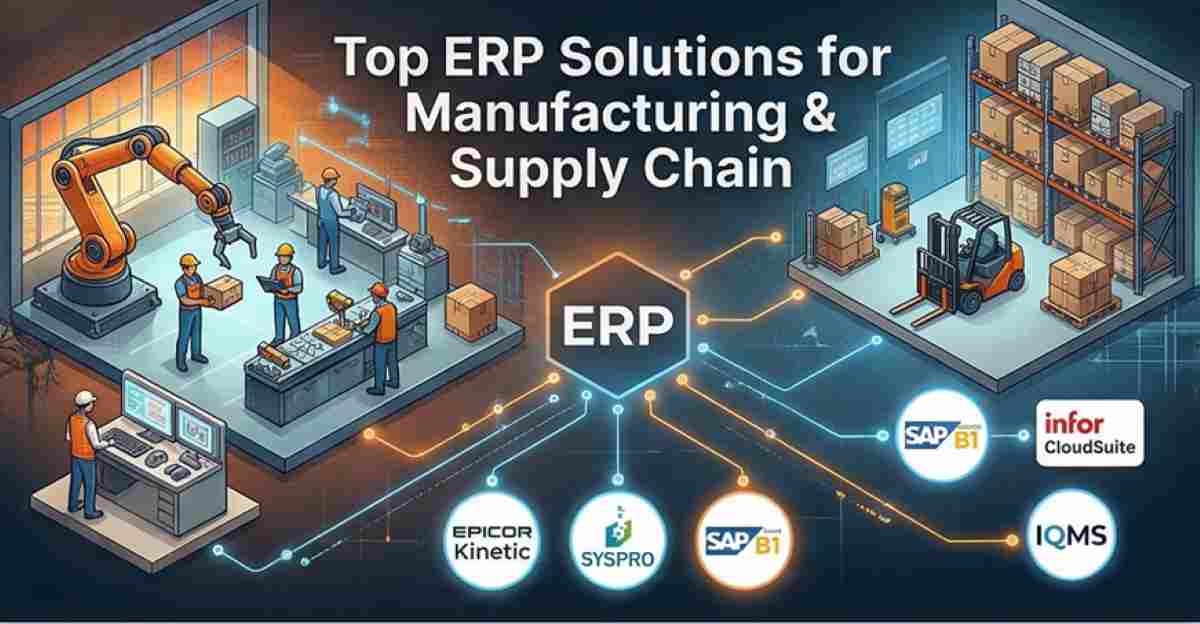
In 2026, the following platforms lead the market based on technical depth and shop-floor integration.
| ERP Solution | Best For | Standout Feature |
|---|---|---|
| Epicor Kinetic | Large-scale Discreet Mfg | Built-in MES and global trade compliance. |
| SYSPRO | Mid-market Manufacturers | Exceptional inventory forecasting and "Bot" automation. |
| SAP Business One | SMEs needing SAP HANA | Real-time analytics and industrial-grade MRP. |
| Infor CloudSuite | Process & Industrial | Deep industry-specific "micro-vertical" functionality. |
| IQMS (DELMIAworks) | Plastic & Automotive | Real-time production monitoring directly from machine PLC. |
1. Epicor Kinetic
Epicor is widely recognized for its "Kinetic" platform, which is built on a browser-based, cloud-native architecture. It is particularly strong for manufacturers in the aerospace, defense, and medical device industries who require strict quality management and traceability.Key Benefit: It manages the entire "cradle-to-grave" lifecycle of a product, from the initial quote to the final shipment.
2. SYSPRO
SYSPRO stands out for its focus on mid-sized manufacturers. Unlike many competitors that grow through acquisition, SYSPRO’s code is developed in-house, leading to a highly consistent user interface.Key Benefit: Their "Inventory Optimization" module uses AI to predict stockouts before they happen, which is critical for supply chain resilience.
3. SAP Business One
For smaller manufacturing firms that want the prestige and analytical power of SAP without the enterprise price tag. Running on the HANA database, it provides instantaneous snapshots of production costs and cash flow.
4. Infor CloudSuite Industrial (Syteline)
Infor specializes in what they call "micro-verticals." They have specific configurations for everything from commercial printing to high-tech electronics.Key Benefit: Strong multi-site management for global manufacturers who need to sync production across different continents.
5. IQMS (DELMIAworks by Dassault Systèmes)
IQMS is unique because it was designed by a manufacturer. It bridges the gap between the ERP and the actual machines on the floor using IoT sensors.Key Benefit: It provides "Real-Time Production Monitoring," showing exactly which machines are running, which are down, and why.
Essential Modules for Modern Supply Chain Visibility
To achieve a high ROI, your manufacturing ERP should include these four non-negotiable modules:Advanced Planning and Scheduling (APS): This goes beyond simple MRP. It analyzes machine capacity, labor availability, and material lead times to provide a "Capable-to-Promise" (CTP) date to customers.Warehouse Management (WMS): Includes bin tracking, cross-docking, and RFID integration to ensure that materials move efficiently from receiving to the production line.Quality Management System (QMS): Automates inspection points throughout the assembly process. If a part fails a tolerance check, the system automatically creates a non-conformance report.Supply Chain Collaboration Portals: Allows vendors to log in and update their own lead times or upload certificates of analysis, reducing the administrative burden on your procurement team.
[Reddit Screenshot Placeholder: A thread from r/Manufacturing discussing how switching from a generic ERP to Epicor reduced their month-end closing time by 4 days.]
The Step-by-Step Implementation Workflow
Building a manufacturing ERP environment is a multi-phase technical project.Phase 1: Process Mapping. Document every physical step on your shop floor. Identify "bottleneck" machines and manual data entry points.Phase 2: Data Cleansing. Standardize your Bill of Materials (BOM). If the same screw is listed as "Item-A" in Engineering and "Item-001" in Purchasing, the ERP will fail.Phase 3: The Pilot Room. Set up a "sandbox" environment. Run a single production line through the new ERP while keeping the old system active to verify that the math matches.Phase 4: User Acceptance Testing (UAT). Ensure the shop floor workers (the ones actually using the tablets and scanners) can navigate the UI efficiently.Phase 5: Cutover. Switch the "system of record" to the new ERP. Usually done over a weekend to minimize production disruption.
Future Trends: AI and IoT on the Shop Floor
In 2026, we are seeing a shift toward Generative AI for Supply Chain.Predictive Maintenance: AI analyzes machine vibration data from the ERP to predict a motor failure 48 hours before it happens.Dynamic Sourcing: If a port strike occurs, the ERP’s AI agent automatically identifies alternative suppliers in the "green zone" and calculates the impact on final product pricing.
Expert Insight:"The biggest mistake manufacturers make is buying an ERP for their current size. You must buy for the size you intend to be in five years. If you don't have a system that supports multi-tenant cloud and API-first architecture, you're building on a legacy foundation that will crumble during your next growth spurt." — Senior Analyst, Gartner Supply Chain Practice.
Frequently Asked Questions (FAQs)
1. What is the difference between MRP and ERP?
MRP (Material Requirements Planning) is a subset of ERP. MRP focuses strictly on the "what, when, and how much" of raw materials and production. An ERP integrates MRP with accounting, HR, sales, and customer service to provide a holistic view of the entire business.
2. How much does a manufacturing ERP cost?
For a mid-sized manufacturer, implementation costs typically range from $150,000 to $500,000. This includes licensing, data migration, and training. SaaS models have lowered the "upfront" hardware cost but require ongoing monthly subscription fees.
3. Can an ERP handle both discreet and process manufacturing?
Some "hybrid" ERPs like Epicor or Infor can handle both. However, specialized businesses (like a pharmaceutical lab or a complex aerospace plant) are usually better served by a system specifically built for their primary manufacturing mode to avoid over-customization.
Advertisement