How to Calculate the True ROI of Upgrading Your Legacy ERP System
Advertisement
The True ROI of upgrading a legacy ERP system is a comprehensive financial calculation that measures the net value generated by transitioning from an outdated, often on-premise Enterprise Resource Planning system to a modern, cloud-native architecture. Unlike simple ROI metrics, "True ROI" accounts for the mitigation of technical debt, the elimination of "shadow IT" costs, and the specific opportunity costs associated with maintaining stagnant business processes.
Quick Navigation:
The High Cost of the "Status Quo": Quantifying Legacy Maintenance
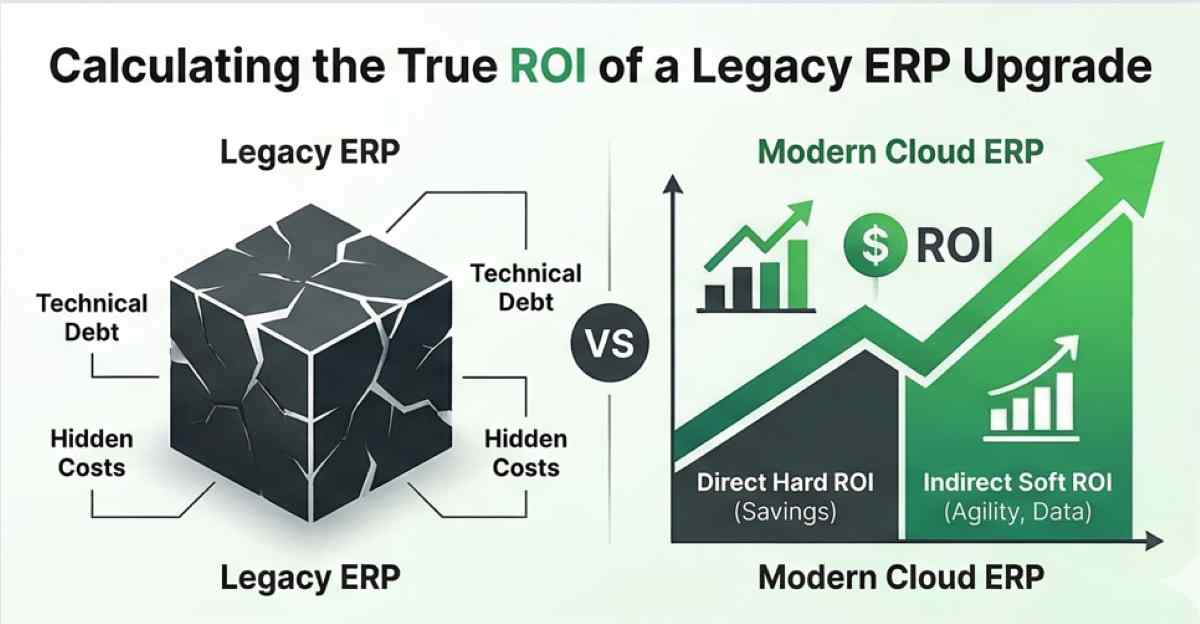
The Direct vs. Indirect ROI Framework
How to Calculate Technical Debt in ERP Systems
Step-by-Step: The 5-Pillar ERP ROI Calculation
Modernization Alternatives: Re-platforming vs. Full Replacement
Tools and Templates for Building the Business Case
The High Cost of the "Status Quo": Quantifying Legacy Maintenance
The most common mistake in ERP ROI calculations is using the current system as a "zero-cost" baseline. In reality, a legacy ERP is a depreciating asset that carries a growing "maintenance tax." To calculate true ROI, you must first identify the bleeding points of your existing setup.
Customization Fragility: Legacy systems often rely on "bolted-on" customizations written in obsolete languages (like older versions of COBOL or proprietary 4GLs). Every time you need a new report or a regulatory update, the labor cost is 3x to 5x higher than in a modern, API-first system.
Infrastructure Overhead: If your ERP is on-premise, you are paying for server hardware, cooling, physical security, and a dedicated IT team to manage backups and patches. In 2026, these "hard costs" often exceed the subscription price of a Tier-1 SaaS ERP.
The Integration Gap: Legacy systems act as data silos. When your ERP cannot talk to your modern CRM or e-commerce platform via standard REST APIs, employees resort to manual data entry. This "human middleware" is an invisible drain on the bottom line.
The Direct vs. Indirect ROI Framework
To secure executive buy-in, your ROI model must balance "Hard ROI" (cash saved) with "Soft ROI" (time and agility gained).
Hard ROI (Direct Savings)
Software Licensing Consolidation: Many companies realize they are paying for 10+ third-party "add-ons" to fix gaps in their legacy ERP. A modern system often includes these features (like advanced WMS or automated AP) out of the box.
Reduction in IT Labor: Modern systems automate patching and security. This allows you to reallocate IT personnel from "keeping the lights on" to high-value data analysis projects.
Operational Efficiency: Quantifiable reductions in inventory carrying costs due to better MRP (Material Requirements Planning) logic and a decrease in shipping errors through automated validation.
Soft ROI (Indirect Value)
Faster Decision Cycles: In a legacy environment, month-end closing can take 10–15 days. Modern systems offer "Continuous Closing," providing real-time financial snapshots.
Employee Retention: Modern talent expects modern tools. Forcing a digital-native workforce to use "green-screen" interfaces or complex 1990s UIs leads to higher turnover and training costs.
Regulatory Resilience: With shifting global tax laws (like the OECD's Pillar Two) and ESG reporting mandates, a legacy system that requires manual spreadsheet work for compliance creates significant audit risk.
Source: Microsoft Dynamics 365
How to Calculate Technical Debt in ERP Systems
Technical debt is the "interest" you pay on suboptimal technology choices. To quantify this for your ROI, use the Maintenance-to-Innovation Ratio.
If your IT budget for the ERP is $100,000 and $85,000 is spent on patching, hosting, and fixing bugs, your ratio is 85/15. A healthy, modern ratio should be closer to 30/70. The $55,000 difference is the "Technical Debt Tax." Adding this figure to your ROI calculation immediately makes the upgrade look more attractive.
Step-by-Step: The 5-Pillar ERP ROI Calculation
Use this workflow to build your final spreadsheet.
Pillar 1: Total Cost of Ownership (TCO) Comparison
Compare the 5-year TCO of your current system (including hardware, upgrades, and support) against the 5-year TCO of the new system (including implementation, training, and subscription).
Formula: (Legacy TCO - New TCO) = Initial Savings.
Pillar 2: Productivity Recovery
Identify 5 key workflows (e.g., Order-to-Cash, Procure-to-Pay). Measure the current time taken. Estimate a 20-30% improvement based on industry benchmarks for modern ERPs.
Formula: (Hours Saved per Year x Average Hourly Rate) = Labor ROI.
Pillar 3: Working Capital Optimization
Better inventory tracking usually leads to a 5-10% reduction in safety stock.
Formula: (Value of Inventory Reduction x Internal Cost of Capital %) = Cash Flow ROI.
Pillar 4: Revenue Enablement
Legacy systems often limit your ability to launch new business models, such as subscriptions or direct-to-consumer (DTC) channels.
Formula: (Estimated Revenue from New Channels - Cost of Channel Setup) = Growth ROI.
Pillar 5: Risk Mitigation
Estimate the cost of a 48-hour system outage (lost sales, reputation damage). Multiply by the probability of failure on legacy hardware (e.g., 5% annually).
Formula: (Cost of Failure x Probability) = Risk ROI.
Modernization Alternatives: Re-platforming vs. Full Replacement
Not every ROI case leads to a total system replacement. You must evaluate the three main paths:
Full Replacement: The "Clean Slate" approach. High upfront cost, highest long-term ROI.
Re-platforming: Moving the existing legacy logic to a cloud-hosted environment. Lower cost, but preserves the "bad" processes.
Two-Tier ERP Strategy: Keeping the legacy ERP at headquarters but deploying a modern, agile ERP for subsidiaries and new branches. This is an excellent way to prove ROI in a "pilot" environment before a full-scale rollout.
Tools and Templates for Building the Business Case
Building the ROI case requires collaboration across Finance, Operations, and IT.
The Gartner ERP Strategy Toolkit: Provides structured worksheets for assessing vendor capabilities and calculating TCO.
The ROI Calculator (Software-Specific): Most Tier-1 vendors (like SAP, Oracle, or Microsoft) provide ROI calculators. Use these as a starting point, but always apply a 20% "skepticism discount" to account for vendor optimism.
Internal Value Engineering (IVE): Dedicated teams within your organization or external consultants who specialize in quantifying business process improvements.
Key Performance Indicators (KPIs) to Track Post-Upgrade
| Metric | Legacy Performance | Target (Year 1) |
|---|---|---|
| Days to Close Month | 12 Days | 4 Days |
| Inventory Turnover | 4.2x | 5.5x |
| Order Processing Time | 48 Hours | 4 Hours |
| Manual Data Re-entry | 15% of records | < 1% |
Frequently Asked Questions (FAQs)
1. Is "The Cost of Doing Nothing" a valid metric for ROI?
Absolutely. In 2026, the cost of doing nothing includes the loss of market share to competitors who can fulfill orders faster, the rising cost of cyber-insurance for legacy systems, and the inability to use AI-driven forecasting tools that require modern data architectures.
2. How long does it take for a modern ERP to pay for itself?
The typical "Payback Period" for a mid-market ERP upgrade is between 18 and 30 months. While the upfront implementation cost is significant, the compounding savings from labor efficiency and inventory optimization usually drive the ROI into positive territory by the middle of year two.
3. Should we include employee training costs in the ROI?
Yes. Training is a critical part of the investment (the "I" in ROI). If you ignore training, user adoption will suffer, and you will fail to achieve the productivity gains calculated in your model. A successful ROI case usually allocates 10-15% of the total project budget to Change Management and training.
4. How does AI impact the ROI of an ERP upgrade in 2026?
Modern ERPs now include built-in AI for anomaly detection in finance and predictive maintenance in manufacturing. These "intelligent" features can identify cost-saving opportunities (like detecting a duplicate invoice or a failing machine) that a human-managed legacy system would never find, adding a new layer of automated ROI.
Advertisement