ERP vs. CRM vs. MRP: What is the Exact Difference?
Advertisement
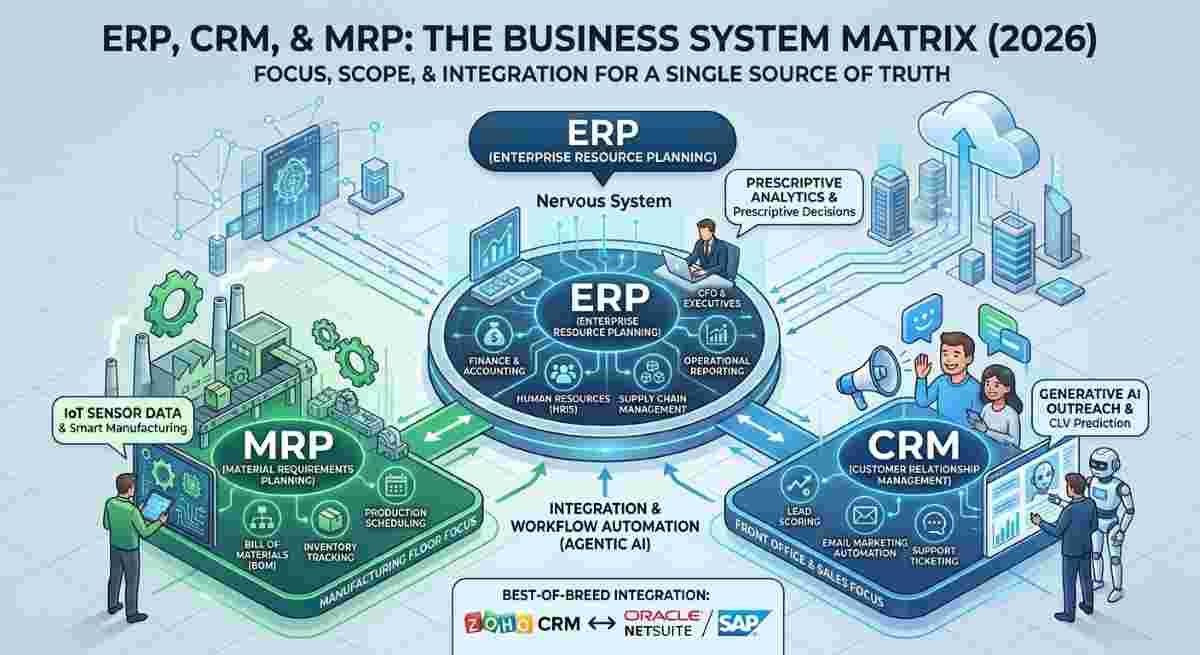
The primary difference between ERP, CRM, and MRP lies in their scope and focus. MRP (Material Requirements Planning) is a specialist tool for the manufacturing floor, focusing on inventory and production. CRM (Customer Relationship Management) is the front-office tool dedicated to sales, marketing, and customer support. ERP (Enterprise Resource Planning) is the comprehensive umbrella system that integrates both MRP and CRM data with finance, HR, and supply chain management into a single source of truth.
In 2026, the boundaries between these systems are becoming more fluid as Agentic AI begins to automate workflows across all three, but their core functions remain distinct.
Quick Navigation: The Business System Matrix
- MRP: The Engine of Manufacturing
- CRM: The Voice of the Customer
- ERP: The Centralized Nervous System
- Comparison Table: At-a-Glance
- The Integration Factor: Why You Might Need All Three
- Business System FAQs
MRP: The Engine of Manufacturing
MRP (Material Requirements Planning) is the oldest of the three concepts, dating back to the 1960s. Its sole purpose is to answer three questions: What is needed? How much is needed? When is it needed?
Primary Users: Production managers, warehouse supervisors, and procurement officers.
Key Functions: Bill of Materials (BOM) management, inventory tracking, and production scheduling.
2026 Trend: MRP II has evolved into smart manufacturing, where IoT sensors on the factory floor feed real-time data into the system to predict part failures before they occur.
CRM: The Voice of the Customer
CRM (Customer Relationship Management) manages the entire lifecycle of a customer. It is designed to increase revenue by improving lead conversion and customer retention.
Primary Users: Sales teams, digital marketing analysts, and customer support agents.
Key Functions: Lead scoring, email marketing automation, sales pipelines, and support ticketing.
2026 Trend: Modern CRM platforms increasingly use generative AI to draft personalized outreach and predict Customer Lifetime Value (CLV) based on behavioral patterns.
ERP: The Centralized Nervous System
ERP (Enterprise Resource Planning) acts as the single source of truth across an organization. While MRP manages factory operations and CRM manages customer relationships, ERP coordinates financial data, workforce management, and enterprise reporting.
Primary Users: Executives, CFOs, HR managers, and department heads.
Key Functions: Financial accounting, human resource management (HRIS), compliance management, and operational reporting.
The Hub: ERP systems often integrate MRP and CRM modules, allowing leadership teams to understand how operational delays affect revenue forecasts and customer commitments.
Comparison Table: At-a-Glance
| Feature | MRP | CRM | ERP |
|---|---|---|---|
| Core Focus | Production & Materials | Sales & Customers | Total Business Integration |
| Primary Goal | Efficiency in manufacturing | Revenue growth & retention | Operational visibility & ROI |
| Data Type | SKU numbers, lead times | Lead data, contact history | Financials, HR, operational logs |
| Department | Warehouse / Factory | Sales / Marketing | Finance / Admin / All departments |
The Integration Factor: Why You Might Need All Three
In modern enterprises these systems rarely operate independently. Many organizations use a composable architecture that integrates specialized tools with centralized reporting platforms.
For example, companies may use Zoho CRM for customer engagement while integrating operational data into enterprise platforms such as Oracle NetSuite or SAP ERP.
According to Gartner, the evolution toward AI-native ERP systems enables organizations to transition from descriptive analytics to prescriptive analytics, where systems actively recommend operational decisions.
Business System FAQs
1. Can a small business just use a CRM instead of an ERP?
Yes. Many startups and service-based companies rely primarily on CRM systems for managing sales pipelines and customer communication. ERP systems typically become necessary when organizations begin managing complex inventory, financial operations, or multiple subsidiaries.
2. Does ERP always include MRP and CRM?
Many enterprise ERP solutions such as Oracle NetSuite or SAP provide integrated modules for manufacturing and customer relationship management. However, some businesses prefer best-of-breed architectures where specialized systems connect through APIs.
3. What is the difference between MRP and MRP II?
MRP focuses primarily on raw materials and production planning. MRP II expands the concept by incorporating labor capacity, operational scheduling, and financial planning into manufacturing management.
Advertisement