NetSuite vs. SAP Business One vs. Microsoft Dynamics 365: Which is Best?
Advertisement
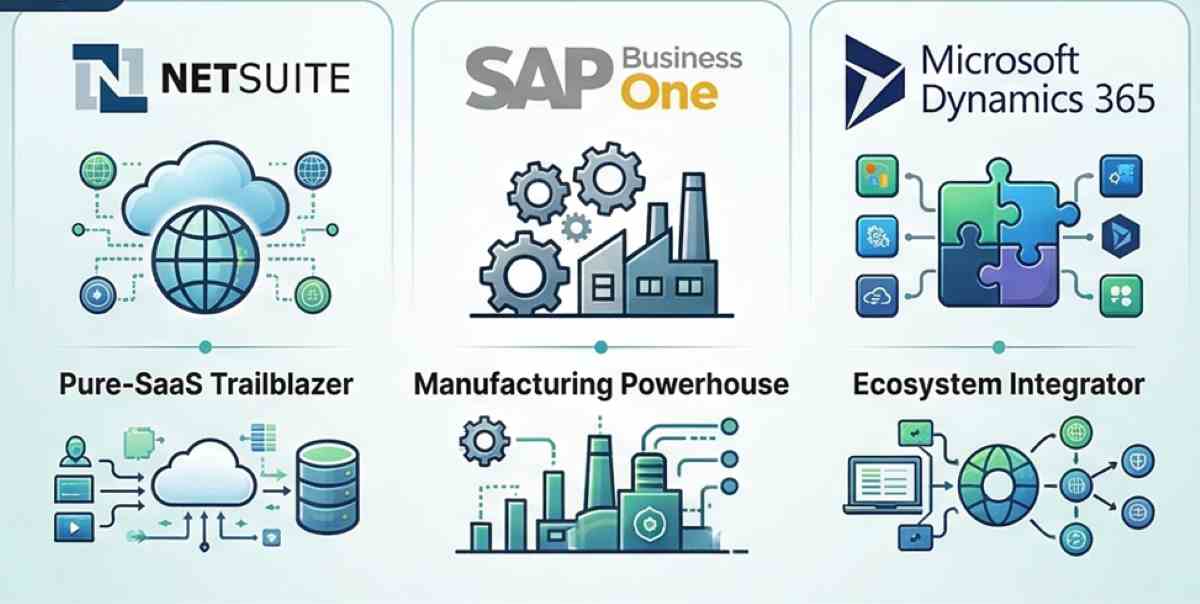
NetSuite, SAP Business One, and Microsoft Dynamics 365 are enterprise resource planning (ERP) solutions designed to unify disparate business functions—ranging from financial management and human resources to supply chain operations and customer relations—into a single, data-driven architecture. While they all occupy the "leader" quadrant for mid-market and enterprise businesses in 2026, their underlying engineering, deployment philosophies, and scalability limits differ significantly.Choosing between them is not merely a software procurement task; it is a long-term architectural commitment that dictates how your data flows across international borders and departmental silos.Quick Navigation:NetSuite: The Pure-SaaS TrailblazerSAP Business One: The Industrial & Manufacturing PowerhouseMicrosoft Dynamics 365: The Ecosystem IntegratorArchitecture & Customization: The Technical DivideImplementation Costs & Hidden FeesThe Final Decision Matrix (Comparison Table)
1. NetSuite: The Pure-SaaS Trailblazer
Oracle NetSuite is widely considered the first "true" cloud ERP. Unlike legacy systems that were retrofitted for the web, NetSuite was built as a multi-tenant SaaS platform from day one. This means every customer is on the same version of the software, and upgrades are pushed automatically twice a year without breaking existing customizations.
Best For: Fast-growing startups, global retail, and professional services firms that need a "lean" infrastructure without the burden of managing local servers.
The SuiteSuccess Advantage: NetSuite utilizes an implementation methodology called SuiteSuccess, which leverages industry-specific templates to get businesses live in weeks rather than months.
OneWorld for Global Scale: For companies operating in multiple countries, NetSuite’s OneWorld module is the gold standard for real-time global consolidation, handling multiple currencies, tax laws, and reporting requirements in a single instance.
The Trade-off: Customization is performed via SuiteScript (based on JavaScript). While flexible, deep architectural changes are more restricted compared to on-premise systems to maintain the integrity of the multi-tenant environment.
2. SAP Business One: The Industrial & Manufacturing Powerhouse
SAP Business One (SAP B1) is the smaller sibling of SAP S/4HANA, specifically engineered for small to mid-sized enterprises (SMEs). While it offers cloud options, it remains deeply rooted in the traditional client-server model, which provides immense control over the database environment.
Best For: Manufacturing, wholesale distribution, and industrial firms that require heavy-duty Material Requirements Planning (MRP) and complex inventory logic.
The SAP HANA Edge: SAP B1 typically runs on the HANA database—an in-memory computing platform that processes massive datasets in real-time. This makes it exceptionally fast for complex analytics and inventory forecasting.
Modular Rigidity: SAP B1 is highly structured. This "rigidity" is actually a benefit for manufacturing, where strict adherence to processes is required for quality control and compliance.
Deployment Flexibility: Unlike NetSuite, SAP B1 can be deployed on-premise, in a private cloud, or as a hosted service. This is vital for businesses in regions with poor internet connectivity or strict data sovereignty laws.
3. Microsoft Dynamics 365: The Ecosystem Integrator
Microsoft Dynamics 365 (specifically Business Central for the mid-market) is less a standalone ERP and more an extension of the Microsoft ecosystem. It bridges the gap between traditional ERP and the productivity tools of Microsoft 365 (Office, Teams, and Outlook).
Best For: Organizations already heavily invested in the Microsoft stack (Azure, Power BI, and Teams) that want a seamless transition between their "work" tools and their "accounting" tools.
The Power Platform Synergy: The real value of Dynamics 365 lies in the Power Platform (Power BI, Power Apps, and Power Automate). You can build custom mobile apps or automate complex cross-app workflows without needing a team of dedicated developers.
Familiar Interface: Because it looks and feels like Excel and Outlook, user adoption rates are typically higher and training costs are lower compared to the more "industrial" feel of SAP B1.
Dual-Tier Strategy: Microsoft offers Business Central for smaller entities and Finance & Supply Chain Management (F&SCM) for large-scale global enterprises, allowing for a migration path as a company grows.
4. Architecture & Customization: The Technical Divide
The "Expert" choice often comes down to the underlying architecture.
NetSuite’s Multi-tenant SaaS means you never have to deal with "version lock." However, you are limited by the platform's API governance and concurrency limits. If you need to perform millions of high-frequency database writes, you may hit a ceiling.
SAP B1’s Single-tenant/On-premise model allows for deep-level database customizations. You can write complex SQL queries directly against the database, but this often makes upgrades a nightmare. Moving from version 9 to version 10 can feel like a full-scale reimplementation.
Dynamics 365 Business Central offers a Hybrid approach. It uses "Extensions," meaning customizations sit on top of the core code rather than modifying it. This allows Microsoft to push updates without breaking your custom apps, similar to the NetSuite model but with more flexibility for local hosting if required.
5. Implementation Costs & Hidden Fees
ERP pricing is notoriously opaque. Beyond the per-user license fee, companies must account for:
- The Implementation Ratio: For every $1 spent on software licenses, expect to spend $2 to $4 on implementation services (consulting, data migration, and training).
- NetSuite’s Escalators: NetSuite often offers aggressive discounts for the first 1-3 years, but renewal prices can jump significantly. Ensure you negotiate "not-to-exceed" caps on renewals.
- Microsoft’s Hidden Licensing: While Business Central licenses are affordable, you may find yourself needing additional Power BI Pro or Azure storage licenses to unlock the full potential of the system.
- SAP’s Maintenance: For on-premise SAP B1, you must account for the 18-22% annual maintenance fee required to access support and future updates.
6. The Final Decision Matrix
| Feature | NetSuite | SAP Business One | Microsoft Dynamics 365 |
|---|---|---|---|
| Deployment | 100% Cloud (Multi-tenant) | On-prem, Private, or Hosted | Cloud (SaaS) or Hybrid |
| Ease of Use | Modern, Web-native | Traditional, Menu-heavy | Familiar (Office-like) |
| Customization | SuiteScript (JavaScript) | C# / .NET / SQL | AL Language / Power Apps |
| Global Finance | Excellent (OneWorld) | Good | Moderate (Requires Add-ons) |
| Manufacturing | Moderate (Stronger in Retail) | Superior (MRP/Production) | Good (Balanced) |
| Integration | Strong (REST/SOAP) | Robust (Service Layer) | Superior (Azure/Office) |
The Verdict:
Choose NetSuite if you are a fast-moving, cloud-first business with global subsidiaries that needs a system that scales without managing hardware.
Choose SAP Business One if you are a manufacturing-heavy organization that values database control and complex inventory logic over "sleek" web interfaces.
Choose Microsoft Dynamics 365 if your team lives in Outlook and Excel, and you want to leverage low-code automation through the Power Platform.
Frequently Asked Questions (FAQs)
1. Is NetSuite more expensive than Microsoft Dynamics 365?
Generally, yes. NetSuite is positioned as a premium, all-in-one suite. While Dynamics 365 Business Central has a lower entry-level per-user price, the "Total Cost of Ownership" often levels out once you factor in the third-party add-ons and Power Platform licenses required to match NetSuite’s out-of-the-box functionality.
2. Can SAP Business One handle multi-currency and international tax?
Yes, SAP B1 supports multiple currencies and has localized versions for dozens of countries. However, consolidating those entities for a single global financial view is often more manual than in NetSuite OneWorld, which automates intercompany eliminations and consolidations in real-time.
3. What is the average implementation time for these ERPs?
A standard mid-market implementation takes between 4 to 9 months. NetSuite’s SuiteSuccess can theoretically go live in 100 days for standard configurations. SAP B1 and Dynamics 365 often take longer due to the deeper level of customization usually required for manufacturing and supply chain workflows.
Advertisement