10 Best ITSM Tools for Enterprise Service Management (2026)
Advertisement
10 Best ITSM Tools for IT Operations (2026)
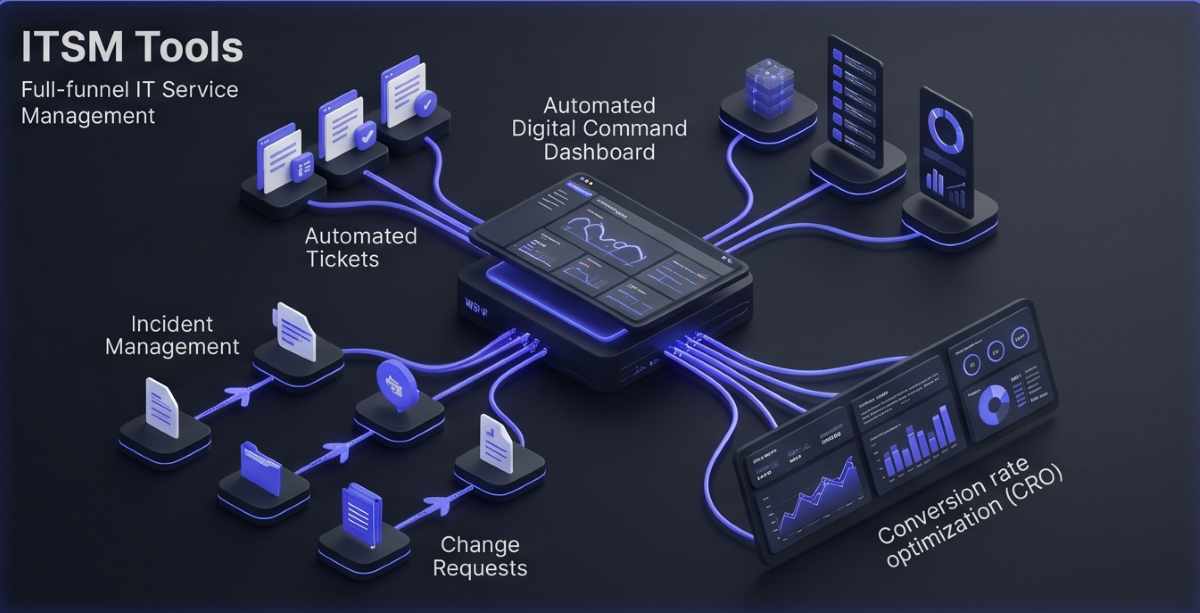
A high-quality ITSM platform enables organizations to manage incidents, track hardware assets, and orchestrate complex change management processes seamlessly. When selecting or evaluating a platform, IT leaders prioritize systems that adhere to the official ITIL (IT Infrastructure Library) best practices. Furthermore, understanding the distinct criteria that research firms use to evaluate these platforms—such as the methodologies outlined in Gartner's ITSM framework—is essential for making an informed enterprise software decision.
We have rigorously analyzed the enterprise market to bring you the ten best ITSM software solutions available today, focusing on automation, ITIL compliance, and cross-departmental service capabilities.
1. ManageEngine ServiceDesk Plus
ServiceDesk Plus is a full-stack ITSM suite that serves as a cornerstone for enterprise IT operations. It provides exceptional visibility and central control over IT issues, ensuring that businesses suffer zero unexpected downtime.
- Proactive Incident Management: Automatically analyzes the root cause of recurring IT problems, alerting technicians to underlying infrastructure issues before they cascade into outages.
- Enterprise Service Management: Extends ITSM best practices far beyond IT, allowing HR, finance, and facilities departments to build and utilize their own custom service desk portals.
- ITIL Ready: Built from the ground up to support core ITIL processes—including incident, problem, change, and release management—right out of the box.
2. Jira Service Management
Jira Service Management by Atlassian bridges the historical gap between IT support and software development teams, breaking down silos to accelerate incident resolution and agile product delivery.
- Collaborative Work Tracking: Allows DevOps and IT teams to share a centralized, open workflow, making it incredibly easy to escalate a user ticket directly into a developer bug report.
- Prioritized SLA Queues: Administrators can configure, prioritize, and deploy strict Service Level Agreement (SLA) queues in minutes to ensure critical requests are addressed first.
- Product Link: Explore their agile IT and enterprise features directly at Jira Service Management.
3. Freshservice
Freshservice is a cloud-native service desk platform heavily praised for its intuitive, modern user interface. It is designed to modernize IT support with powerful AI and rapid deployment capabilities.
- AI-Powered Support: Utilizes sophisticated chatbots to handle Tier-1 end-user requests (like password resets) automatically, freeing up technicians for complex troubleshooting.
- Automated Discovery: Features out-of-the-box discovery tools that automatically track and log all hardware and software assets connected to your corporate network.
- No-Code Workflows: Enables IT managers to build highly complex ticket routing and multi-level approval workflows without writing a single line of code.
4. NinjaOne
NinjaOne approaches ITSM uniquely by combining a robust help desk ticketing system directly with its world-class endpoint management platform, allowing IT teams to manage everything from one unified dashboard.
- Unified IT Operations: Merges Remote Monitoring and Management (RMM) directly with the service desk, providing technicians with full device context the moment a ticket is opened.
- Automated Remediation: Can trigger background scripts to automatically fix common endpoint issues (like clearing a full cache) before the user even realizes there is a problem.
- Cross-Platform Control: Seamlessly manages and supports Windows, macOS, and Linux devices simultaneously.
5. SysAid
SysAid is highly focused on service desk automation, aiming to digitize manual IT processes to drastically reduce ticket resolution times and improve the end-user experience.
- Workflow Digitization: Features an integrated, drag-and-drop workflow designer that allows you to configure and standardize common organizational requests, such as employee onboarding.
- AI-Ticket Routing: Utilizes machine learning to automatically categorize, prioritize, and assign incoming tickets to the most appropriate IT technician based on historical data.
- Custom Fields and Templates: Offers unlimited customization for forms and templates, ensuring the ticketing experience matches your exact corporate structure.
6. Zendesk
While globally recognized as a customer service titan, Zendesk offers a highly robust internal IT help desk solution that is incredibly easy to deploy and scale for employee support.
- Omnichannel Submission: Employees can submit IT tickets seamlessly via email, Slack, Microsoft Teams, or a beautifully designed self-service portal.
- Knowledge Base Integration: Automatically suggests highly relevant IT knowledge base articles to users as they type their support request, deflecting tickets before they are submitted.
- Massive Marketplace: Connects flawlessly with thousands of third-party applications in the Zendesk marketplace, allowing for deep ecosystem integration.
7. Zoho Assist
Zoho Assist is an enterprise-grade remote support tool that acts as a vital, integrated extension to traditional ITSM ticketing, enabling immediate hands-on troubleshooting.
- Unattended Remote Access: IT technicians can securely connect to employee laptops, mobile devices, or remote servers to perform maintenance without requiring the user to be present.
- Diagnostic Tools: Features over a dozen built-in remote diagnostic tools, allowing admins to open the Command Prompt or Task Manager of a remote machine without disrupting the user's screen.
- Enterprise Security: Ensures all remote IT sessions are shielded by TLS 1.2 and AES 256-bit encryption for total compliance.
8. InvGate
InvGate delivers a visually stunning, highly modern ITSM experience. It focuses heavily on intuitive design, root-cause analysis, and boosting the day-to-day productivity of IT agents.
- Visual Problem Management: Allows IT managers to visually link recurring help desk incidents to specific network infrastructure, pinpointing the root cause of systemic issues quickly.
- Agent Gamification: Features built-in gamification elements that reward IT technicians for maintaining high customer satisfaction scores and fast resolution times.
- Centralized Tool Access: Provides all essential troubleshooting tools within a single, unified ticket window to prevent "tab fatigue" for support agents.
9. Cherwell (by Ivanti)
Cherwell provides a highly customizable, enterprise-class ITSM software tailored for massive organizations with complex, heavily regulated environments.
- Codeless Architecture: Allows for deep, structural customization of the software interface and databases without altering the core code, ensuring future software upgrades remain painless.
- Compliance Tracking: Excellent for heavily audited industries (like healthcare or finance) that need to prove strict adherence to access controls and change management protocols.
- Extensive Dashboards: Features highly granular, executive-level reporting dashboards for tracking global IT spend and service delivery efficiency.
10. Spiceworks
Spiceworks offers a completely free, ad-supported cloud help desk that serves as the ultimate entry-level ITSM tool for small businesses, startups, and solo sysadmins.
- Zero Cost: Provides core IT ticketing, hardware inventory management, and basic reporting features entirely for free without arbitrary user limits.
- Community Integration: Directly links IT administrators into the massive Spiceworks community forum, providing instant access to crowdsourced troubleshooting and peer advice.
- Rapid Setup: As a lightweight, cloud-based platform, an IT admin can deploy the helpdesk and start accepting employee tickets in under ten minutes.
FAQs
What does ITSM stand for?
ITSM stands for Information Technology Service Management. It refers to the entirety of activities—directed by policies, organized and structured in processes and supporting procedures—that are performed by an organization to design, plan, deliver, operate, and control information technology services offered to customers.
What is the difference between ITSM and ITIL?
ITSM is the actual practice of managing IT services, while ITIL (Information Technology Infrastructure Library) is a widely adopted framework of best practices used to implement ITSM. Essentially, ITSM is *what* you do, and ITIL provides a standardized guide on *how* to do it effectively.
Why is Asset Management important in an ITSM tool?
Asset management allows IT teams to track every laptop, server, and software license across the company. When an employee submits a ticket, a good ITSM tool automatically links the ticket to the user's specific hardware asset, giving the technician instant context about the machine's specs, warranty status, and past issues.
Advertisement