How to Calculate the ROI of a New HR Information System
Advertisement
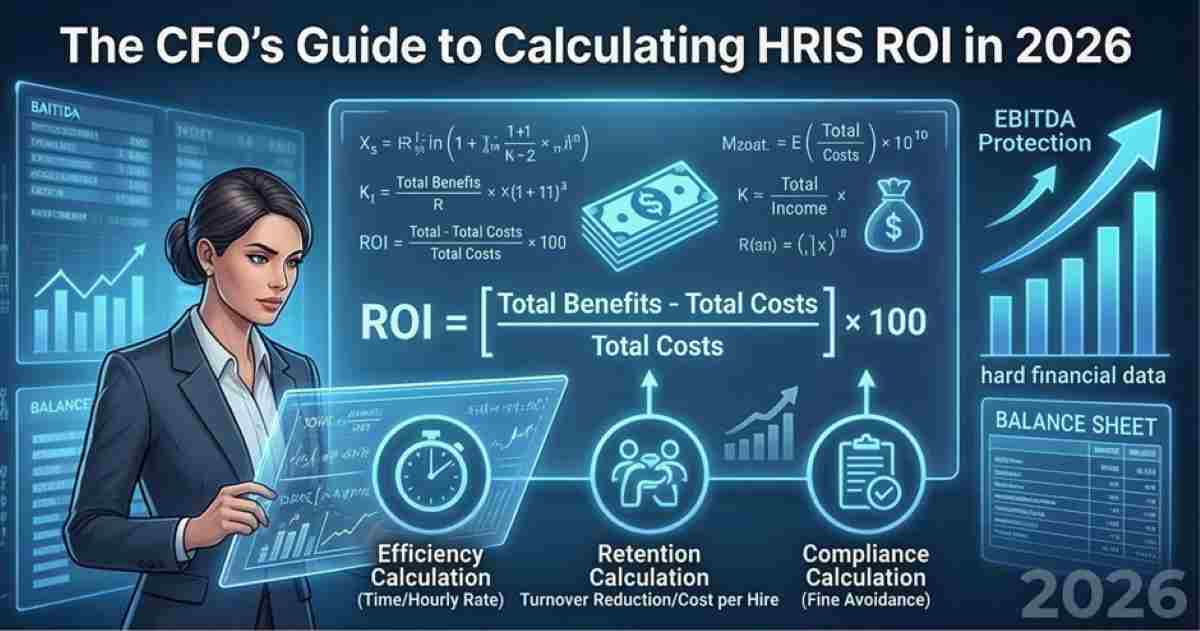
To present a winning case, you must look at the three pillars of ROI: Efficiency Gains, Risk Mitigation, and Talent Retention.
1. The Standard ROI Formula
At its most basic level, the formula is:
However, the "Total Benefits" in 2026 are categorized by a mix of direct savings and redirected productivity.
2. The "Efficiency" Calculation (Labor Savings)
The most immediate ROI comes from automating manual tasks like payroll entry and leave approvals.
Formula: $(\text{Monthly Admin Hours Saved} \times \text{Average Hourly Rate}) \times 12$
Example: If your team saves 40 hours a month on manual reporting at an average rate of $50/hour, that is $24,000 in annual efficiency gains.
3. The "Retention" Calculation (Turnover Reduction)
High turnover is the largest "hidden" cost in most businesses. A modern HRIS improves retention through better onboarding and engagement tools.
Formula: $(\text{Reduction in Turnover Rate} \times \text{Number of Employees}) \times \text{Cost per Hire}$
Example: For a 200-person company, reducing turnover by just 2% (4 people) when the cost to replace an employee is $15,000 saves the company $60,000 annually.
4. The "Compliance" Calculation (Risk Avoidance)
As global labor laws (like the EU AI Act and updated GDPR 2.0) become more complex in 2026, the value of avoiding a fine is a legitimate ROI metric.
Benchmark: According to recent industry data, the cost of non-compliance is approximately 2.7 times higher than the cost of maintaining compliance via a system.
Calculation: $(\text{Average Industry Fine} \times \text{Probability of Audit}) - \text{Cost of System Compliance Module}$
FAQ
What should be included in the "Total Cost" of the system?
Don't just look at the sticker price. You must calculate the Total Cost of Ownership (TCO), which includes:
- Annual subscription/seat fees.
- One-time implementation and data migration fees.
- Internal labor costs (the hours your team spends in training).
- Any hardware or secondary integration costs.
How long does it take for an HRIS to pay for itself?
This is known as the "Payback Period." In 2026, most mid-market companies reach the break-even point within 14 to 18 months. Tech-heavy platforms like Rippling often see a faster payback due to immediate IT and hardware automation savings.
How do I quantify "Soft Benefits" like employee happiness?
While "happiness" is hard to put on a balance sheet, you can quantify its outcome. Use eNPS (Employee Net Promoter Score). Companies with high eNPS typically see a 5–10% increase in Revenue per Employee. Multiply your total revenue by that percentage to show the potential "Productivity Uplift."
Advertisement