10 Best Enterprise Single Sign-On (SSO) Solutions (2026)
Advertisement
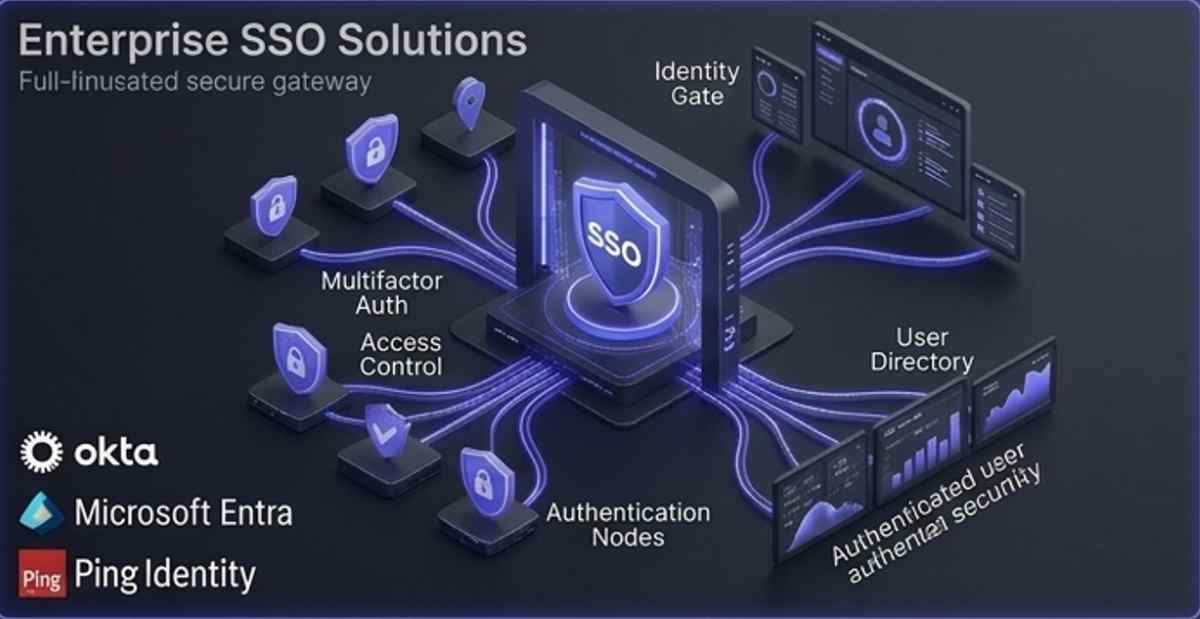
Modern SSO extends far beyond simple password abstraction; it facilitates secure identity federation using open standards like SAML 2.0 and OpenID Connect (OIDC). IT administrators must ensure their access management architectures align with the strict NIST Special Publication 800-63B guidelines for digital identity and authenticator assurance. Additionally, the industry is aggressively shifting toward phishing-resistant, passwordless environments built on cryptographic standards defined by the FIDO Alliance. Leading pure-play identity providers, such as Okta, act as the central nervous system for these modern, secure authentication routing protocols.
A mathematically rigorous approach to authentication emphasizes the cryptographic security of the underlying SSO tokens. The entropy ($E$) of a generated session token can be modeled using the equation $E = \log_2(R^L)$, where $R$ is the size of the cryptographic character pool and $L$ is the token length. Maximizing this entropy—alongside enforcing short-lived session lifetimes—is mathematically required to insulate the enterprise against brute-force token collisions and session hijacking attacks.
| Tool Name | Best For | Deployment Model |
|---|---|---|
| Okta | Agile, Multi-Cloud SaaS Environments | Cloud-Native (SaaS) |
| Microsoft Entra ID | Microsoft 365 Ecosystem Integration | Cloud / Hybrid |
| Ping Identity | Complex, Hybrid Enterprise Architectures | Cloud / On-Premise |
| OneLogin | Rapid Deployment & Automated Provisioning | Cloud-Native (SaaS) |
| Cisco Duo | Zero Trust & Device Posture Checks | Cloud-Native (SaaS) |
| IBM Security Verify | AI-Driven Threat Analytics & SOCs | Cloud / Hybrid |
| JumpCloud | Unified Device & Directory Management | Cloud-Native (SaaS) |
| ForgeRock | Massive Scale B2B/B2C Deployments | Cloud / Self-Hosted |
| Auth0 | Custom App Developer Integrations | Cloud-Native (SaaS) |
| CyberArk | Privileged Workforce Identity | Cloud / Hybrid |
1. Okta
Okta is the undisputed leader in independent identity and access management. Its cloud-native platform provides a massive, pre-configured integration network designed to seamlessly federate identities across thousands of B2B applications without locking enterprises into a specific cloud infrastructure provider.
- Okta Integration Network (OIN): Features over 7,000 out-of-the-box SAML and OIDC integrations, dramatically reducing the IT engineering hours required to onboard new SaaS vendors.
- Adaptive MFA: Utilizes machine learning to evaluate contextual risk (such as IP velocity and device recognition) in real-time, dynamically prompting for step-up authentication only when anomalies are detected.
- Universal Directory: Serves as a single source of truth for identity, capable of ingesting and consolidating user data from legacy on-premise Active Directory and modern cloud HRIS platforms simultaneously.
2. Microsoft Entra ID
Formerly known as Azure Active Directory, Microsoft Entra ID is the default, highly robust identity solution for enterprises heavily invested in the Microsoft ecosystem. It offers deep, native hooks into Windows endpoints and Office 365 services.
- Conditional Access Policies: Enables granular, "if-then" access controls based on user group, location, application sensitivity, and real-time risk data calculated by Microsoft's global threat intelligence.
- Seamless SSO: Provides a frictionless login experience where users logged into a corporate Windows 11 machine are automatically authenticated into their permitted web applications without secondary prompts.
- Identity Protection: Automatically detects compromised credentials by scanning dark web databases and forcing immediate password resets for at-risk enterprise users.
3. Ping Identity
Ping Identity is engineered for the complex reality of legacy enterprise IT. It excels in hybrid environments where organizations must bridge the gap between ancient, on-premise mainframe applications and modern cloud microservices.
- DaVinci Orchestration: Features a visual, no-code identity orchestration engine that allows administrators to drag-and-drop complex user registration, authentication, and recovery flows.
- PingAccess & PingFederate: Provides enterprise-grade federation servers and API gateways that secure legacy applications that cannot natively support modern SAML or OIDC protocols.
- API Intelligence: Uses AI to automatically discover undocumented APIs and detect anomalous traffic patterns, preventing data exfiltration through backend service connections.
4. OneLogin
OneLogin (now part of Identity Security) delivers a streamlined, highly effective SSO and unified access management platform. It is particularly favored by mid-market organizations for its rapid deployment capabilities and tight HRIS synchronizations.
- Real-Time Directory Sync: Bi-directionally syncs with major HR platforms (like Workday or BambooHR) to ensure that employee terminations instantly revoke access across the entire SaaS portfolio.
- SmartFactor Authentication: Employs a Vigilance AI engine to calculate risk scores during authentication attempts, thwarting sophisticated credential stuffing and brute-force attacks.
- Unified Cloud Directory: Provides a cloud-based directory that can entirely replace legacy LDAP servers, reducing on-premise infrastructure footprints for scaling startups.
5. Cisco Duo
While historically known as a standalone Multi-Factor Authentication (MFA) provider, Cisco Duo has evolved into a comprehensive SSO platform centered entirely around Zero Trust network access and endpoint health.
- Trusted Endpoints: Blocks authentication attempts from unmanaged or compromised devices, ensuring that only corporate-issued or compliant BYOD hardware can access sensitive ITSM databases.
- Device Health Checks: Inspects the operating system version, browser patch level, and local encryption status of a device *before* granting the SSO token.
- Duo Network Gateway: Allows remote employees to access internal web applications securely without requiring a traditional, full-tunnel corporate VPN.
6. IBM Security Verify
IBM Security Verify brings enterprise-grade, AI-driven security to the SSO market. It is designed for mature Security Operations Centers (SOCs) that require deep auditing and decentralized identity capabilities.
- AI-Powered Risk Analytics: Leverages IBM's deep learning models to establish behavioral biometric baselines for users, detecting anomalies in typing speed or mouse movements during a session.
- Decentralized Identity Support: Pioneers the use of verifiable credentials and digital wallets, allowing organizations to securely accept privacy-preserving proofs of identity.
- Extensive Compliance Reporting: Generates automated, immutable audit trails of all access events, satisfying strict regulatory mandates across financial and healthcare sectors.
7. JumpCloud
JumpCloud takes a holistic approach by combining SSO with full mobile device management (MDM) and directory services, acting as a complete "Directory-as-a-Service" for cloud-forward IT teams.
- Cross-OS Device Management: Manages Mac, Windows, and Linux endpoints from the same console used to configure SSO web access, unifying identity and hardware management.
- Cloud RADIUS & LDAP: Provides managed RADIUS for secure Wi-Fi/VPN authentication and cloud LDAP to authenticate legacy applications without maintaining physical servers.
- Zero-Touch Provisioning: Allows IT to ship a factory-sealed laptop to a remote worker, which automatically configures itself and connects to the JumpCloud SSO environment upon first boot.
8. ForgeRock
ForgeRock (now integrated with Ping Identity) is a massively scalable identity platform built for organizations that need to manage millions of identities across both enterprise workforces (B2B) and consumer portals (B2C).
- Intelligent Access Trees: Replaces static login scripts with dynamic, node-based authentication trees that can branch based on contextual risk, user attributes, or external API calls.
- IoT Identity Management: Extends SSO and identity governance beyond human users, securing the automated API communications of connected devices and headless servers.
- Identity Governance and Administration (IGA): Natively includes access certification workflows, ensuring managers regularly review and approve the permissions granted to their subordinates.
9. Auth0
Auth0 (an Okta company) approaches SSO from a developer-first perspective. It provides the APIs, SDKs, and extensibility required to embed secure authentication directly into custom-built SaaS applications.
- Extensible Actions pipeline: Allows developers to write custom Node.js serverless functions that execute during the authentication lifecycle to enrich tokens with external database queries.
- Universal Login: Provides a highly customizable, centralized login page that handles complex routing for enterprise federation (e.g., routing a user to their specific corporate IdP based on email domain).
- Machine-to-Machine (M2M) Authorization: Secures backend microservice communications by issuing and validating strict OAuth 2.0 access tokens.
10. CyberArk Workforce Identity
CyberArk applies its pedigree in Privileged Access Management (PAM) to the broader workforce SSO market, creating a solution heavily focused on locking down high-risk access vectors and administrative accounts.
- Secure Web Sessions: Continuously monitors and records user actions within high-risk web applications, providing step-by-step forensic auditing of what an employee did post-login.
- Credential Vaulting: Provides a secure, shared enterprise password manager for legacy web applications that cannot physically support SAML or OIDC federation.
- Continuous Authentication: Does not implicitly trust a user just because they have an active token; it continuously re-evaluates risk throughout the active session to detect hijacking.
FAQs
What is the difference between SAML and OpenID Connect (OIDC)?
SAML (Security Assertion Markup Language) is an older, XML-based protocol predominantly used for enterprise web-browser SSO. OpenID Connect (OIDC) is a newer, JSON/REST-based identity layer built on top of the OAuth 2.0 protocol. OIDC is generally preferred for modern web and mobile applications due to its lighter weight and developer-friendly architecture.
How does Adaptive MFA enhance standard SSO?
Standard SSO reduces login fatigue but creates a single point of failure if credentials are compromised. Adaptive MFA mitigates this by analyzing the context of the authentication request—such as IP reputation, geographic location, and device posture. It only prompts the user for a second authentication factor (like a push notification or biometric scan) when the system detects anomalous or high-risk behavior.
Can modern SSO solutions integrate with legacy, on-premise applications?
Yes. While cloud-native applications use standard federation protocols, legacy applications often rely on older methods like LDAP or header-based authentication. Enterprise SSO providers bridge this gap using lightweight, on-premise access gateways or identity proxies that translate modern cloud tokens into the legacy authentication headers the older applications require.
Advertisement