The Great Consolidation: A CIO’s Blueprint for Ending SaaS Sprawl
Advertisement
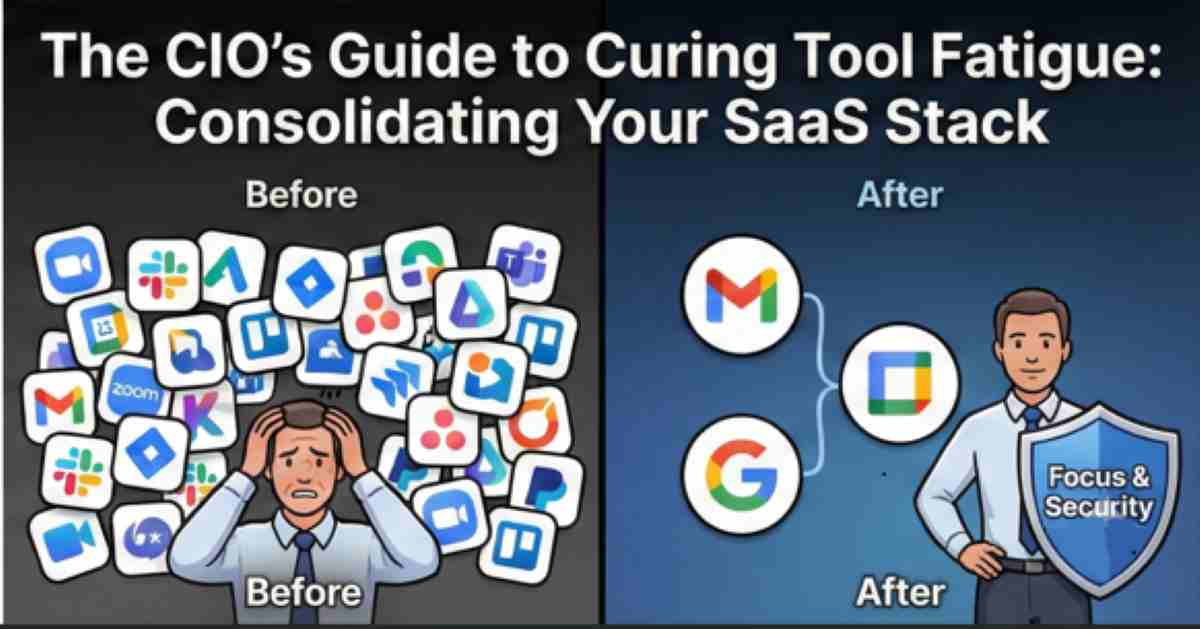
For the modern CIO, the biggest threat to productivity isn't a lack of tools—it’s the tax of context switching. Every time an employee jumps from a Slack thread to a Zoom call, then over to a Jira ticket, and finally into a shared Google Doc, they lose a sliver of focus. Multiply that by 500 employees, and you aren't just losing time; you're losing millions in "shadow" productivity costs.
Reducing tool fatigue isn't about being the "Office Grinch" who takes away everyone's favorite apps. It’s about building a streamlined architecture where the tools actually talk to each other—or better yet, where one tool does the work of three.
The Audit: Identifying "Shadow Comms"
Before you can consolidate, you have to find where the leak is. Most CIOs find that their "official" stack (like Microsoft 365) is being bypassed by "Shadow Comms"—teams using Discord for quick chats, WhatsApp for emergencies, or personal Trello boards for task management.
This isn't just a security risk; it’s a fragmentation disaster. Information becomes "siloed" in places the company can’t search or archive. Your strategy must start with an audit that asks: "What is the unique utility of this app?" If the answer is "I just like the UI better," that app is a candidate for the chopping block.
The "Power of One" (or Two)
The goal of consolidation is to reach a "Primary Operating System" for the company. In 2026, this usually comes down to two giants: Microsoft 365 or Google Workspace.
The Microsoft Strategy: If you are an Outlook house, using Zoom and Slack is often redundant. The modern CIO strategy is to lean into Teams—not because it’s the "best" chat app, but because it’s the most integrated. When your files, calls, and chats live in one ecosystem, the "context switch" tax drops to near zero.
The "Best of Breed" Strategy: If your culture demands Slack, then you must ruthlessly eliminate other "chat-adjacent" tools. You can’t have Slack and Teams chat and Monday.com comments all happening at once.
The "Mutiny-Free" Migration
You can't just turn off an app on a Friday and expect a happy workforce on Monday. Consolidation is 20% technical and 80% change management.
Successful CIOs use a "Sunset Period." Announce the consolidation three months in advance. Offer "Office Hours" for the new tool. Most importantly, show the "WIIFM" (What’s In It For Me). If you tell an engineer, "You will have 40% fewer notifications if we move to this one tool," they will follow you anywhere.
FAQ
How do I handle departments that claim they "need" a specific tool to function?
Ask for a workflow demonstration. Often, they believe the "official" tool can't do what their favorite app does. In 2026, the feature gap between major SaaS players is narrower than ever. If it's a legitimate specialized need (like CAD for engineers), keep it. If it's just a preference, prioritize the organization's collective focus over individual habit.
Does consolidation actually save money on licensing?
Yes, but that's usually the smaller win. The real ROI is in security and support. Managing 50 different vendors means 50 different security vulnerabilities and 50 different support queues for your IT team. Consolidation simplifies your "attack surface" and lets your IT staff focus on high-value projects instead of resetting passwords for a fringe app.
What is the "Rule of Three" in tool consolidation?
A good rule of thumb is that if a piece of information needs to be communicated, there should only be three possible places it could live: the "Live" space (Chat), the "Static" space (Intranet/Wiki), and the "Project" space (Task Manager). If a tool doesn't fit clearly into one of those—or creates a fourth category—it should be consolidated.
Advertisement