The End of the Zoom Happy Hour: Building a Digital Watercooler That Doesn't Suck
Advertisement
The "Watercooler" was never about the water. It was about the unstructured, spontaneous collisions that happen when people aren't in a formal meeting. In a hybrid world, these collisions don't happen by accident. The office folks get them at the coffee machine, while the remote folks sit in silence. This creates a two-class culture.
To build a digital watercooler, you don't need a calendar invite. You need a SaaS ecosystem that facilitates low-stakes, asynchronous social friction.
1. The "Introvert-Friendly" Connection: Donut and RandomCoffees
If you use Slack or Teams, you've likely seen Donut. It’s the gold standard for a reason. It pairs two people for a "coffee chat" every two weeks.
The brilliance of this isn't the meeting itself; it’s the permission. By using an automated tool, the company is explicitly saying: "It is okay to spend 30 minutes of on-the-clock time talking about nothing in particular." For hybrid teams, this ensures that the person in Omaha actually gets to know the person in the London office without it feeling "weird" to reach out.
2. Gamified Recognition: HeyTaco and Bonusly
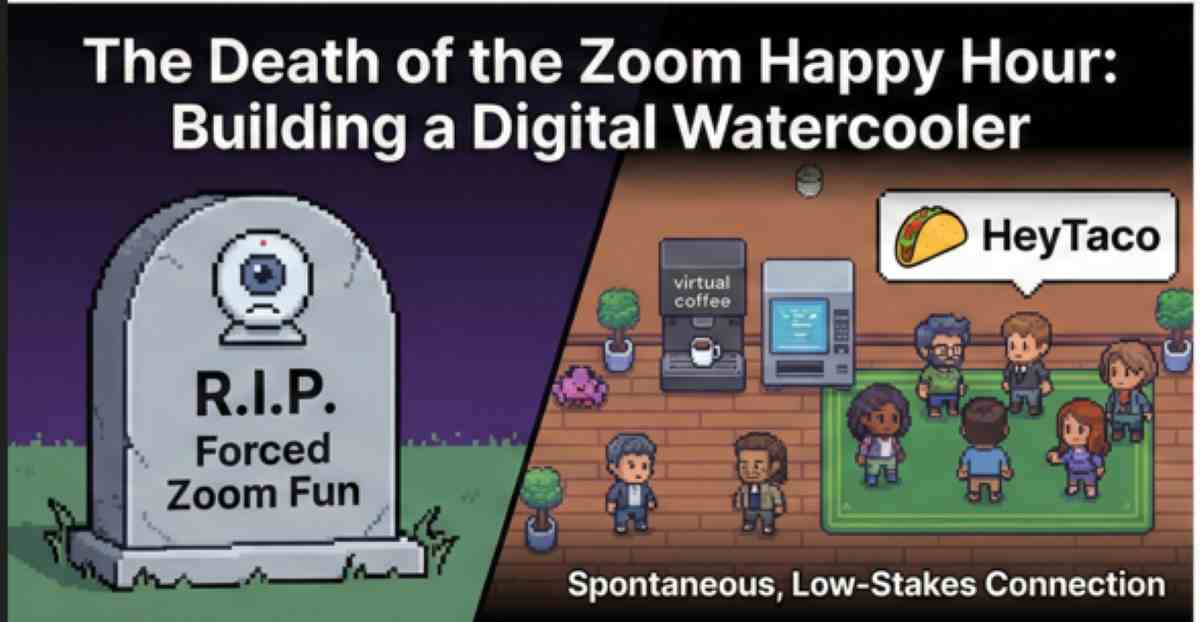
Peer-to-peer recognition is the "social currency" of a digital watercooler. Tools like HeyTaco allow employees to give each other virtual tacos for being helpful.
It sounds silly—and it is—but that’s the point. It lowers the barrier to saying "thanks." When these tacos are visible in a public channel, it creates a "vibe" of appreciation that mimics the casual "thanks for the help" you’d hear in an open-plan office. It turns "engagement" from a top-down HR initiative into a bottom-up habit.
3. Spatial Software: The "Sims" for Work
If you want to get truly experimental, look at Gather or Kumospace. These tools create a 2D or 3D digital office where your avatar moves around. If you walk your avatar near someone else's, your video and audio automatically turn on.
It sounds like a video game, but for hybrid teams, it solves the "proximity" problem. You can "sit" at a digital table with three other people while you do your separate work. If someone has a quick question, they just "walk over." It removes the friction of "scheduling a call" for a 30-second interaction.
The Human Rule: You Can't Automate Empathy
FAQ
How do we prevent "digital watercooler" tools from becoming a distraction?
Set clear boundaries. Social channels should be muted by default. The goal isn't to have people chatting all day; it's to provide a dedicated space so that social chatter doesn't bleed into the #production-outage channel.
Do these tools work for introverts?
Actually, async tools like HeyTaco or Bonusly are often better for introverts than traditional office socializing. They allow people to participate and show appreciation on their own terms without the pressure of "performing" in a crowded breakroom.
What is the "ROI" of an engagement tool?
You don't measure a watercooler in dollars; you measure it in retention and speed. Teams that trust each other move faster. Teams that feel connected to their coworkers are significantly less likely to jump ship for a 10% raise elsewhere.
Advertisement