Stop the Zoom fatigue. Learn how a Head of Remote builds an asynchronous stack using Loom, Notion, and Linear to boost distributed team productivity.
Advertisement
The future of high-performing distributed teams isn't better video quality; it’s Asynchronous Communication.
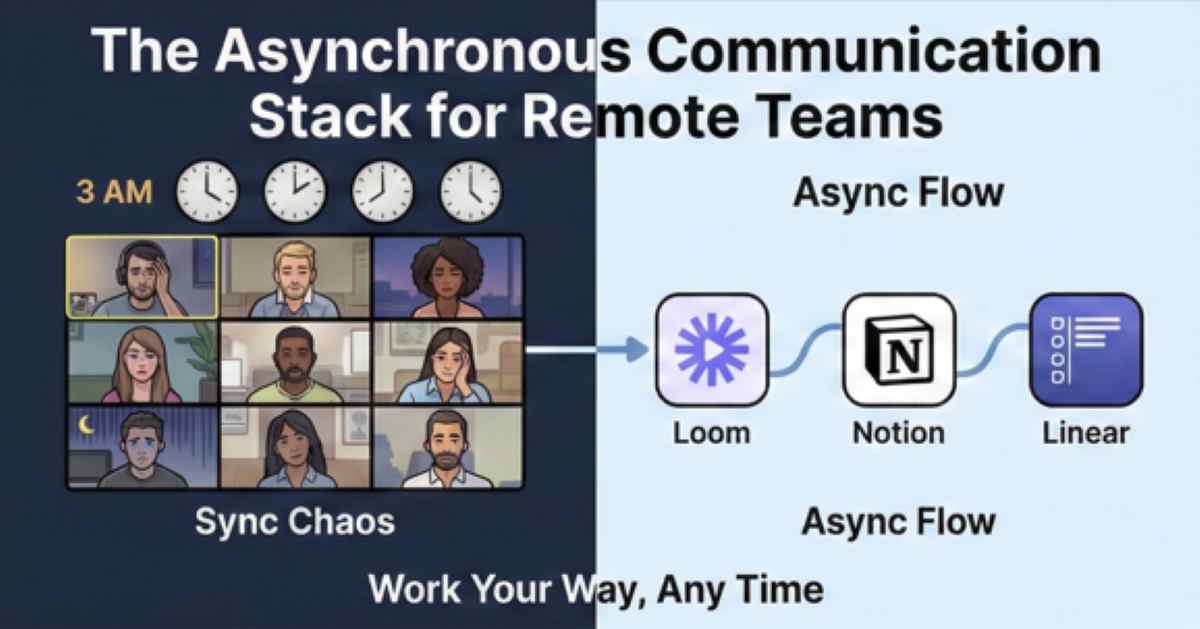
Async is the ability to move projects forward without requiring two or more people to be present at the exact same time. It’s the only way to scale a team across 12 time zones without making half the company work at 2:00 AM. But you can't just tell people to "be async." You have to provide the skeletal structure—the SaaS stack—that makes it possible.
The Philosophy of Context Persistence
When I evaluate tools for a remote organization, I look for one thing: Context Persistence. In a synchronous meeting, the context disappears the moment the "End Call" button is clicked. In an async-first tool, the context is the foundation. Every decision, debate, and file is linked to a permanent, searchable record.
1. The Video Killers: Loom and Bubbles
The biggest drain on remote productivity is the "quick sync." Usually, these calls are just one person sharing their screen and talking for ten minutes. Tools like Loom have fundamentally changed this. If you can record your screen and voice in five minutes, your team can watch it at 1.5x speed on their own time. It respects the "Flow State" of your contributors. I’ve seen teams reduce their "Status Update" meetings by 80% just by mandating weekly Loom updates.
2. The Brain of the Operation: Notion vs. Linear
You cannot be an asynchronous company if your information lives in people’s heads. For general knowledge and documentation, Notion is the industry standard. It allows you to build a wiki that stays updated.
However, for product teams, I often point people toward Linear. It is built for speed and clarity. It doesn't try to be everything to everyone; it just tries to be the best way to track what is being built and why. The magic of Linear is that it assumes you are remote. It creates a clear trail of progress that anyone can audit at any time without needing to ping a project manager.
3. The "Slow Chat" Revolution: Threads
Slack is a wonderful tool, but it is inherently synchronous. It’s a "river" of information—if you aren't there when it flows past, you’ve missed it. Newer tools like Threads (the work platform) are designed to bridge the gap. They force users to categorize conversations into organized topics rather than one long, chaotic stream. This makes it possible for a developer in Berlin to wake up and see exactly what was decided by the team in San Francisco without scrolling through 400 messages of filler.
Final Thoughts
Moving to an asynchronous model is an act of trust. It requires people to become better writers and better planners. While the transition is difficult, the result is a team that owns its schedule and delivers higher-quality work.
FAQ
Doesn't async work feel lonely?
It can if you only do async. The goal is to move "work" to async so that the time you do spend together in sync can be focused on social connection and team building. Use Zoom for birthdays and strategy workshops, not status updates.
How do I handle "urgent" problems in an async culture?
You define what "urgent" actually means. Usually, 95% of things we call urgent are actually just "important." For the real 5%, you use a specific "Red Alert" channel or a phone call.
Which tool should I buy first?
Start with a screen recording tool like Loom. It is the lowest barrier to entry and provides the quickest ROI in terms of hours saved.
Advertisement