Signal vs. Noise: Choosing the Right Internal Communication Architecture
Advertisement
This is the central crisis of internal communications: we are drowning in tools, but starving for attention. In 2026, the challenge isn't finding a way to send a message; it's finding a way to ensure the message is actually processed. If you are an Internal Comms Manager, you are essentially the "Editor-in-Chief" of an incredibly distracted audience. To succeed, you have to stop thinking about which tool has the most features and start thinking about the half-life of your information.
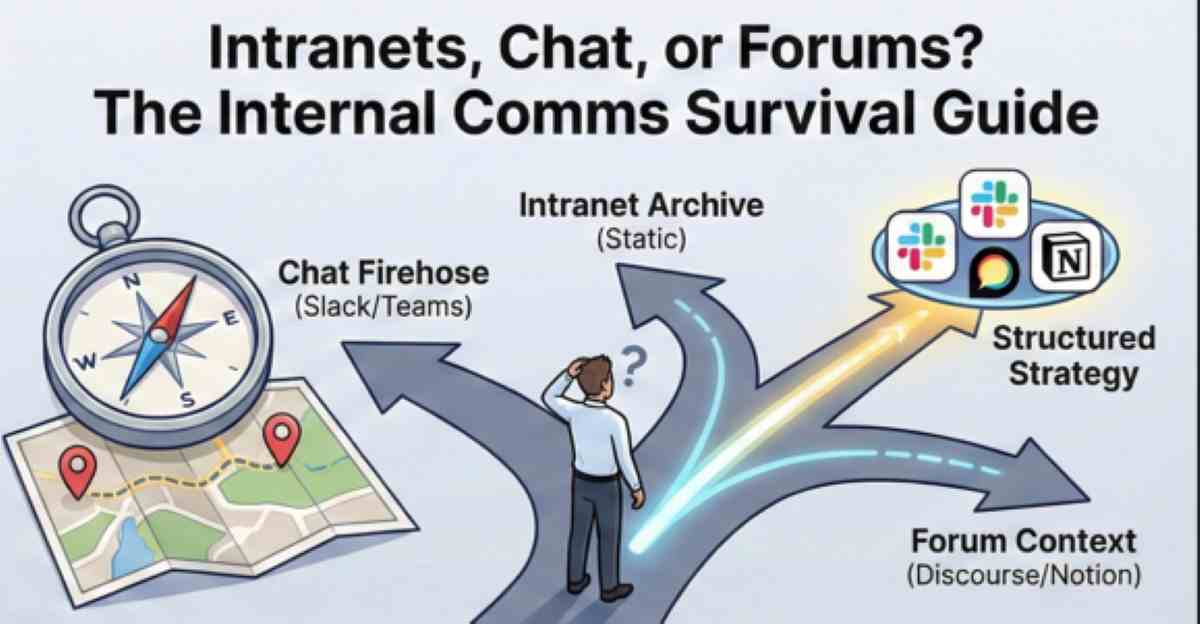
The Intranet: The Digital Library (or the Corporate Museum)
Traditional wisdom suggests the Intranet is the "Single Source of Truth." In reality, most traditional intranets are where information goes to die. They are the digital equivalent of the binder on the high shelf that no one touches unless there is an audit.
The strength of the intranet is Authority and Longevity. It is the place for the "Permanent Record." Your employee handbook, brand assets, and legal disclosures belong here. The problem is that many companies try to use the Intranet for "News." Unless your team is forced to set the Intranet as their browser homepage—which they will likely resent—they aren't going to check it for news.
If you’re going to invest in an intranet, buy it for its Search and Storage capabilities. A modern intranet needs to work like a Google Search for your company. If a new hire can’t find the "Dental Plan PDF" in under ten seconds, your intranet has failed, regardless of how many "social" widgets it has.
Team Chat: The High-Speed Firehose
Slack and Microsoft Teams have won the war for employee attention. If you want someone to see something right now, you put it in chat. It is the "Pulse" of the company.
However, chat is the enemy of Information Context. The "river" moves too fast. If a Comms Manager posts a strategic shift in a main channel, it will be buried by ten other messages and five emojis within an hour. Chat creates a culture of "ASAP," where employees feel they must be "always-on" to avoid missing anything.
For the Internal Comms Manager, Slack is a tactical tool, not a strategic one. It’s great for the "Site is down" alerts or the "Lunch has arrived" pings. It is a terrible place for anything that requires nuance, reflection, or deep thought. When you use chat for everything, you aren't communicating; you’re just creating notification fatigue.
Forums and Knowledge Bases: The Missing Middle
This is the most underrated category in the internal comms stack. Tools like Discourse, Notion, or even specialized internal forum software provide something that neither chat nor intranets do: Threaded, Searchable Context.
A forum is like a library with an ongoing conversation. It is organized by topic, not by time. If a new employee joins, they can go to a forum thread about "Product Roadmap Q3" and see the entire history of the debate, the questions asked by their peers, and the final decisions made.
Forums allow for "Asynchronous Discussion." Unlike chat, where you feel pressured to reply in seconds, a forum encourages people to think for a few hours and write a thoughtful response. For a Comms Manager, this is the gold mine. It’s where you can actually gauge sentiment and alignment through long-form feedback rather than just a "thumbs up" emoji.
The Triage Framework: What Do You Actually Need?
Most internal comms failures happen because the borders between tools are porous. You likely need a combination of all three, but you must define their use cases ruthlessly:
- The Intranet (The Archive): "This is the law." Use it for policies, benefits, and foundational documents.
- Team Chat (The Pulse): "This is happening now." Use it for urgent updates, social bonding, and quick triage.
- Forums/KB (The Brain): "This is why we do what we do." Use it for project post-mortems, Q&A, and strategic debates.
Your next step isn't buying a new tool. It’s writing a Communication Manifesto. Tell your team: "We don't talk about long-term strategy in Slack. We don't post memes on the Intranet. We use the Forum for the 'Why' and the Chat for the 'What'." Only then will you stop the "Death by a Thousand Pings" and start actually communicating.
FAQ
What is the best tool for a small team under 50 people?
At that size, you can usually skip the formal Intranet and Forum software. A "Chat + Wiki" combo works best. Use Slack for daily talk and Notion for your permanent documentation. You only need a formal forum once the "river" of Slack starts making people lose track of important decisions—usually around 75-100 employees.
How do I get people to actually use the Intranet?
Stop calling it an Intranet. Call it the "Answer Center" or the "Library." Don't put "News" there; put "Answers." If people know they can find the answer to "How do I book a flight?" or "What is our dental plan?" in three seconds, they will use it. If it’s just a place for the CEO’s monthly blog, they won't.
Should we allow "Social" channels in our chat app?
Absolutely, but keep them separate. Channels like #pets, #gaming, or #music are vital for remote culture, but they should be muted by default. Encourage the team to use them, but make it clear that no one is expected to keep up with them during "Deep Work" hours.
Advertisement