Field vs. Office: Why Most Construction Project Management Fails at the Job Site
Advertisement
The High Stakes of Construction Management
I’ve spent enough time around job sites and project trailers to know that construction project management is a completely different beast than the "agile" workflows found in tech hubs. You aren't managing pixels; you’re managing steel, concrete, weather, and a dozen different sub-contractors who all have their own ideas about how the schedule should look.
If your "management" currently consists of a stack of weathered blueprints on the hood of a truck and a messy email chain of change orders, you aren't managing a project—you’re just reacting to a series of expensive accidents.
The Life Cycle: It’s Not a Sprint, It’s an Ultra-Marathon
In construction, the project life cycle is rigid for a reason. You can’t iterate on a skyscraper once the crane is gone:
- Pre-Construction: This is where the money is made or lost. Estimating, bidding, and risk management happen here. If your SaaS tool doesn't help you nail the take-offs, the rest of the project is just damage control.
- Procurement: Managing the supply chain. In 2026, material delays are still a project killer. You need to know exactly when that specialized HVAC unit is arriving before you schedule the crane.
- Execution (The Build): This is the "Field" part. This is where the office loses touch with reality. Real-time updates from the job site are the only thing that keeps the budget alive.
- Closeout: The punch list. This is the last 5% of the project that takes 50% of the emotional energy. If you haven't been tracking submittals and warranties all along, this phase will be a nightmare.
Why Generic SaaS Tools Fail Construction Teams
I often see firms try to save money by using generic project management tools like Trello or Monday.com. They are great tools for marketing agencies, but they fail the "muddy boot" test.
Construction requires specific workflows: RFIs (Requests for Information) and Submittals. When a sub-contractor realizes the plumbing doesn't line up with the structural beam, they need to file an RFI. That RFI needs to go to the architect, get a response, and be documented so that three years from now, when there’s a leak, the paper trail is clear.
Generic tools don't have the "Plan View" features that specialized SaaS like Procore or Autodesk Build offer. On a job site, the project manager needs to be able to drop a "pin" on a digital blueprint, attach a photo of the problem, and assign it to a sub-contractor in three clicks. If they have to navigate a complex task list, they just won't do it.
The "Single Source of Truth" Problem
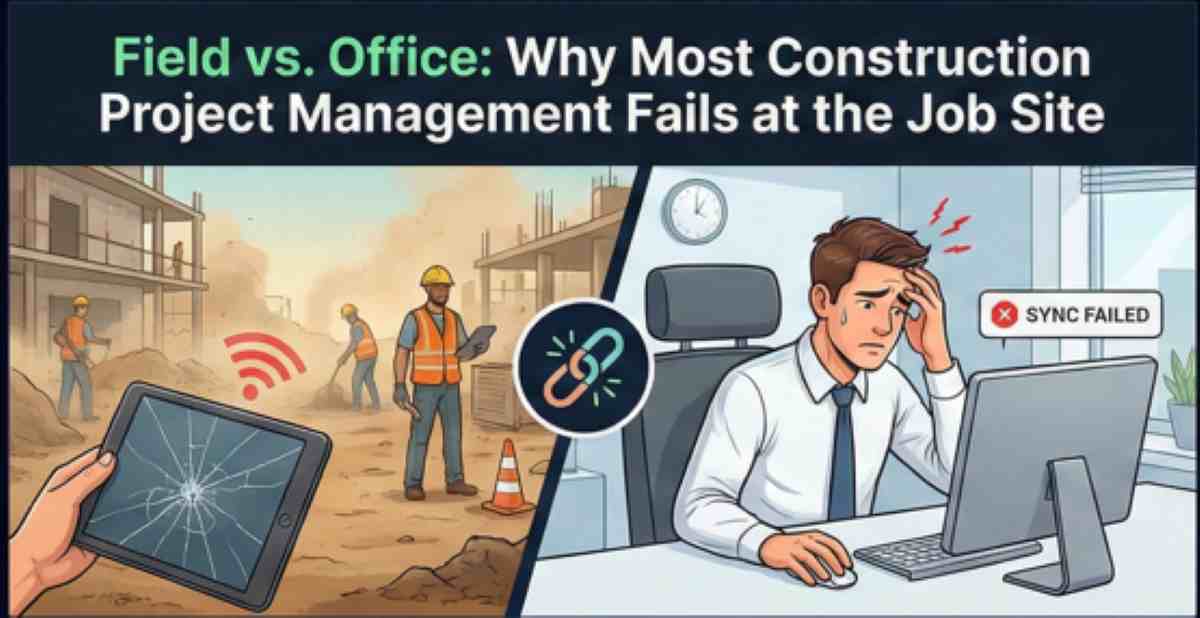
The biggest friction point in construction project management is the lag between the field and the office. When the office is working off Rev 2 of the plans, but the sub-contractor on the third floor is looking at Rev 4, you have a disaster in the making.
Modern construction SaaS solves this by hosting everything in the cloud. When an architect updates a drawing, it syncs to every iPad on the site instantly. This "Single Source of Truth" isn't just a buzzword—it’s the difference between a profitable build and a lawsuit. If your team is still printing out sets of drawings every time there’s a change, you’re hemorrhaging money.
The Human Element
Construction is a high-stakes, high-stress environment. Project managers aren't just moving tickets; they are negotiating with human beings. You have the owner who wants it cheaper, the architect who wants it prettier, and the sub-contractor who just wants to get paid and get to the next job.
Great project management software should act as a neutral arbiter. When a project manager can point to a timestamped log of an RFI that went unanswered for two weeks, it removes the "he said, she said" from the trailer meeting. It shifts the focus from blaming people to solving problems.
Final Thoughts: Choosing Your Stack
Stop looking for the "cheapest" way to manage your project. Look for the tool that your superintendent will actually use. If it’s too complicated for the guy in the field, it doesn’t matter how many features it has—it’s useless. Transitioning from spreadsheets to a dedicated construction SaaS is a painful jump, but once you see the visibility it gives you into your margins, you’ll never go back to the "truck-hood" method of management.
FAQ
What is the difference between an RFI and a Change Order?
An RFI (Request for Information) is a question asked when the plans are unclear. A Change Order is the formal document that changes the project scope and, usually, the price. Think of the RFI as the "why" and the Change Order as the "how much."
Is Procore worth the high price tag for small contractors?
It depends on your volume. For small residential builders, it might be overkill. However, once you’re managing multiple commercial sites, the "error protection" it provides usually pays for the platform within the first year. If Procore is too expensive, look at Fieldwire or Buildertrend as mid-market alternatives.
Can I manage a construction project in Excel?
Technically, yes. People have built skyscrapers with less. But in 2026, the speed of information is too fast for Excel. By the time you update your spreadsheet and email it out, the information is already obsolete.
Advertisement