What is Project Management? A Practical SaaS Guide (2026)
Advertisement
Project Management: The Invisible Friction Reducer
What Project Management Actually Is (Beyond the Definition)
If you look at a textbook, they’ll tell you project management is the application of processes, methods, and skills to achieve specific objectives. That’s technically true, but it’s also boring and tells you nothing about the day-to-day grind.
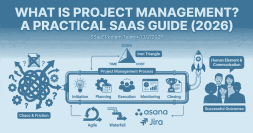
In the real world, project management is the art of getting a group of distracted, busy people from Point A to Point B without burning the budget or the team’s morale. It’s about balancing the "Iron Triangle": scope, time, and cost. You can usually have two, but rarely all three.
The Project Life Cycle: Why the "Middle" is Where Most People Fail
- Initiation: This is the "Why." Before you open a single ticket, you need to know if the project is actually worth doing. If you can’t answer this in three sentences, don't start.
- Planning: This is the "How." It’s breaking the giant rock into manageable pebbles and identifying dependencies, like a lead developer going on vacation.
- Execution: The "Do." The project manager’s job here isn't to do the work, but to clear the obstacles.
- Monitoring and Control: The "Check." Are we still on track? You need a dashboard that tells you the truth, even if it’s ugly.
- Closing: The "Finish." Most teams skip this, but without a post-mortem, you’re doomed to repeat the same mistakes next quarter.
Agile vs. Waterfall: Don’t Get Caught in the Religious War
Waterfall is linear. It works great for building bridges where you can’t iterate on the foundation. Agile is the darling of the software world, focusing on iterative progress, testing, and pivoting.
My take? Most successful teams use a "Hybrid" model. They have a long-term roadmap (Waterfall-ish) but execute in short, flexible bursts (Agile). Don't get bogged down in the purity of the method; use what keeps the tickets moving.
The Role of Software: Why Your Spreadsheet is Killing You
Google Sheets is a terrible project manager. It doesn't notify people when a task is ready or visualize dependencies. Modern tools like Asana or Jira provide a "Single Source of Truth." However, a tool is only as good as the data you put in it. Overdue tasks are usually a discipline problem, not a software problem.
The Human Element (The Part Most People Ignore)
You can have the best Gantt chart in the world, but if your team doesn't trust the process, the project will fail. A project manager is often a translator, managing expectations between stakeholders, developers, and leadership.
FAQ
Do I need a certified Project Manager (PMP) to be successful? In a fast-moving SaaS startup? Not necessarily. You need someone with the mindset—organized, communicative, and detail-oriented.
What is the best project management software for beginners? For most teams, Trello or Asana are the best entry points.
How do you deal with "Scope Creep"? The best way to kill it is to have a "Change Request" process. Show them the impact on the timeline; usually, the "must-have" feature suddenly becomes a "nice-to-have" for version 2.0.
Advertisement