How to Calculate the ROI of an Integrated ITSM and Security Platform
Advertisement
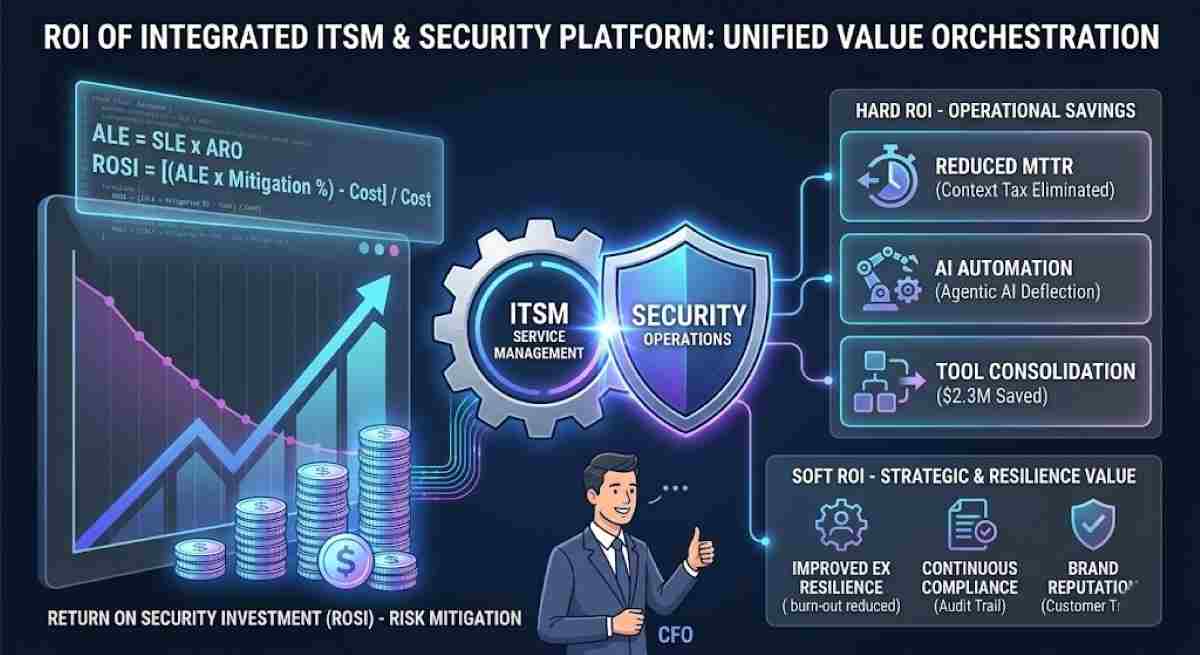
The ROI of an integrated ITSM and security platform is a financial metric that quantifies the net value generated by consolidating IT service management and security operations into a single, unified workflow. Unlike standalone software evaluations, this calculation measures the "synergy effect"—the cost savings and risk reduction achieved when security alerts automatically trigger IT response workflows. In 2026, as enterprise IT spending is forecast to top $6.15 trillion, CFOs are increasingly demanding that technology investments be justified through Return on Security Investment (ROSI) and operational efficiency benchmarks.
Quick Navigation: The ROI Framework
The ROSI Formula: Calculating Risk Mitigation
When calculating the ROI for a security-integrated platform, the standard ROI formula is often insufficient because security "gains" are typically avoided losses. Instead, industry leaders use the Return on Security Investment (ROSI) model.
The foundation of ROSI is the Annualized Loss Expectancy (ALE). This is calculated by multiplying the cost of a single security incident (SLE) by how often that incident is likely to occur in a year (ARO).
According to Safe Security, an integrated platform that reduces the risk of a $2 million breach by 70% with a $150,000 investment yields a ROSI of over 800%. By integrating security into ITSM, the "Mitigation %" increases because the response is faster and more coordinated.
Hard ROI: Quantifiable Operational Savings
Beyond risk mitigation, an integrated platform delivers Hard ROI through direct reductions in operational expenses.
1. Reduction in Mean Time to Repair (MTTR)
In a siloed environment, engineers waste an average of 15–25 minutes simply gathering context between security alerts and IT tickets. Integrated platforms eliminate this "context tax" by automatically enriching tickets with asset health data.
2. Ticket Deflection and AI Automation
Modern platforms utilizing Agentic AI can achieve a 30% ticket deflection rate by year three. By automating routine tasks, skilled staff can focus on high-value projects.
3. Tool Consolidation
According to Deviniti research, enterprises can save approximately $2.3 million over three years just by retiring disconnected service desk and security monitoring solutions.
Soft ROI: Strategic and Resilience Value
Soft ROI represents the qualitative benefits that eventually transform into financial gains.
- Improved Employee Experience (EX): Automated workflows reduce the friction and burnout felt by IT agents, leading to lower turnover costs.
- Continuous Compliance: An integrated platform provides a built-in audit trail, reducing audit preparation time by 40-50%.
- Brand Reputation: Preventing a public data breach protects the company’s long-term market valuation and customer trust.
A 3-Step Practical Calculation Example
To present a business case, follow this structured example based on a mid-sized enterprise with 500 employees.
- Step 1: Identify Total Cost of Ownership (TCO): Including licenses, implementation, and training ($700,000 in Year 1).
- Step 2: Calculate Quantifiable Gains: Such as labor savings ($120k/yr) and downtime prevention ($67k/incident). Reis Informatica suggests that preventing even one major outage can pay for the platform's annual cost.
- Step 3: Compare and Determine Payback Period: Typically achieved within 18–24 months for integrated platforms.
ROI of Integrated Platforms FAQs
How does integrating security into ITSM lower the cost per ticket?
Integration lowers cost by reducing manual triage labor. When alerts are automatically routed with full context, senior engineering time is saved.
What is the "Gordon-Loeb Model" in security ROI?
The Gordon-Loeb model suggests that organizations should not spend more than roughly 37% of the expected loss from a breach on the countermeasures to prevent it.
Can small IT teams see a positive ROI on integrated platforms?
Yes. For small teams, the ROI comes from productivity scaling—enabling a small team to manage more devices without adding new headcount.
Advertisement