The Role of Generative AI in Modernizing the IT Service Desk
Advertisement
Generative AI in the IT service desk is the application of large language models (LLMs) and autonomous agents to automate the end-to-end lifecycle of IT support requests, from initial intake to final resolution. Unlike traditional "if-then" automation, Generative AI (GenAI) understands natural language intent, generates human-like responses, and orchestrates complex technical tasks across multiple software systems. By 2026, the focus has shifted from simple chatbots to Agentic AI, where autonomous entities perform root-cause analysis and execute remediation scripts without human oversight.
Quick Navigation: The GenAI Transformation
How GenAI Differs from Traditional Automation
Traditional ITSM automation relies on rigid, pre-defined workflows that break if a user’s request deviates from a specific template. GenAI provides a "fluid" logic layer that can handle ambiguity.
| Feature | Traditional ITSM Automation | Generative AI (2026) |
|---|---|---|
| Input Type | Structured forms/specific keywords | Natural language (Voice & Text) |
| Reasoning | Deterministic (Fixed paths) | Probabilistic (Context-aware) |
| Data Source | Local database only | Global knowledge + Internal CMDB |
| Action | Routes tickets | Executes tasks & writes code |
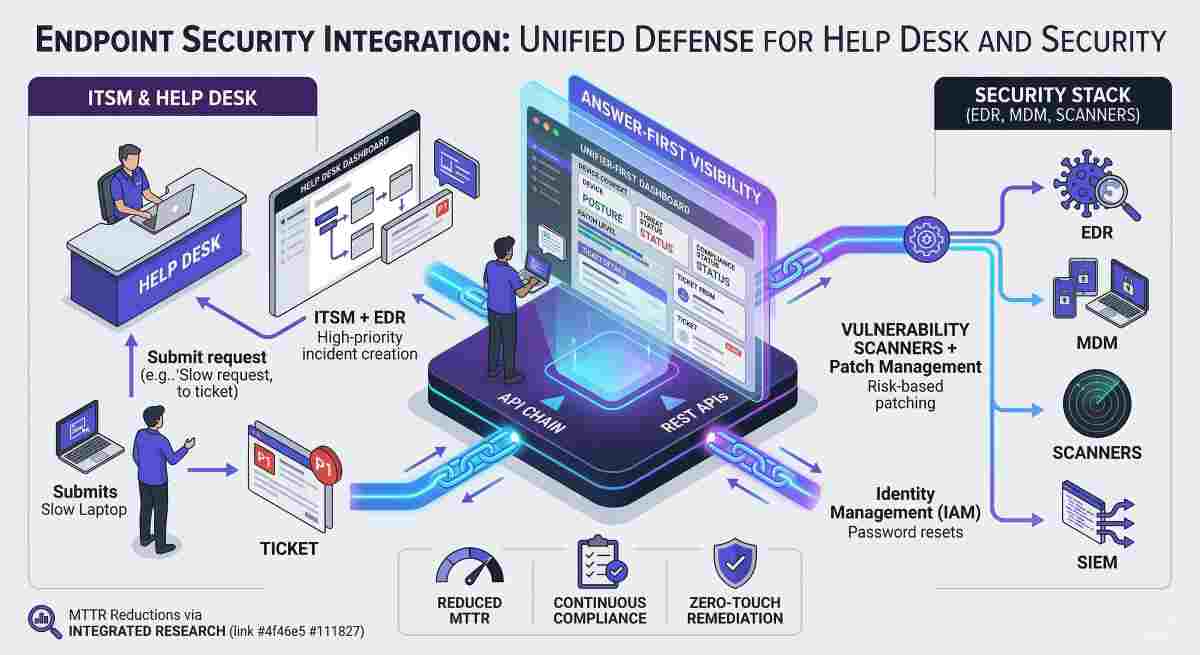
According to Integrated Research, GenAI-powered service desks can reduce manual ticket handling by up to 70% by providing immediate, "answer-first" solutions to recurring employee queries.
Key Use Cases: From Auto-Triage to Self-Healing
GenAI modernizes the service desk by acting as a "force multiplier" for both users and technicians.
1. Intelligent Ticket Enrichment
When a ticket is created, GenAI automatically scans the user’s history, asset data from the CMDB, and recent network logs. It then "enriches" the ticket with a summary of the problem and potential solutions. This ensures that by the time a human agent opens the ticket, 80% of the investigative work is already done.
2. Automated Knowledge Creation
GenAI can transform a resolved incident thread into a structured Knowledge Base (KB) article instantly. This ensures that "tribal knowledge" is captured and made available for self-service, preventing the same issue from being escalated twice.
3. Agentic Remediation
Advanced AI agents can now perform "Self-Healing" workflows. If a user reports a VPN issue, the AI can check the server status, verify the user's certificates, and reset the connection—all in real-time while the user is still in the chat interface.
The 4-Step Implementation Strategy
To successfully integrate GenAI into your service desk, follow this "Foundations-First" roadmap:
- Consolidate Data Silos: AI is only as good as its data. Ensure your ITSM, ITAM, and monitoring tools are connected via APIs to provide a "Single Source of Truth."
- Define Guardrails: Implement "Human-in-the-loop" (HITL) requirements for high-risk actions, such as server restarts, to ensure security compliance.
- Optimize for Query Fan-Out: Structure your internal documentation to answer "What, Why, and How." This allows GenAI to "fan-out" a user's broad query into specific steps.
- Monitor "Hallucination" Rates: Regularly audit AI-generated responses to ensure accuracy. Modern platforms like ServiceNow include built-in confidence scores.
Technical Benefits: Velocity and Human Efficiency
- 50% Reduction in MTTR: By automating diagnostics and triage, the time between "Incident Opened" and "Incident Resolved" is cut in half.
- 24/7 Support Scalability: GenAI provides high-quality support across all time zones without increasing headcount.
- Reduced Agent Burnout: By handling 100% of "low-value" tickets, human agents can focus on complex projects.
- Improved Employee Sentiment: Instant resolutions via Slack or Teams lead to significantly higher CSAT scores.
Generative AI in ITSM FAQs
How does GenAI improve the Configuration Management Database (CMDB)?
GenAI can proactively identify "data decay" in your CMDB. For example, if an asset hasn't been scanned in 30 days, it can flag the record for update or trigger an automated discovery scan.
Is Generative AI secure for corporate IT data?
Yes, provided you use enterprise-grade LLMs. Organizations must use "Private" AI instances where data is not used to train the public model, ensuring SOC2 and GDPR compliance.
What is the first step for a small IT team to start using GenAI?
Start with "AI-Assisted Drafting." Allow agents to use GenAI to draft responses and summarize threads. This provides productivity gains with zero risk as a human still reviews the output.
Can GenAI handle multi-lingual support?
Yes. LLMs can translate and provide support in over 100 languages fluently, allowing global companies to provide "local" support experiences without regional headcount increases.
Advertisement