IT Asset Management (ITAM): How to Track and Secure Corporate Devices
Advertisement
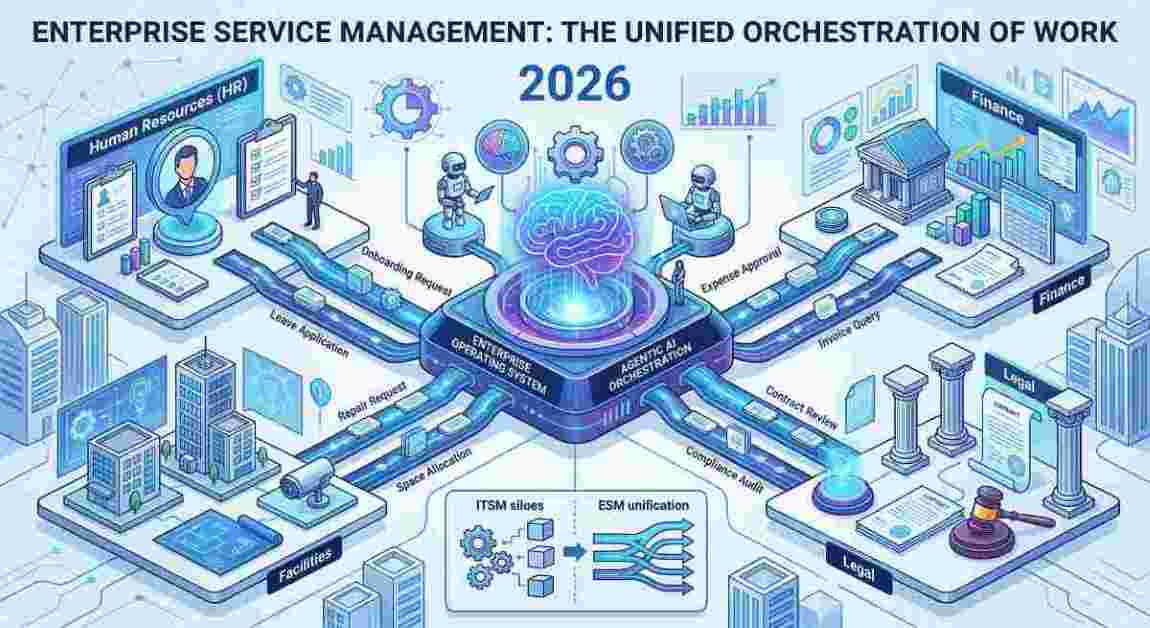
Enterprise Service Management (ESM) is the organizational strategy of applying IT Service Management (ITSM) principles—such as service desks, incident management, and automated workflows—to non-IT departments like Human Resources, Finance, Legal, and Facilities. While ITSM focuses on technology infrastructure, ESM treats the entire organization as a collection of service providers and consumers. By 2026, ESM has evolved from a "tool-first" implementation into a unified "Enterprise Operating System" that uses Agentic AI to orchestrate cross-departmental tasks autonomously.
Quick Navigation: The ESM Blueprint
The Shift from ITSM to ESM: Key Differences
The convergence of ITSM and ESM is no longer a debate; it is a requirement for enterprise resilience. Organizations are increasingly moving away from managing discrete silos toward a coordinated ecosystem of intelligent capabilities.
| Feature | IT Service Management (ITSM) | Enterprise Service Management (ESM) |
|---|---|---|
| Primary Scope | IT Infrastructure & Software | HR, Finance, Facilities, Legal, etc. |
| Core Goal | System Uptime & Security | Employee Experience & Velocity |
| Standard Framework | ITIL, COBIT, ISO 20000 | Adapted ITIL |
| 2026 AI Role | Predictive Maintenance | Agentic Workflow Orchestration |
While ITSM provides the technical foundation, ESM expands that logic to improve service delivery across the board. For example, a tech firm might use ITSM to resolve a server outage, while simultaneously using ESM to manage the onboarding of the engineer who fixes that server.
How ESM Transforms Non-IT Departments
ESM eliminates the "email black hole" where requests are sent to general aliases and lost. Instead, it provides a structured, transparent, and measurable service experience.
1. Human Resources (HR)
- Employee Onboarding: Triggering hardware procurement in IT, access rights in Security, and payroll setup in Finance through a single request.
- Leave Management: Standardizing approvals and ensuring compliance with local labor laws.
- Policy Access: Providing a 24/7 AI-powered knowledge base for benefits and travel policies.
2. Finance and Procurement
- Expense Approvals: Automated routing of claims based on deal size or department risk.
- Invoice Queries: Centralizing vendor communication to reduce payment bottlenecks.
3. Facilities and Legal
- Facilities: Managing office repairs, space allocation, and safety inspections via mobile-friendly service catalogs.
- Legal: Automating contract reviews where documents are routed to the correct attorney based on predefined risk levels.
The 5-Step ESM Implementation Framework
Successful ESM adoption requires a strategy that prioritizes "foundations over features." Follow this 5-step roadmap to scale service management effectively.
- Define a Shared Taxonomy: Before choosing a tool, standardize your service language. Establish a common service catalog structure.
- Secure Executive Sponsorship: ESM is a cultural shift. It requires CIO and COO-level support to break down departmental resistance.
- Select a Scalable Platform: Choose a tool that supports multi-tenancy—allowing each department to have its own private workspace.
- Design Experience-Centric Workflows: Move away from "ticket-centric" designs. Focus on the employee journey and use Query Fan-Out principles.
- Implement Agentic AI: Integrate AI agents to handle routine exception triage and diagnostics autonomously.
Technical Benefits: Why ESM is the Future of Work
- 30% Reduction in Response Times: Standardized workflows eliminate manual handoffs and signature chasing.
- Zero-Touch Resolution: AI-powered self-service can deflect up to 45% of repetitive requests.
- Continuous Compliance: Every request leaves an audit trail, ensuring compliance with GDPR, HIPAA, or internal standards.
- Consolidated Tech Stack: Using one platform for HR, IT, and Finance reduces licensing costs and simplifies data management.
Enterprise Service Management FAQs
Does ESM require a separate software from ITSM?
Usually, no. Most modern ITSM platforms are built to support ESM. You can simply create new "service domains" for HR or Finance within your existing tool.
What is the "First Step" in a successful ESM journey?
The first step is identifying a "Partner Department"—usually HR or Facilities—that handles high volumes of manual, repetitive requests.
How does AI change ESM in 2026?
In 2026, AI has shifted from simple chatbots to Agentic AI. These agents don't just answer questions; they execute tasks like payroll discrepancy correction.
What are the biggest challenges to ESM adoption?
The biggest barrier is Change Management. Non-IT departments may be hesitant to move away from email. Training must focus on ease of use.
Is ESM suitable for small businesses?
Yes. SMEs use ESM to maintain professional service standards without needing a large staff, utilizing pay-as-you-grow pricing models.
Advertisement