Architectural Guide to Enterprise Network Virus Scanning & Threat Inspection Tools
Advertisement
Architectural Guide to Enterprise Network Virus Scanning & Threat Inspection Tools
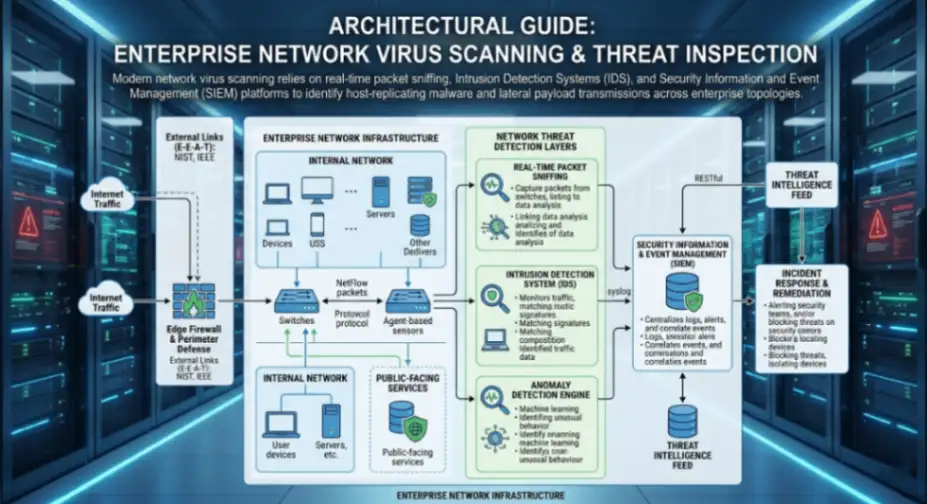
Unlike file-based endpoint infections, network-level malware propagates across subnets via rogue IP packets, exploit payloads, and unauthorized port bindings. Implementing effective defense mechanisms requires a combination of Deep Packet Inspection (DPI), heuristic traffic analysis, and central threat aggregation compliant with cybersecurity standards established by organizations like the National Institute of Standards and Technology (NIST).
Site24x7
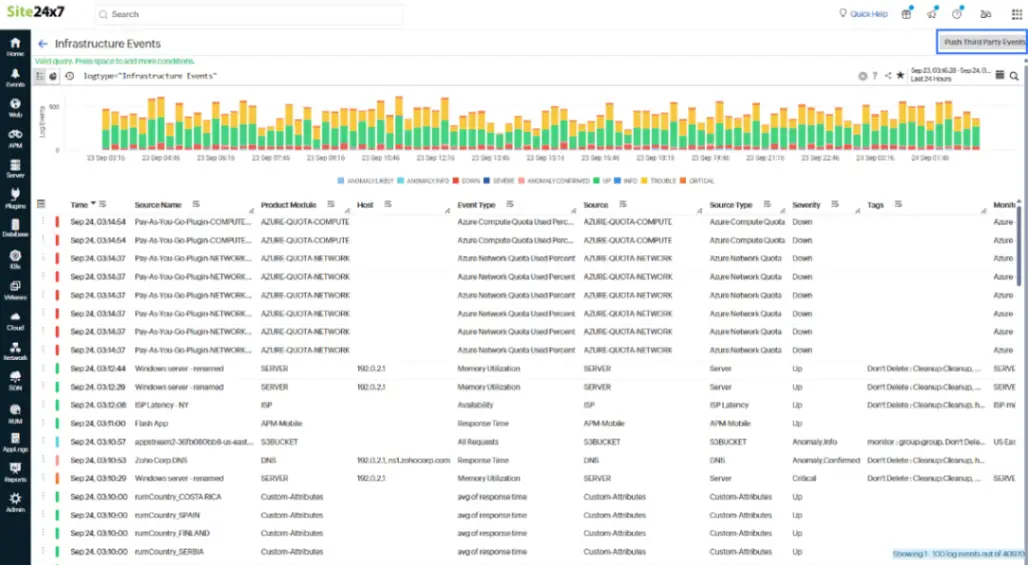
Site24x7 is a SaaS-native infrastructure and application monitoring platform that integrates cloud-based packet inspection with automated network traffic telemetry. It ingests flow data across multi-cloud and hybrid environments to pinpoint anomalous spikes, unauthorized device communication, and packet-level threat patterns.
- SaaS Architecture & Edge Polling: Leverages secure lightweight on-premises poller agents to push flow metrics securely over HTTPS/TLS to a centralized cloud engine.
- AI-Driven Anomaly Engine: Uses machine learning baselines to continuously detect non-standard protocol behavior, unexpected egress volumes, and suspicious port usage.
- Restful API & Integrations: Offers robust RESTful APIs to feed network security metrics directly into enterprise ITSM workflows and third-party orchestration tools like Site24x7 Network Monitoring.
Paessler PRTG Network Monitor
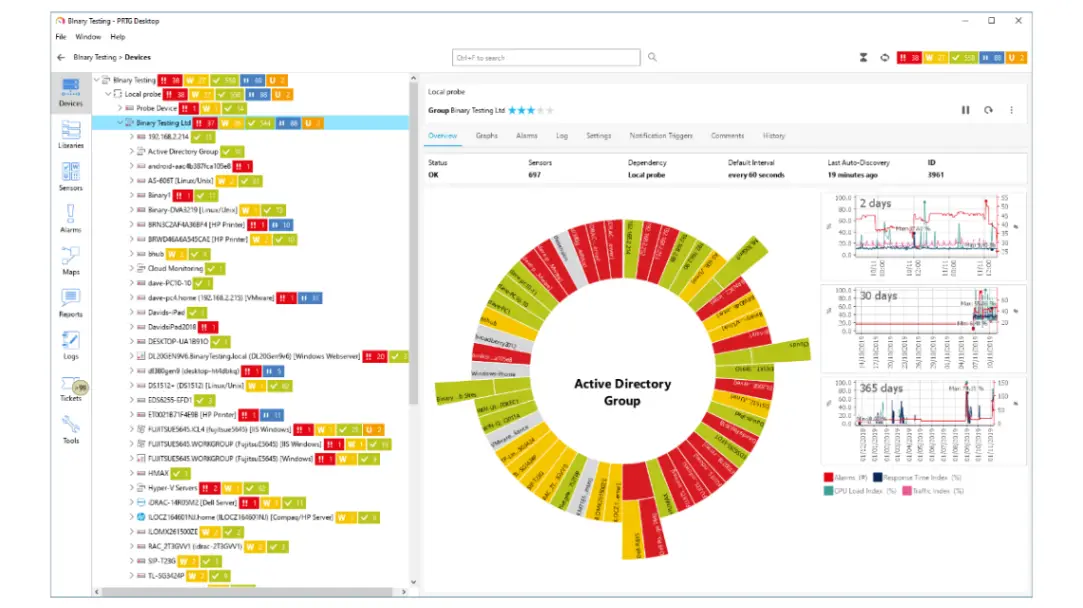
Paessler PRTG is an all-in-one infrastructure monitoring engine that utilizes specialized sensors for packet sniffing, NetFlow, IPFIX, and SNMP data capture. Designed for both Windows Server deployment and hosted cloud instances, it provides real-time topology mapping alongside deep protocol auditing.
- Modular Sensor Architecture: Deploys dedicated packet-sniffing and protocol-analysis sensors to monitor specific subnets without overburdening core host CPU cycles.
- Protocol-Level Header Parsing: Inspects incoming and outgoing IP packet headers to flag non-HTTP/S web traffic, unauthorized FTP/SSH tunnels, and broadcast storms.
- On-Premises & SaaS Availability: Supports bare-metal Windows Server installations for air-gapped environments alongside a managed PRTG Hosted Monitor option.
ManageEngine NetFlow Analyzer
ManageEngine NetFlow Analyzer specializes in flow-based bandwidth analysis and network threat telemetry processing across Cisco NetFlow, sFlow, IPFIX, and J-Flow streams. It acts as an intrusion detection component by correlating flow patterns against known malicious IP lists and zero-day threat profiles.
- Continuous Flow Analysis Engine: Processes raw flow records across multi-vendor routers and switches to identify malware-driven traffic amplification and scanning activity.
- Behavioral Anomaly Detection (CSPM/NTA): Utilizes a built-in Network Analytics Engine (NAE) to detect port scanning, DDoS patterns, and botnet command-and-control (C2) communication.
- Cross-Platform Deployment: Deploys natively on 64-bit Windows Server and Linux operating systems with custom REST APIs for automated firewall policy enforcement.
ManageEngine Log360
ManageEngine Log360 is an integrated SIEM and threat intelligence solution that combines agent-based endpoint log collection with agentless network event correlation. It aggregates syslog messages, firewall alerts, and raw packet logs into a centralized dashboard for real-time threat detection and compliance reporting.
- Unified SIEM & UEBA Processing: Employs User and Entity Behavior Analytics (UEBA) powered by ML models to correlate host-level file changes with network-level data exfiltration attempts.
- Real-Time Threat Intelligence Feeds: Integrates global STIX/TAXII threat feeds to instantly flag malicious external IP addresses and malicious packet domains.
- On-Premises Windows Deployment: Runs natively on Windows Server architectures with high-throughput SQL indexing for long-term log auditing and automated incident response scripts.
CrowdStrike Falcon
CrowdStrike Falcon is a cloud-native Endpoint Protection Platform (EPP) and Endpoint Detection and Response (EDR) solution that integrates localized host protection with cloud-delivered threat graph processing. It continuously monitors process behavior and outbound network sockets to isolate infected endpoints before lateral movement occurs.
- Single Lightweight Kernel Agent: Deploys a unified, low-overhead agent across Windows, macOS, and Linux endpoints that intercepts system calls and network sockets in real time.
- Threat Graph Cloud ML Engine: Processes trillions of telemetry events daily in the cloud using graph database architectures and predictive machine learning models to block zero-day exploits.
- Automated Micro-Segmentation & Isolation: Offers native remote network containment capabilities that immediately cut infected devices off from internal subnets while retaining cloud telemetry channels.
SolarWinds Security Event Manager
SolarWinds Security Event Manager (SEM) is an enterprise log management and SIEM appliance designed to process network security events at high log-per-second (LPS) velocity. It features real-time event correlation, integrated active response actions, and pre-built compliance audit rules.
- In-Memory Event Correlation Engine: Analyzes security event logs instantly in RAM to trigger immediate automated responses such as blocking rogue IP addresses or detaching switch ports.
- Virtual Appliance Deployment: Ships as a hardened pre-packaged virtual appliance for VMware vSphere and Microsoft Hyper-V environments for simple architectural isolation.
- Cryptographically Secure Log Archiving: Stores compressed, tamper-evident log data to meet stringent regulatory mandates including PCI DSS, HIPAA, and SOX.
Frequently Asked Questions
What is the primary technical difference between a packet sniffer and an Intrusion Detection System (IDS)?
A packet sniffer passively captures and decodes raw network frame headers and payloads for manual forensic analysis. In contrast, an IDS actively evaluates captured packet data against signature databases or heuristic machine learning models to automatically generate alerts or execute threat response rules.
Why do traditional desktop antivirus solutions fail to prevent network virus propagation?
Traditional antivirus tools focus on host file systems and execution memory signatures. Network viruses replicate by injecting malicious payloads directly into raw network traffic packets across open socket channels, bypassing standard endpoint file-system scanning engines.
How does anomaly-based detection outperform signature-based scanning in network virus tools?
Signature-based scanning requires pre-defined hash patterns or byte sequences and consistently fails against encrypted or zero-day malware. Anomaly-based engines establish baseline network behavior using machine learning models, allowing them to flag non-standard traffic volumes, unusual port access, or suspicious C2 telemetry regardless of payload encryption.
Advertisement