10 Best Bandwidth Monitoring Tools for IT Networks (2026)
Advertisement
10 Best Bandwidth Monitoring Tools (2026)
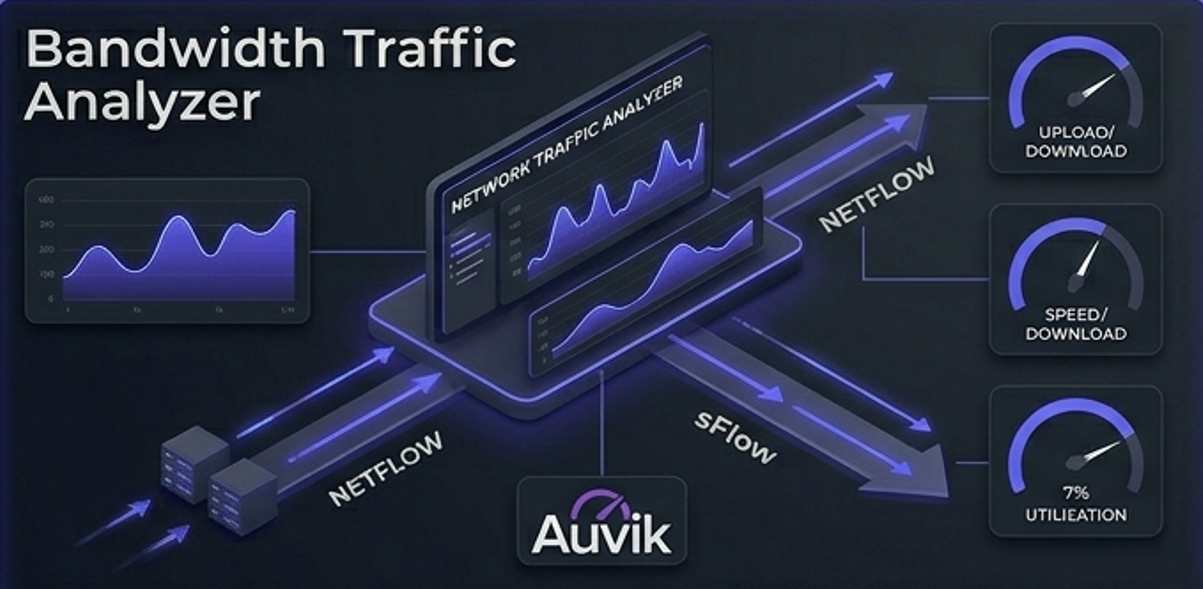
Monitoring bandwidth involves analyzing flow data (like NetFlow, sFlow, and IPFIX) to dissect traffic patterns down to the specific application and user. To understand the underlying internet protocols these tools analyze, network engineers rely on documentation provided by the IETF Official Site. Furthermore, continuously monitoring your network for unauthorized data exfiltration is a critical component of cybersecurity, aligning with standards established by the NIST Computer Security Resource Center.
We have rigorously evaluated the industry's top network management platforms to bring you the ten best bandwidth monitoring tools available today, focusing on traffic visualization, protocol support, and proactive alerting.
1. ManageEngine NetFlow Analyzer
NetFlow Analyzer is a comprehensive, flow-based traffic analysis tool. It excels at breaking down bandwidth usage to show exactly which applications, IP addresses, and protocols are consuming the most network resources.
- Deep Packet Inspection: Captures and translates raw network packets from the server to accurately identify the root cause of network latency.
- Cisco AVC Monitoring: Integrates deeply with Cisco Application Visibility and Control to observe traffic performance and shape bandwidth allocation dynamically.
- Traffic Volume Forecasting: Analyzes historical data trends to accurately predict future bandwidth needs, allowing IT teams to plan infrastructure upgrades timely.
2. Paessler PRTG Bandwidth Monitor
Paessler PRTG is renowned for its highly customizable, sensor-based architecture. It allows IT teams to monitor bandwidth across local networks, cloud environments, and remote IoT devices simultaneously.
- Broad Protocol Support: Supports native packet sniffing, SNMP, WMI, and all major flow protocols including NetFlow, jFlow, and IPFIX.
- PRTG Map Designer: Create dynamic, visually appealing dashboards that display real-time bandwidth metrics overlaid on physical office floor plans or geographic maps.
- Custom Alerts: Configure multi-tier threshold alerts that trigger emails or push notifications the moment an application begins hogging bandwidth.
3. Auvik
Auvik is a modern, cloud-based network monitoring tool designed to simplify complex infrastructure management. It is highly praised for its automated network mapping and deep traffic insights.
- Automated Discovery: Instantly scans the network to discover all connected routers, switches, and firewalls, visually mapping the entire topology.
- Traffic Insights: Dissects traffic flow down to the specific device port, making it incredibly easy to isolate bandwidth-heavy applications or rogue devices.
- Product Link: You can explore their cloud-based network management capabilities directly at Auvik.
4. ManageEngine OpManager
OpManager is a holistic infrastructure monitoring platform that includes powerful bandwidth tracking capabilities. It is designed to provide end-to-end visibility across massive, multi-vendor enterprise networks.
- Real-Time Analytics: Continuously tracks interface utilization across switches and routers, updating performance dials in real-time.
- Fault Management: Features a proactive fault detection system that immediately alerts administrators to hardware failures causing network congestion.
- Mobile Monitoring: Provides a robust mobile app that allows network engineers to monitor bandwidth spikes and acknowledge alerts from anywhere.
5. Site24x7
Site24x7 offers a fully cloud-based approach to bandwidth monitoring. It is an excellent choice for distributed organizations that need to monitor the network health of multiple remote branch offices from a single pane of glass.
- Unified Dashboard: Combines bandwidth monitoring with website, server, and application performance metrics to provide a complete picture of IT health.
- Anomaly Detection: Uses machine learning to establish baseline bandwidth usage and alerts you instantly when abnormal traffic patterns occur.
- Zero Infrastructure: Because it is SaaS-based, there are no heavy on-premise servers to maintain, allowing for instant deployment.
6. SolarWinds Network Bandwidth Analyzer Pack
SolarWinds offers one of the most powerful enterprise-grade suites for network performance and bandwidth monitoring. It combines their flagship Network Performance Monitor (NPM) with the NetFlow Traffic Analyzer (NTA).
- Bandwidth Hogs: Instantly identifies the specific users, applications, and protocols consuming the most network bandwidth.
- CBQoS Policies: Monitor and validate the effectiveness of your Class-Based Quality of Service policies to ensure critical VoIP traffic is prioritized over web browsing.
- PerfStack: Drag and drop bandwidth data alongside CPU and memory metrics on a common timeline to quickly correlate network spikes with server performance.
7. NetworX Traffic Monitoring Tool
NetworX (by SoftPerfect) takes a unique, agentless approach to real-time data gathering. It is highly effective for IT teams that need a lightweight tool to monitor bandwidth without deploying heavy software across their fleet.
- Agentless Monitoring: Automatically detects network devices and begins monitoring physical and logical ports without requiring client-side installations.
- Configuration Review: Validates device configurations and tracks changes to quickly detect if a misconfigured router is causing bandwidth drops.
- Cross-Network Search: Easily find specific devices, IP addresses, or MAC addresses across an extensive, distributed network inventory.
8. Progress WhatsUp Gold
WhatsUp Gold provides comprehensive oversight of network traffic flow. It is highly valued for its interactive network mapping and support for complex, customized database monitoring scripts.
- Dynamic Performance Maps: Visualizes bandwidth bottlenecks directly on interactive topology maps, showing exactly where traffic is being choked.
- Dark Web Traffic Tracking: Can be configured to alert administrators immediately if internal network traffic is detected routing to known Tor exit nodes or malicious IP addresses.
- Custom Scripting: Supports PowerShell and VBScript, enabling precise, customized bandwidth polling for proprietary applications.
9. LogicMonitor
LogicMonitor is an agentless, SaaS-based observability platform that excels at monitoring complex hybrid IT environments. It automatically scales alongside your network's growth.
- Automated Deployment: Instantly begins polling bandwidth data the moment a new switch, router, or firewall is added to the network.
- SD-WAN Visibility: Provides deep monitoring capabilities for modern SD-WAN architectures, ensuring bandwidth is optimally routed across diverse connection types.
- Data Forecasting: Utilizes advanced algorithms to project exactly when a specific network link will reach maximum capacity based on historical usage.
10. Datadog Network Performance Monitoring
Datadog brings its renowned cloud-native observability to the network layer. It is the perfect bandwidth monitoring solution for modern engineering teams running complex, containerized microservices.
- Cloud-Scale Visibility: Tracks traffic flowing between individual containers, availability zones, and hybrid cloud environments in real-time.
- DNS Performance: Monitors DNS resolution times and failure rates alongside bandwidth metrics to pinpoint the exact cause of application latency.
- Seamless Correlation: Automatically correlates network bandwidth spikes with application logs and infrastructure metrics to drastically reduce mean time to resolution (MTTR).
FAQs
What is the difference between Internet Speed and Bandwidth?
Bandwidth is the maximum amount of data that can be transmitted over an internet connection in a given amount of time (the "width of the pipe"). Internet speed refers to how fast that data is actually traveling. A network can have high bandwidth but slow speeds if it is congested by heavy traffic.
How do bandwidth monitoring tools identify what is consuming data?
These tools primarily use flow protocols like NetFlow, sFlow, and IPFIX. Routers and switches export these flow records to the monitoring software, which analyzes the packet headers to determine the source IP, destination IP, and the specific application protocol (e.g., HTTP, VoIP, or FTP) consuming the bandwidth.
Why is monitoring network bandwidth important for security?
Beyond ensuring performance, bandwidth monitoring is a critical security measure. A sudden, unexplained massive spike in outbound traffic (especially during off-hours) is a primary indicator of a data breach, ransomware exfiltration, or a compromised device participating in a DDoS attack.
Advertisement