Enterprise Architectural Guide: Throughput vs. Bandwidth Optimization

Advertisement
Enterprise Architectural Guide: Throughput vs. Bandwidth Optimization
Architecting scalable enterprise infrastructure requires distinguishing between physical medium channel limits and actual application-level data arrival rates. Standards established by the Institute of Electrical and Electronics Engineers (IEEE) govern physical layer signaling speeds and medium access control mechanisms across Ethernet and wireless frameworks. Enterprise monitoring suites such as PRTG Network Monitor continuously ingest SNMP and flow-based telemetry to track real-time bandwidth utilization and throughput bottlenecks across distributed network segments.
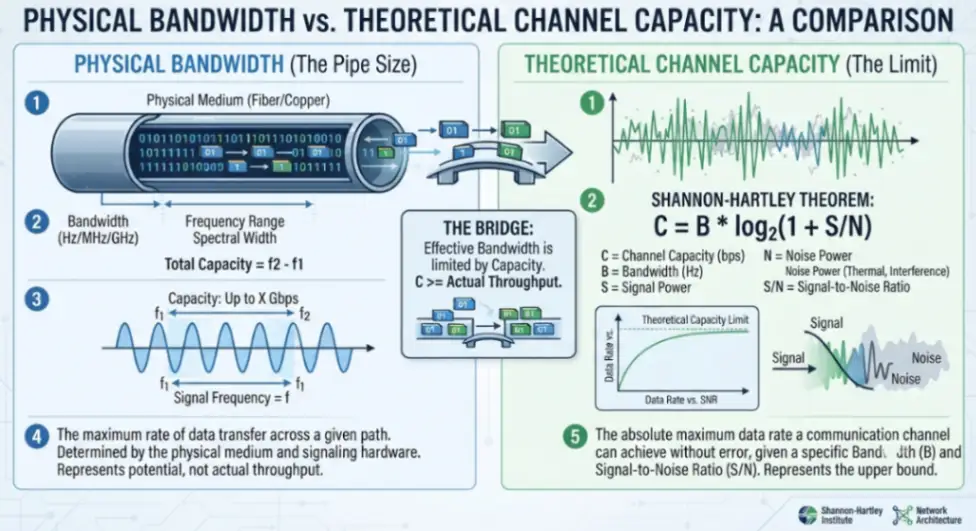
1. Physical Bandwidth and Theoretical Channel Capacity
Bandwidth represents the fixed channel width dictated by signaling frequencies, modulation schemes, and physical transmission media capabilities. It establishes the absolute upper boundary for bit transmission across copper, optical fiber, or radio frequency allocations regardless of network load.
- Nyquist and Shannon-Hartley Boundaries: Constrained physically by channel bandwidth and signal-to-noise ratio ($C = B \log_2(1 + S/N)$), establishing maximum error-free bit rates.
- Physical Media Modulation: Leverages advanced line encoding techniques such as PAM4 in high-speed optical links and QAM-4096 in Wi-Fi 7 to maximize bit density per hertz.
- Static Allocation Frameworks: Configured at the physical layer (L1) and link layer (L2) through fixed port speed provisioning (e.g., 10GbE, 100GbE) and link aggregation groups (LAG).
2. Realized Throughput Mechanics and Bottlenecks
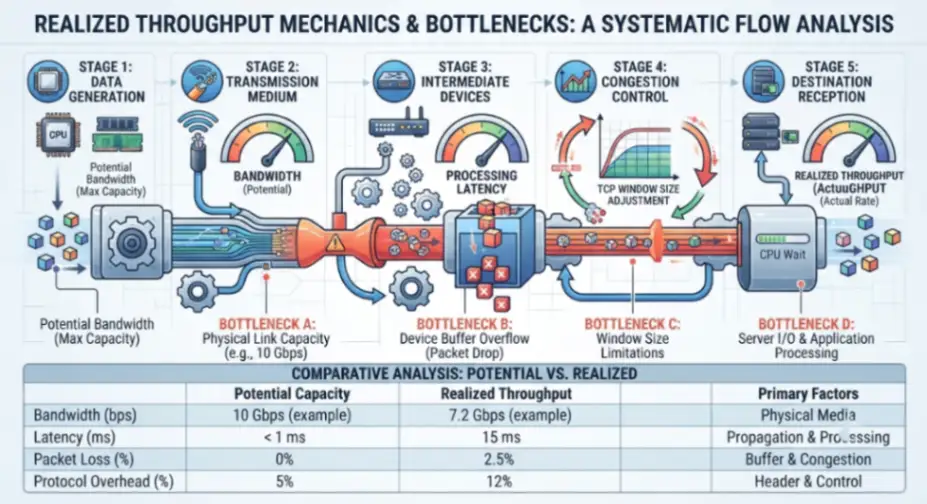
Throughput reflects the actual volume of payload data successfully moved across the network topology under real-world operational conditions. It is dynamically reduced below maximum bandwidth by TCP window scaling limits, retransmissions, inter-frame gaps, and switch buffer congestion.
- Bandwidth Delay Product (BDP) Constraints: Dictated by $\text{BDP} = \text{Bandwidth} \times \text{RTT}$, where insufficient TCP window sizes create artificial throughput ceilings regardless of available link bandwidth.
- Protocol Overhead and Goodput Filtration: Payload delivery efficiency reduced by Layer 2 through Layer 7 encapsulation headers (Ethernet, IP, TCP/UDP, TLS) and packet retransmission overhead.
- Congestion Control Dynamics: Algorithmically constrained by TCP congestion window algorithms (e.g., BBR, CUBIC) adjusting transmission rates in response to packet loss or delay signals.
3. Architectural Engineering Strategies to Maximize Throughput
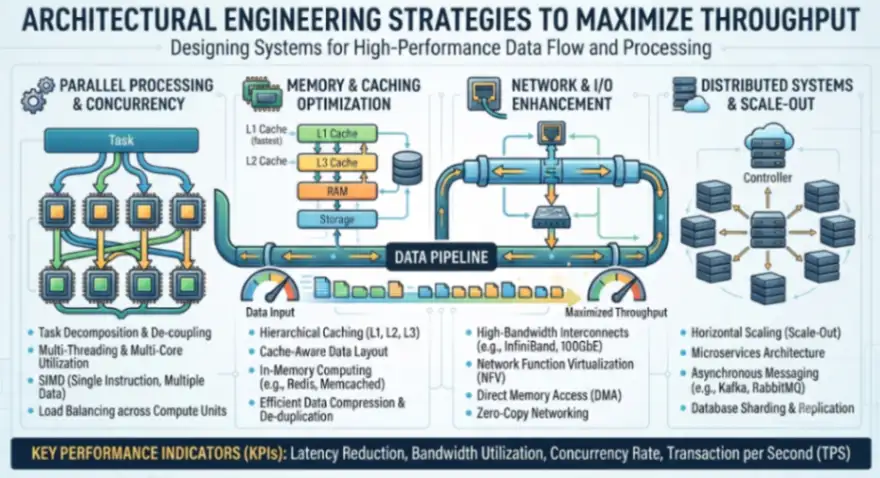
Closing the gap between allocated bandwidth and realized throughput requires targeted hardware tuning, protocol optimization, and traffic management frameworks. Enterprise architects implement systemic queue management and framing enhancements to minimize protocol overhead and buffer saturation.
- Jumbo Frame Deployment: Increasing the Maximum Transmission Unit (MTU) from 1500 to 9000 bytes to reduce CPU packet processing interrupts and lower framing overhead ratio.
- TCP Buffer and Stack Optimization: Auto-tuning kernel receive/transmit buffers and enabling TCP Selective Acknowledgment (SACK) to prevent full window collapses during localized packet drops.
- Traffic Shaping and Rate Limiting: Enforcing Token Bucket and Leaky Bucket algorithms on WAN egress interfaces to smooth out bursty traffic flows and prevent tail drop buffer saturation.
Frequently Asked Questions
Why is realized network throughput always lower than allocated link bandwidth?
Throughput is reduced below physical bandwidth capacity due to protocol encapsulation overheads (L2–L7 headers), TCP acknowledgment round-trips, packet retransmissions, switch buffer queuing delays, and network hardware processing limitations.
What is the difference between throughput and goodput?
Throughput measures the total volume of data transmitted over the link including protocol headers and retransmitted packets, whereas goodput strictly measures the useful application-layer payload data delivered without overhead or duplicates.
How does Bandwidth Delay Product (BDP) impact enterprise network performance?
BDP defines the amount of data "in flight" required to fully saturate a network path; if TCP window sizes are configured smaller than the link's BDP, maximum throughput cannot be achieved despite having excess bandwidth available.
Advertisement