10 Best Business Intelligence Software Tools for Data-Driven Companies (2026)
Advertisement
10 Best Business Intelligence Software Tools for Data-Driven Companies (2026)
Business Intelligence (BI) software is a category of application software designed to retrieve, analyze, transform, and report data for business intelligence purposes. In 2026, the BI market has shifted from static reporting to Agentic Analytics, where platforms don't just visualize historical data but use autonomous AI agents to suggest "next-best actions" in real-time. Modern BI tools act as the central nervous system of a data-driven company, integrating disparate data silos into a unified "Single Source of Truth." According to IBM, BI platforms help organizations transform raw data into actionable insights that guide strategic decisions.
Quick Navigation: Selecting Your 2026 BI Stack
- The Top 10 BI Platforms of 2026
- Comparison Table: Features and Pricing
- Key Trends: The Rise of Agentic BI
- How to Choose the Right Tool
- BI Software FAQs
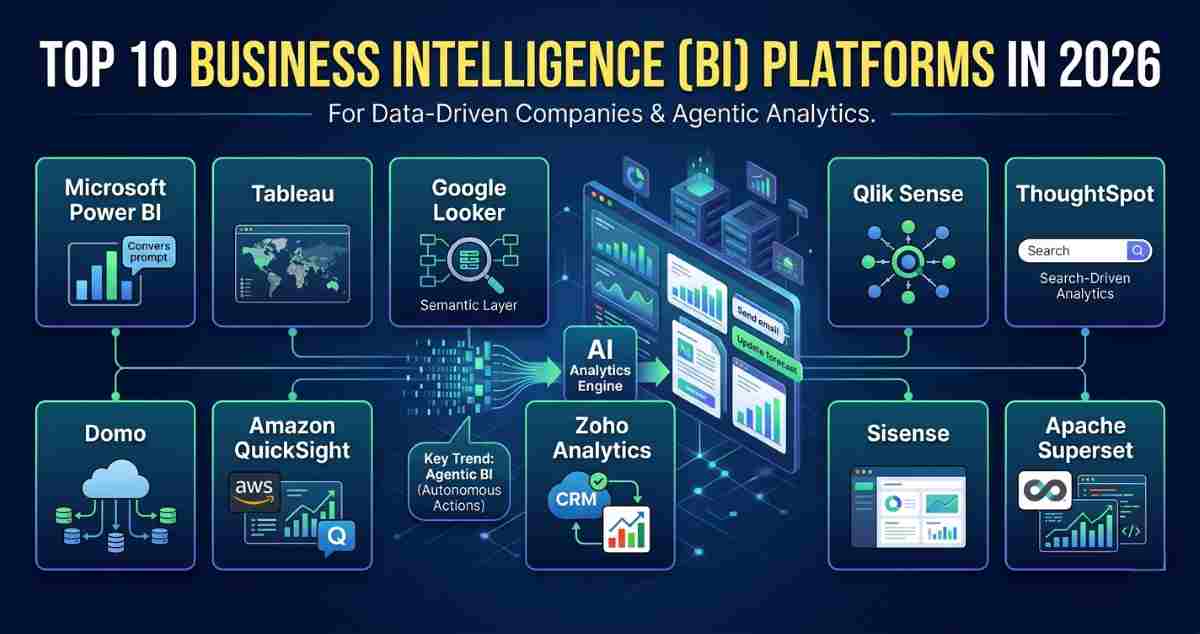
The Top 10 BI Platforms of 2026
The following list represents the market leaders based on the 2025 Gartner Magic Quadrant for Analytics and Business Intelligence Platforms and current 2026 adoption rates.
- Microsoft Power BI: The dominant leader for companies within the Microsoft 365 ecosystem. In 2026, its "Copilot in Fabric" feature allows users to build entire data models and dashboards via conversational prompts. Learn more at the official Microsoft Power BI platform.
- Tableau (Salesforce): Still the gold standard for high-end data storytelling and visualization. Its new Tableau Pulse feature uses AI to push proactive KPI alerts directly to Slack and Teams. Details available on the Tableau official website.
- Google Looker: Best for companies requiring a strong Semantic Layer. Looker ensures that "Revenue" is defined identically across every department, preventing data discrepancies.
- Qlik Sense: Famous for its Associative Engine, which allows users to explore data relationships that traditional SQL-based tools might miss.
- ThoughtSpot: A leader in "Search-Driven Analytics." It is designed for non-technical users who want to query billions of rows of data as easily as using a search engine.
- Domo: A cloud-native platform that excels in Data Integration. With over 1,000 pre-built connectors, it is the fastest way to unify data from marketing, finance, and operations.
- Amazon QuickSight: The go-to choice for AWS-heavy organizations. It offers "Amazon Q," a generative AI assistant that simplifies dashboard creation and complex calculations.
- Zoho Analytics: Highly popular among SMBs for its affordability and deep integration with the Zoho CRM suite.
- Sisense: Specializes in Embedded Analytics, allowing SaaS companies to build white-labeled dashboards directly into their own customer-facing products.
- Apache Superset (Open Source): The top choice for tech-forward companies that want a powerful, SQL-native visualization tool without vendor lock-in or high licensing fees.
Comparison Table: Features and Pricing
| Tool | Best For | Key 2026 Feature | Starting Price (Approx.) |
|---|---|---|---|
| Power BI | Microsoft Ecosystem | Microsoft Fabric Integration | $14/user/month |
| Tableau | Visual Storytelling | Tableau Pulse (Proactive AI) | $75/user/month |
| Looker | Data Governance | LookML Semantic Layer | Custom / GCP Credits |
| ThoughtSpot | Self-Service Search | Agentic "Spotter" AI | Usage-based |
| Zoho Analytics | SMBs / Affordability | Ask Zia (NLQ Assistant) | ~$30/month (Basic) |
Key Trends: The Rise of Agentic BI
According to Gartner, the defining trend of 2026 is the transition from Passive BI to Agentic BI.
- Multistep Reasoning: Instead of just showing a chart of declining sales, AI agents in tools like Power BI and Qlik can now investigate why (e.g., cross-referencing weather patterns with shipping delays) and draft a summary email for the regional manager.
- Conversational Interfaces: The "Drag-and-Drop" era is being replaced by "Ask and Receive." Users now interact with their data through natural language interfaces (NLQ), reducing the need for specialized SQL knowledge.
How to Choose the Right Tool
Selecting a BI tool is a long-term strategic decision. Consider these three criteria:
1. Ecosystem Alignment
If your data lives in BigQuery, Looker is the natural choice. If you are a Salesforce powerhouse, Tableau’s native integration will save hundreds of engineering hours.
2. User Skill Level
Do you have a team of Data Scientists or Business Managers? Tools like Apache Superset require SQL expertise, whereas ThoughtSpot or Zoho Analytics are built for the average "Data Citizen."
3. Latency Requirements
For real-time supply chain monitoring, you need a tool optimized for Live Querying (like Looker or Domo). If you only need end-of-day reports, "In-Memory" tools like Tableau or Power BI are sufficient.
As noted by IBM, the most successful implementations are those that prioritize Data Literacy training alongside the software rollout. No tool can drive ROI if the staff doesn't know how to interpret the charts.
BI Software FAQs
Is Excel still considered a BI tool?
Yes. For many small businesses, Excel remains the primary tool for data modeling. However, it lacks the scalability, security, and real-time collaboration features of modern platforms like Power BI or Tableau.
What is the "Semantic Layer" and why do I need it?
The Semantic Layer is a mapping of your complex data into business terms. It ensures that when two different people look at "Profit," they are seeing the same calculated figure. Looker and Power BI (via Fabric) are currently the leaders in this space.
Are these tools secure enough for financial or healthcare data?
Most enterprise-grade BI tools (Power BI, SAP, Oracle) are compliant with HIPAA, GDPR, and SOC2. However, organizations often prefer On-Premise or Private Cloud deployments for maximum security.
Advertisement