10 Best Cloud ERP Systems for Small to Mid-Sized Businesses (2026)
Advertisement
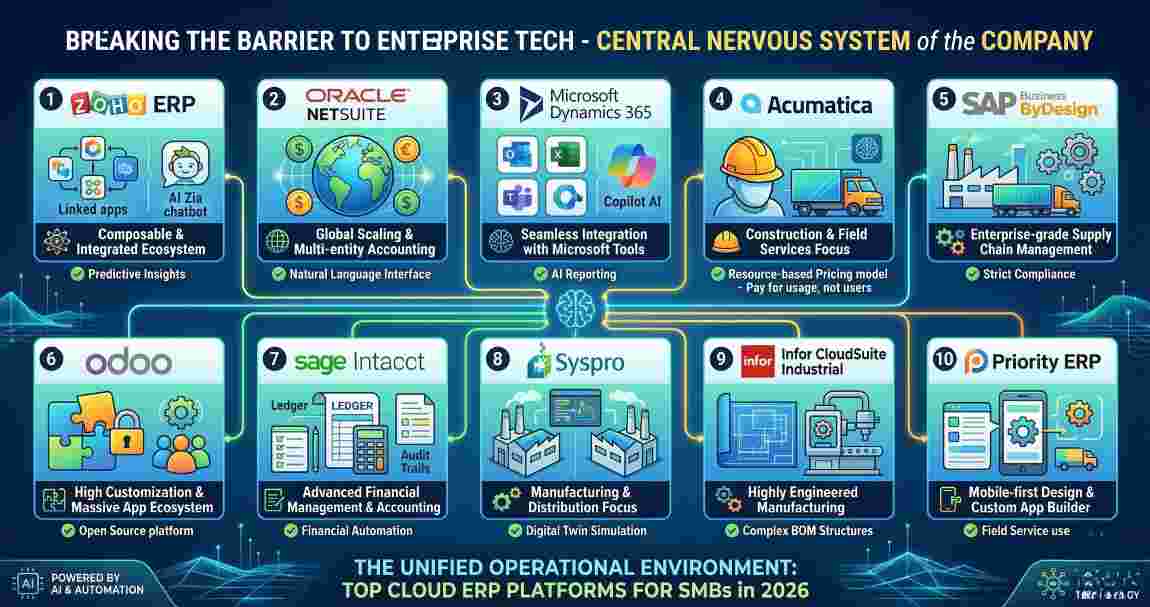
In 2026 the barrier to enterprise technology has largely disappeared. Small and mid sized businesses are no longer forced to manage fragmented systems for accounting inventory and sales. Modern cloud ERP platforms provide a unified operational environment powered by automation and artificial intelligence.
These systems function as the central nervous system of a company by connecting departments through a single data layer. Many platforms now include agentic AI capabilities that automate repetitive tasks including financial reconciliation supply chain forecasting and operational reporting.
Selecting the right ERP depends on industry requirements growth expectations and the level of technical customization a company is comfortable managing. The following platforms represent the most widely adopted cloud ERP systems for SMBs in 2026.
Top 10 Cloud ERP Rankings
1. Zoho ERP
Zoho provides a composable ERP approach through its Zoho One suite. Businesses can combine more than forty integrated applications covering CRM finance HR and project management.
The built in AI assistant Zia analyzes business metrics and generates predictive insights helping companies identify operational issues such as declining sales trends before they impact monthly targets.
2. Oracle NetSuite
Oracle NetSuite remains one of the most mature ERP platforms for rapidly growing companies. It supports complex multi entity accounting international tax compliance and multi currency operations.
Recent updates introduce natural language interfaces allowing managers to trigger operational actions using conversational prompts.
3. Microsoft Dynamics 365 Business Central
For organizations deeply invested in Microsoft productivity tools Microsoft Dynamics 365 offers seamless integration with Outlook Excel and Teams.
Its Copilot AI assistant allows users to generate financial summaries operational reports and procurement drafts directly within familiar collaboration tools.
4. Acumatica
Acumatica is particularly popular among construction and field service companies. Its resource based pricing structure means companies pay for system usage rather than individual user licenses.
This model works well for organizations with seasonal workforces or temporary field staff.
5. SAP Business ByDesign
SAP Business ByDesign brings enterprise grade supply chain and manufacturing management to mid sized businesses.
It is especially strong in global manufacturing environments that require strict compliance and complex logistics coordination.
6. Odoo
Odoo is an open source ERP platform with a massive ecosystem of community built modules. Companies can assemble custom workflows by installing specific apps that match their operational needs.
This flexibility makes it attractive for technical teams that want full customization without proprietary vendor restrictions.
7. Sage Intacct
Sage Intacct is widely known for its advanced financial management capabilities. It is commonly used by accounting heavy organizations such as professional services firms and nonprofit institutions.
Its financial automation tools provide detailed audit trails regulatory compliance support and advanced reporting capabilities.
8. Syspro
Syspro focuses specifically on manufacturing and distribution industries. Its latest releases include digital twin simulation features that allow companies to test production adjustments virtually before implementing them on the factory floor.
9. Infor CloudSuite Industrial
Infor CloudSuite Industrial is designed for highly engineered manufacturing environments.
It handles complex bill of materials structures and engineering workflows required for make to order production models.
10. Priority ERP
Priority ERP is gaining attention due to its mobile first design philosophy.
Its application generator enables non technical employees to create custom ERP mobile apps for warehouse staff delivery teams or field service workers.
Comparison Table: Which Cloud ERP Fits You
| ERP System | Key Strength | Ideal Business Size | Pricing Model |
|---|---|---|---|
| Zoho One | Flexibility and integrated ecosystem | 10 to 500 employees | Per user subscription |
| Oracle NetSuite | Global scaling capabilities | 50 to 5000 employees | Enterprise subscription |
| Acumatica | Construction and service industries | 20 to 1000 employees | Resource based pricing |
| Odoo | High customization and open ecosystem | 5 to 500 employees | App based pricing |
Cloud ERP FAQs
Is Cloud ERP safer than on premise systems?
Modern cloud infrastructure providers such as Amazon Web Services, Microsoft Azure, and Google Cloud invest heavily in cybersecurity infrastructure including encryption intrusion detection and threat monitoring. For most small and mid sized businesses this level of protection exceeds what could realistically be maintained internally.
What is the most common failure point during ERP implementation?
Data quality is the primary risk factor. Migrating inconsistent or outdated information from spreadsheets into a centralized ERP database can cause operational errors. Organizations should clean and standardize their data before migration begins.
Do businesses need a full time IT administrator to manage a cloud ERP?
Generally no. Cloud native ERP platforms handle infrastructure updates security patches and system maintenance automatically. Instead of server administrators companies typically assign a business process owner who manages workflows and system configuration.
Advertisement