Architectural Breakdown: 10 Enterprise PCI DSS Compliance Software Platforms
Advertisement
Architectural Breakdown: 10 Enterprise PCI DSS Compliance Software Platforms
Securing payment infrastructure against credential harvesting, exfiltration, and unauthorized privilege escalation requires real-time telemetry processing across all payment-processing endpoints. As established by the National Institute of Standards and Technology (NIST), integrating continuous security monitoring and zero-trust verification mechanisms is vital for maintaining audit-ready operational resilience. Below is an architectural analysis of 10 enterprise PCI DSS compliance software solutions designed for high-throughput payment networks and hybrid infrastructure.
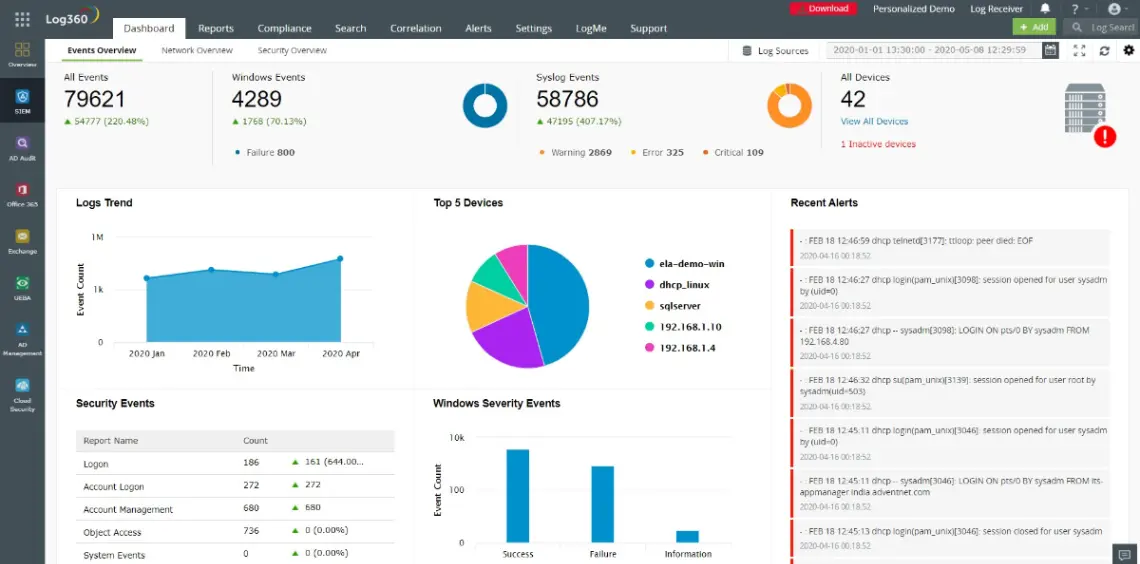
1. ManageEngine Log360
ManageEngine Log360 delivers an integrated SIEM and log auditing engine specifically built to satisfy PCI DSS Requirements 10 and 11. The platform centralizes, normalizes, and correlates log data across domain controllers, databases, firewalls, and cloud payment services in real time.
- SIEM Telemetry Ingestion: Ingests heterogeneous network events, Syslog, and cloud audit logs to establish immutable audit trails across the CDE.
- File Integrity Monitoring (FIM): Sub-second detection of file state changes, permission escalations, and unauthorized binary modifications on payment servers.
- Deployment Architecture: On-premises Windows Server deployment featuring agentless log collection and native webhooks for SIEM alert integration.
2. ManageEngine EventLog Analyzer
ManageEngine EventLog Analyzer focuses on high-performance event log correlation, custom audit trail generation, and automated compliance reporting. It helps organizations fulfill PCI DSS log retention rules by collecting and archiving system events across enterprise payment switches and servers.
- Out-of-the-Box PCI Reports: Pre-built reporting dashboards mapping log activity directly to PCI DSS 4.0 technical requirement clauses.
- Log Archiving & Encryption: Automated cryptographic hashing (SHA-256) and log archiving pipelines to preserve evidence integrity for QSA audits.
- Deployment & API Footprint: Cross-platform support (Windows/Linux) with RESTful export endpoints for SOC dashboard consolidation.
3. Site24x7
Site24x7 offers a cloud-native monitoring platform that continuously tracks server performance, network uptime, and system configurations across cloud payment environments. It ensures multi-cloud infrastructure hosting payment applications remains compliant with CIS benchmarks and PCI DSS standards.
- Continuous Configuration Auditing: Scans cloud instances (AWS, Azure, GCP) and container environments to detect configuration drift in cardholder systems.
- SaaS Log Management: High-throughput cloud log pipeline capable of indexing millions of payment access logs without infrastructure management.
- Deployment Model: Site24x7 operates as a cloud-native SaaS platform utilizing lightweight server monitoring agents and cloud provider native API connectors.
4. Netwrix Auditor
Netwrix Auditor gives security teams full visibility into user behavior and system changes acrossActive Directory, database clusters, and file systems containing sensitive cardholder data. Its risk assessment engine pinpoints over-privileged accounts and risky access policies that threaten CDE isolation.
- Automated Risk Scoring: Dynamically calculates enterprise exposure levels based on excessive permissions, inactive accounts, and open shares in the CDE.
- Ransomware & Exfiltration Alerts: Pattern-matching algorithms designed to flag mass file alterations or unauthorized database dumps.
- Integrations Scope: Native connectors for Microsoft 365, Active Directory, SQL Server, Oracle DB, and VMware vSphere environments.
5. SolarWinds Security Event Manager
SolarWinds Security Event Manager (SEM) provides real-time log normalization, active threat response, and automated compliance auditing. By processing events in-memory, SEM detects malicious access attempts against payment networks immediately upon occurrence.
- In-Memory Event Correlation: Analyzes raw logs at high throughput to trigger instantaneous automated defenses before data exfiltration occurs.
- Automated Active Responses: Executes programmatic actions like blocking network ports, detaching USB storage, or disabling compromised AD accounts.
- Pre-Built PCI Templates: Out-of-the-box compliance reports mapping network access control and account management logs to PCI DSS mandates.
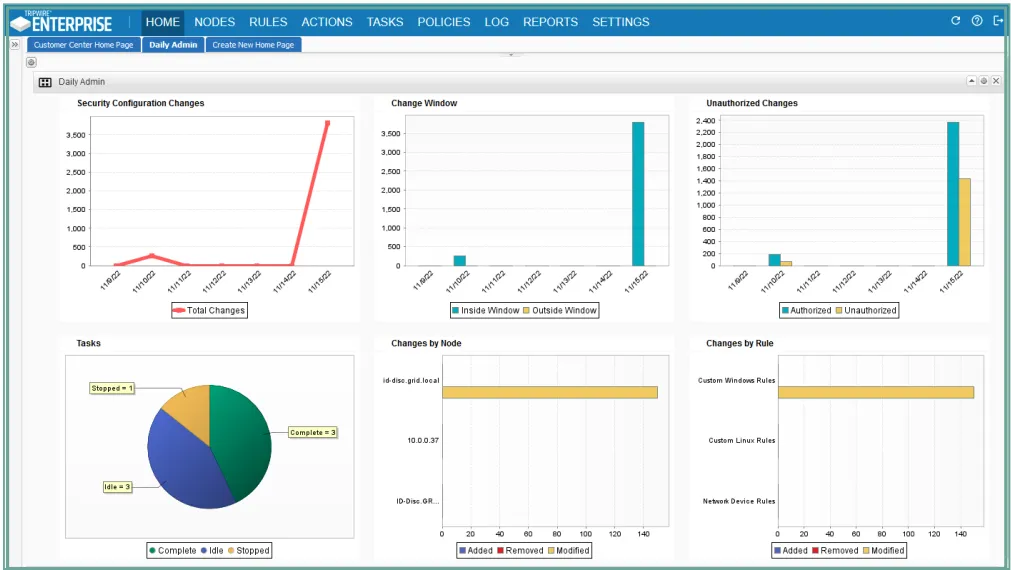
6. Tripwire Enterprise
Tripwire Enterprise is an enterprise File Integrity Monitoring (FIM) and Security Configuration Management (SCM) tool engineered for rigorous PCI DSS controls. It serves as a benchmark for verifying file changes and maintaining baseline system configurations across critical payment assets.
- Advanced FIM Engine: Deep inspection capabilities that analyze file hashes, metadata, and content changes to satisfy PCI DSS Requirement 11.5.
- Automated Policy Remediation: Real-time detection of misconfigurations relative to PCI DSS baselines with step-by-step guidance for system hardening.
- Enterprise Deployment: Agent-based architecture supporting Windows, Linux, UNIX, network devices, and virtualized assets.
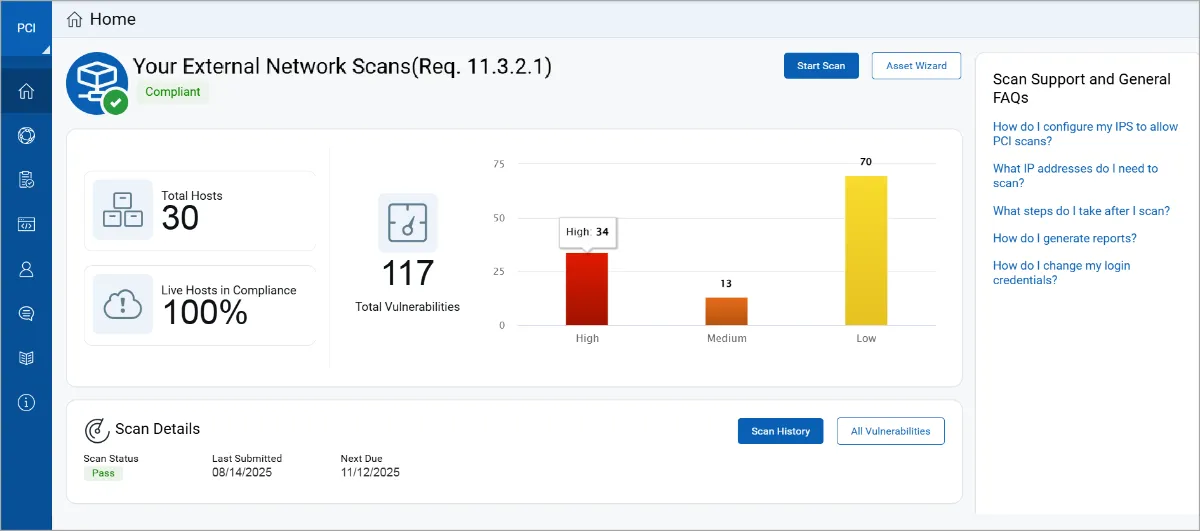
7. Qualys PCI Compliance
Qualys PCI Compliance is a cloud-based vulnerability management and ASV (Approved Scanning Vendor) scanning solution designed for automated perimeter validation. It streamlines self-assessment questionnaires (SAQs) and automates network vulnerability testing required for Level 1-4 merchants.
- Certified ASV Scanning Engine: Automated external and internal network scans verified against official PCI Security Standards Council criteria.
- SAQ Workflow Engine: Interactive guidance that automatically maps scan results to relevant SAQ sections for rapid evidence generation.
- Cloud Platform Scale: Completely agentless perimeter discovery combined with lightweight cloud agents for internal CDE monitoring.
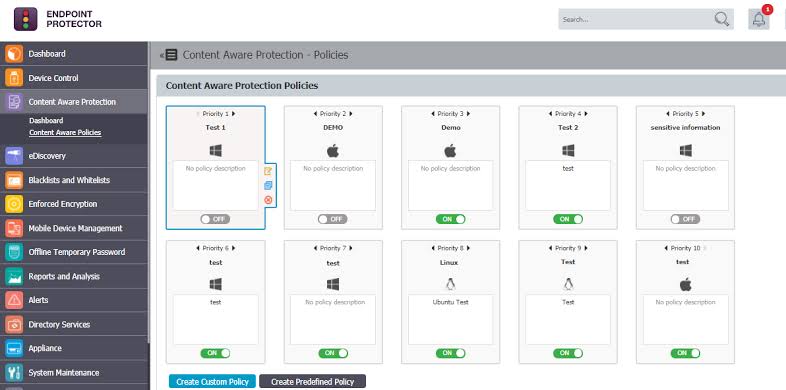
8. CoSoSys Endpoint Protector
CoSoSys Endpoint Protector delivers Data Loss Prevention (DLP) across heterogeneous operating systems to prevent credit card numbers (PAN) from exiting enterprise networks. It monitors and blocks sensitive data transfers across removable storage, email channels, and web applications.
- Content-Aware Inspection: Regex and contextual scanning algorithms tailored to detect Primary Account Numbers (PAN) and CVV codes in transit.
- Enforced Device Encryption: Automatically encrypts data transferred to USB storage devices to maintain data protection outside the CDE boundary.
- Deployment Options: Available as an on-premises virtual appliance, cloud-hosted instance, or standalone software client for Windows, macOS, and Linux.
9. Lepide Data Security Platform
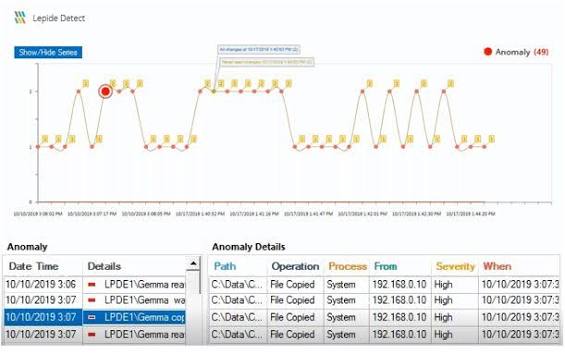
Lepide Data Security Platform provides data security posture management (DSPM) and automated cardholder data discovery across cloud storage and file servers. It tracks access rights, detects anomalous data access, and provides detailed visibility into PAN storage location.
- PCI Data Discovery Engine: Scans unstructured storage, Office 365, and databases to locate unencrypted cardholder data across the organization.
- ML-Driven Anomaly Detection: Machine learning baselines user behaviors to flag unusual data downloads or modification spikes.
- Audit Trail Reporting: Generates automated compliance reports verifying that cardholder data access is restricted on a strict need-to-know basis.
10. AuditBoard
AuditBoard is a cloud GRC solution that unifies PCI DSS compliance management with broader enterprise security frameworks. It eliminates manual evidence collection by aggregating control testing, policy acknowledgments, and risk assessments into a single platform.
- Common Control Framework (CCF): Enables teams to test technical security controls once and map results across PCI DSS, SOC 2, and ISO 27001.
- Automated Evidence Collector: API integrations that automatically capture system evidence from security platforms to streamline QSA audits.
- Bi-Directional API Sync: Seamless connection with Jira, ServiceNow, and Okta for automated ticketing and identity access reviews.
Frequently Asked Questions
What is the technical definition of the Cardholder Data Environment (CDE)?
The Cardholder Data Environment (CDE) comprises the people, processes, and technologies that store, process, or transmit cardholder data (CHD) or sensitive authentication data (SAD). It also includes any connected system components that could impact the security of the CDE if compromised.
Why is File Integrity Monitoring (FIM) mandatory for PCI DSS compliance?
PCI DSS Requirement 11.5 mandates FIM to ensure that critical system files, configuration files, and application binaries within the CDE are monitored for unauthorized changes. FIM alerts security teams when critical binaries are modified, helping detect rootkits, malware, and unauthorized admin changes.
How do automated PCI DSS tools simplify external QSA audits?
Automated PCI DSS software connects directly to enterprise infrastructure via APIs or agents to continuously collect log data, system configurations, and patch levels. By storing this evidence in cryptographically verified audit trails, QSA auditors can review automated proof of control operational effectiveness without requiring manual screenshot gathering.
Advertisement