10 Best Cloud Monitoring Tools & Software (2026)
Advertisement
10 Best Cloud Monitoring Tools for Multi-Cloud Environments
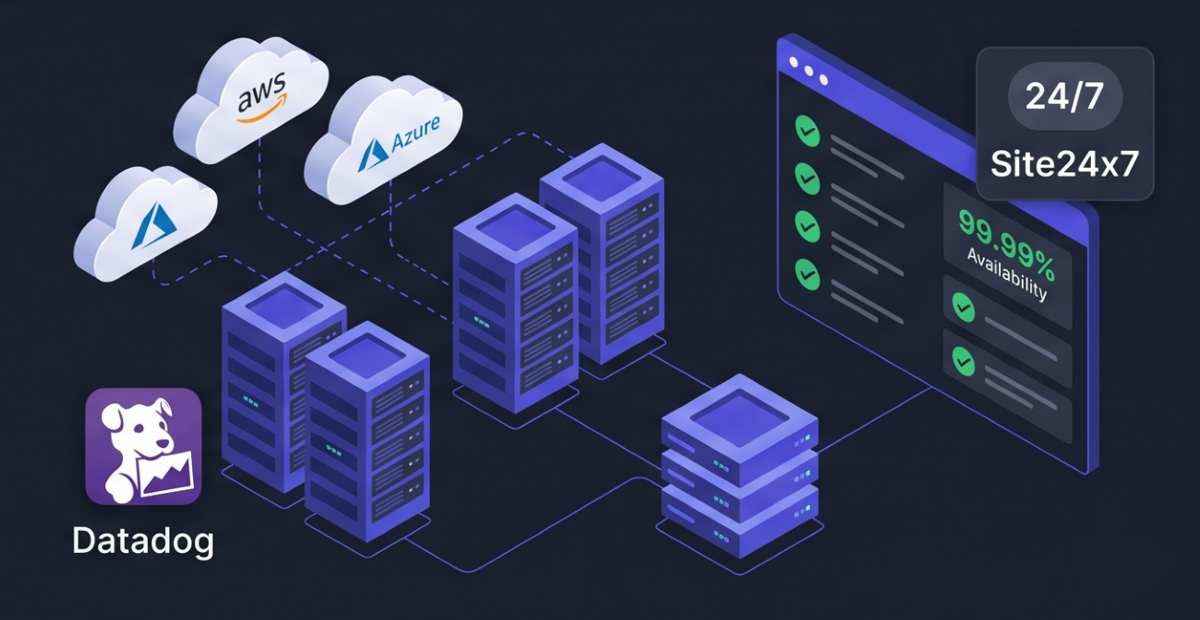
The right cloud monitoring software doesn't just collect data—it reduces noise, leverages AI to catch anomalies, and automatically maps dependencies across hybrid environments. We have evaluated the market's leading observability platforms based on scalability, alert intelligence, and real-world usability. Here are the top ten cloud monitoring tools designed to keep your infrastructure resilient and cost-effective.
1. Site24x7
Site24x7 provides a unified, highly intuitive platform for tracking AWS, Azure, and GCP resources alongside on-premise infrastructure. It is heavily favored by IT teams looking for out-of-the-box functionality without spending weeks on configuration.
- AI-Based Anomaly Detection: Learns your cloud's historical baselines to alert you only when genuine, unexpected spikes in CPU or network traffic occur.
- IT Automation: Capable of automatically executing remediating actions, such as restarting an EC2 instance if a specific performance threshold is breached.
- Multi-Cloud Dashboards: Consolidates billing and performance metrics from different cloud providers into a single, cohesive view.
2. LogicMonitor
LogicMonitor is a SaaS-based infrastructure performance monitoring platform that excels in complex hybrid environments. It is completely agentless, making deployment across massive enterprise networks incredibly fast.
- Auto-Device Discovery: Instantly detects and begins monitoring new cloud instances and network switches the moment they spin up.
- Built-in Integrations: Features over 2,000 pre-configured logic modules to seamlessly ingest data from virtually any cloud service or hardware appliance.
- External Reference: Explore their platform at LogicMonitor.
3. Datadog
Datadog is the undisputed king of cloud-native observability. It is built specifically to handle the sheer volume of telemetry data generated by modern microservices, Docker containers, and Kubernetes clusters.
- Infrastructure Metrics: Offers real-time, high-cardinality data visualization for every single node in your cloud architecture.
- Seamless Log Correlation: Allows engineers to pivot instantly from a spike in cloud CPU directly to the specific application log that caused it.
- Cloud Security Posture: Actively monitors your cloud environment for misconfigurations and compliance violations.
4. Dynatrace
Dynatrace redefined cloud monitoring by placing its powerful AI engine, Davis, at the core of its platform. It requires zero manual configuration, automatically mapping billion-node environments in real time.
- Deterministic AI: Analyzes billions of dependencies instantly to provide the exact root cause of a cloud failure, rather than just throwing a barrage of alerts.
- OneAgent: A single, universal agent that automatically instruments all cloud instances, applications, and processes upon installation.
- External Reference: Learn more at Dynatrace.
5. SolarWinds AppOptics
AppOptics provides an incredibly streamlined approach to cloud infrastructure and application performance monitoring. It cuts through the bloat to deliver clean, actionable metrics tailored for SaaS operators.
- Custom Metrics Collection: Easily ingests highly specific, custom business metrics via a lightweight API to monitor unique application logic.
- Distributed Tracing: Follows requests as they bounce between different cloud regions and microservices to locate latency bottlenecks.
- Host & Container Focus: Provides dedicated visualization maps for Docker and Kubernetes environments.
6. Paessler PRTG
Paessler’s PRTG takes a unique, sensor-based approach to monitoring. It bridges the gap between legacy on-premise hardware (like routers and switches) and modern cloud deployments perfectly.
- Sensor-Based Licensing: You only pay for the specific sensors (metrics) you monitor, allowing for highly cost-effective scaling.
- Predefined Cloud Sensors: Includes ready-to-use sensors for Amazon CloudWatch and Microsoft Azure to pull data directly from cloud APIs.
- Visual Network Maps: Allows IT administrators to build drag-and-drop topographical maps of their entire hybrid network.
7. AppDynamics
AppDynamics, backed by Cisco, targets massive enterprise architectures. It connects the raw health of your cloud infrastructure directly to the financial performance of your digital business.
- Business Journeys: Maps out how cloud latency specifically impacts user checkout funnels and overall revenue generation.
- Dynamic Baselining: Learns the daily and weekly rhythms of your cloud workloads to intelligently adjust alert sensitivities.
- Cloud Migration Tracking: Provides comparative data to prove that moving a legacy application to the cloud actually improved its performance.
8. New Relic
New Relic offers a powerful, data-first observability platform. It allows engineers to query all their cloud telemetry data using a flexible, SQL-like language (NRQL) for total transparency.
- Telemetry Data Platform: Ingests metrics, events, logs, and traces from any cloud provider into a single, unified database.
- Custom Dashboards: Empowers teams to build highly customized, interactive charts that monitor specific cloud instances and containers.
- Kubernetes Cluster Explorer: Provides a brilliant visual representation of pod health within complex Kubernetes clusters.
9. Zabbix
For organizations prioritizing open-source solutions and complete data ownership, Zabbix is a heavyweight contender. It is infinitely scalable and completely free, though it requires significant technical expertise to manage.
- Unlimited Scalability: Capable of monitoring tens of thousands of cloud instances simultaneously without licensing restrictions.
- Predictive Trend Analysis: Uses historical data to predict when cloud storage will run out or when bandwidth caps will be hit.
- Agent & Agentless Operations: Offers maximum flexibility by supporting deep agent-based polling and lightweight API integrations.
10. ManageEngine Applications Manager
ManageEngine excels at providing deep, component-level visibility. It is an excellent tool for organizations that need to tightly monitor the applications running *on top* of their cloud infrastructure.
- Cloud Database Monitoring: Provides exceptional query-level tracking for managed cloud databases like Amazon RDS and Azure SQL.
- Virtualization Metrics: Deeply integrates with VMware and Hyper-V for organizations running private clouds.
- Threshold Profiles: Allows administrators to set highly granular, multi-condition alerts to prevent alert fatigue.
FAQs
What is the difference between Cloud Monitoring and APM?
Cloud monitoring focuses on the underlying infrastructure—such as CPU usage, network bandwidth, container health, and cloud billing constraints. Application Performance Monitoring (APM) focuses on the software running on that infrastructure, tracking things like code execution speeds and database query efficiency.
Why can't I just use AWS CloudWatch or Azure Monitor?
Native tools like CloudWatch are excellent, but they are siloed. If your company uses a multi-cloud strategy (e.g., hosting databases on AWS but running AI workloads on Google Cloud), relying on native tools creates massive blind spots. Third-party cloud monitors centralize all data into a single, unified dashboard.
How do these tools prevent 'Alert Fatigue'?
Modern tools use machine learning to establish dynamic baselines. Instead of triggering an alert every time CPU hits 80% (which might be normal during a morning rush), AI tools only trigger alerts when the behavior deviates from the historical norm, drastically reducing false positives.
Advertisement