Top Event Log Analysis Software & Enterprise Log Management Tools
Advertisement
Top Event Log Analysis Software & Enterprise Log Management Tools
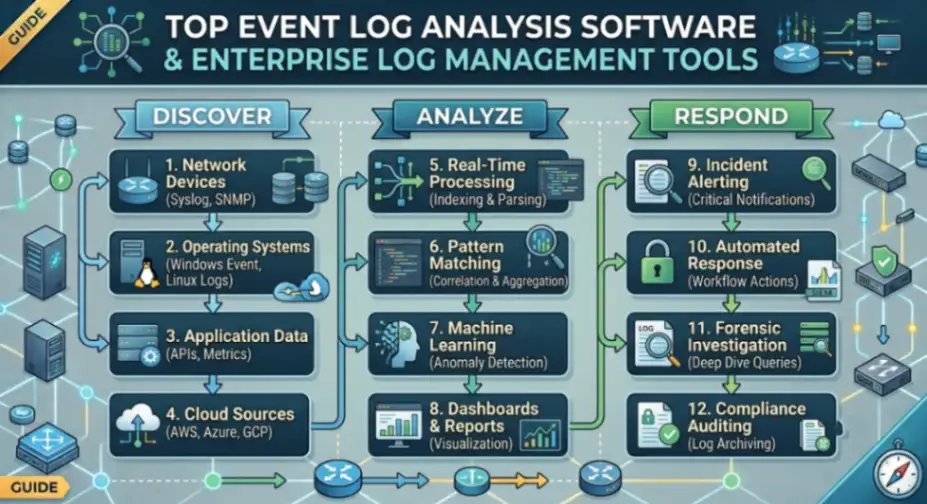
In complex infrastructure deployments, aggregating syslog streams, Windows Event Logs (EVTX), and cloud provider audit trails is critical for establishing end-to-end security visibility and satisfying regulatory compliance frameworks like PCI-DSS and HIPAA. Enterprise log architectures must process tens of thousands of events per second (EPS) without introducing pipeline latency, adhering to standards defined by NIST guidelines like NIST SP 800-92 Computer Security Log Management. Selecting an enterprise log management platform involves evaluating ingestion protocols, real-time threat detection algorithms, dynamic indexing engines, and long-term compliance archiving capabilities.
1. ManageEngine EventLog Analyzer
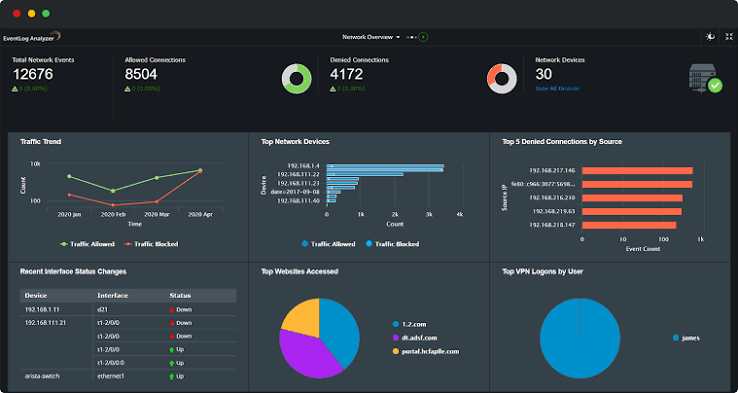
ManageEngine EventLog Analyzer is a centralized log management and auditing platform engineered to process high-throughput syslog and Windows Event Log streams across heterogeneous networks. It normalizes unstructured event data into structured formats to simplify security monitoring, threat detection, and automated compliance reporting.
- Log Ingestion & Parsing: Supports agentless and agent-based collection across 700+ network devices, servers, and applications using Syslog, HTTPS, WMI, and FTP protocols.
- Integrity & Cryptography: Implements time-stamping and cryptographic hashing (SHA-256) on archived log files to guarantee tamper-proof audit trails for regulatory compliance.
- Deployment & Editions: Distributed as on-premises installations for Windows Server and Linux, offering Free (up to 5 sources), Premium, and Distributed enterprise editions.
2. ManageEngine Log360
ManageEngine Log360 is a comprehensive SIEM and User and Entity Behavior Analytics (UEBA) platform designed for deep security visibility across hybrid infrastructures. It aggregates log telemetry across network perimeters, active directories, and enterprise endpoints to detect advanced persistent threats in real time.
- Behavioral Analytics Engine: Leverages ML-driven UEBA models to establish baseline user behaviors, flag anomalous access patterns, and calculate real-time threat scores.
- Threat Intelligence Integration: Correlates internal system event logs with global threat feeds (STIX/TAXII) to identify malicious IP connections and known botnet communications.
- Deployment Model: Native on-premises deployment supporting distributed architecture models with centralized log processing consoles.
3. Site24x7 Log Management
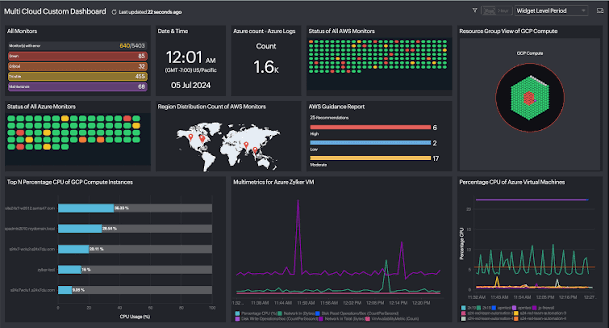
Site24x7 offers cloud-native log management integrated into its broader infrastructure and application performance monitoring ecosystem. It aggregates and indexes log data from distributed servers, containerized workloads, and cloud platforms for fast troubleshooting and full-stack observability.
- Log Parsing & Discovery: Auto-discovers application log formats and applies custom pattern-matching rules to extract key-value pairs from unorganized log files.
- Cloud-Native Telemetry Integration: Natively processes log outputs from Kubernetes clusters, Docker environments, and public cloud providers like AWS CloudWatch and Azure Monitor.
- Delivery Architecture: Delivered as a cloud-based SaaS model with lightweight agent execution across Windows, Linux, and FreeBSD servers.
4. Datadog Log Management
Datadog Log Management provides a decoupled indexing and ingestion framework capable of handling massive telemetry loads across microservices and cloud infrastructures. It allows engineering teams to ingest 100% of their log streams, route them dynamically, and index only high-value events to optimize storage costs.
- FlexLogs Architecture: Decouples log ingestion from indexing, enabling cost-effective long-term retention and re-indexing via Datadog live archive queries.
- Pipeline Processing: Features custom processing pipelines that perform automated JSON parsing, field extraction, obfuscation of PII data, and metric conversion at the edge.
- Deployment & API Integrations: Fully managed SaaS platform utilizing open-source Vector agents, Fluentbit integration, and RESTful APIs for log ingestion and export.
5. SolarWinds Security Event Manager (SEM)
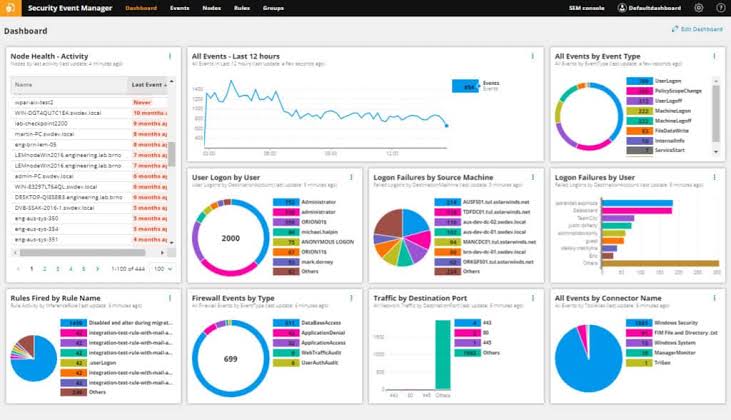
SolarWinds Security Event Manager is a hardened virtual appliance built for active threat detection, automated response, and real-time security log correlation. It processes log streams in-memory to detect malicious activity instantaneously without waiting for database indexing routines.
- In-Memory Correlation Engine: Evaluates thousands of log events per second against pre-built rule sets in-memory to identify multi-vector attacks in real time.
- Automated Active Response: Triggers immediate defensive actions upon threat detection, including disabling user accounts, blocking IP addresses, and terminating compromised processes.
- Deployment Formats: Deployed as a pre-packaged virtual appliance for VMware vSphere and Microsoft Hyper-V with built-in encrypted storage.
6. InsightOps (Rapid7)
InsightOps by Rapid7 combines centralized cloud log management with advanced endpoint visibility and IT operational analytics. It simplifies log search and normalization, allowing security and operations teams to query real-time event data using natural language and structured query paradigms.
- LEQL Query Engine: Utilizes Logentries Query Language (LEQL) for visual data aggregation, real-time field extraction, and complex regex pattern searching.
- Endpoint Telemetry Correlation: Correlates centralized system event logs with live endpoint state data via the unified Rapid7 Insight Agent.
- Deployment Architecture: Fully cloud-hosted SaaS platform featuring automated log routing, live-tail visualization, and webhook-driven alert channels.
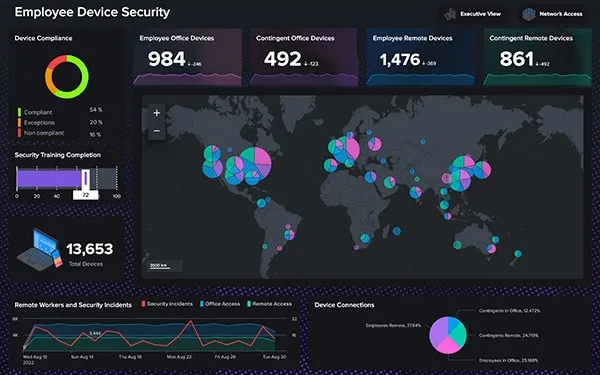
7. Splunk Enterprise & Cloud
Splunk is an industry-standard data analytics platform that ingests, indexes, and analyzes machine-generated data from virtually any source at massive scale. Its proprietary indexing technology enables schema-on-read querying, making it ideal for complex enterprise security monitoring and operational intelligence.
- SPL Engine & Schema-on-Read: Employs Search Processing Language (SPL) to evaluate unstructured log data at query time without requiring pre-defined database schemas.
- Machine Learning Toolkit (MLTK): Integrates custom ML models for anomaly detection, predictive forecasting, and outlier analysis directly within log analytics pipelines.
- Deployment Versatility: Available as on-premises software (Splunk Enterprise), managed cloud service (Splunk Cloud), or hybrid distributed deployment architectures.
8. Sematext Logs
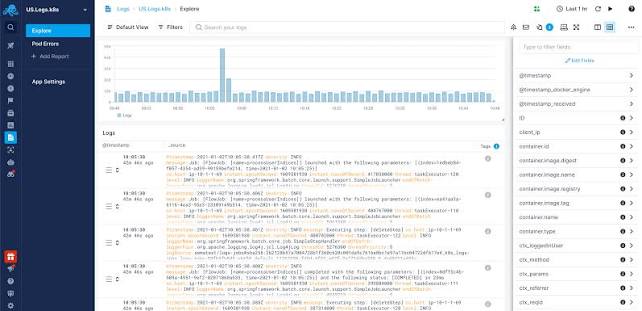
Sematext Logs provides a centralized log management and analysis solution built on an Elasticsearch-compatible architecture. Designed for DevOps and SRE teams, it delivers real-time log search, parsing, and alerting alongside native metrics monitoring within a unified dashboard interface.
- Elasticsearch Protocol Compatibility: Works seamlessly with standard ELK stack agents (Logstash, Filebeat, Vector) and offers standard RESTful API access.
- Live-Tail & Threshold Alerting: Enables live log tailing for rapid debugging and real-time threshold and anomaly alerts integrated with PagerDuty, Slack, and webhooks.
- Deployment Models: Offered as a fully managed SaaS platform or an on-premises enterprise software installation (Sematext Enterprise).
Frequently Asked Questions
How does schema-on-read differ from schema-on-write in event log analysis software?
Schema-on-write parses and structures log fields prior to storage, requiring defined database schemas and upfront processing, which can limit query flexibility. Schema-on-read stores raw, unstructured log data immediately and applies structural definitions at query execution time, allowing security analysts to write custom extraction patterns retroactively without re-indexing past events.
What ingestion protocols are commonly supported by enterprise log collectors?
Enterprise event log analysis software typically supports Syslog (over UDP/TCP/TLS), Windows Event Forwarding (WEF/WMI), SNMP traps, HTTP Event Collectors (HEC), and cloud-native API integrations (such as AWS CloudWatch Logs, Azure Event Hubs, and GCP Cloud Logging).
How do automated response mechanisms work in modern SIEM platforms?
Modern SIEM and log analysis platforms use automated orchestration engines (SOAR) or active response scripts. When incoming log streams match predefined threat rules or anomaly thresholds, the system executes real-time mitigation actions, such as revoking Active Directory session tokens, updating firewall access control lists (ACLs), or isolating infected endpoint agents.
Advertisement