Enterprise Log Management Tools: Architecture & Analysis Solutions
Advertisement
Enterprise Log Management Tools: Architecture & Analysis Solutions
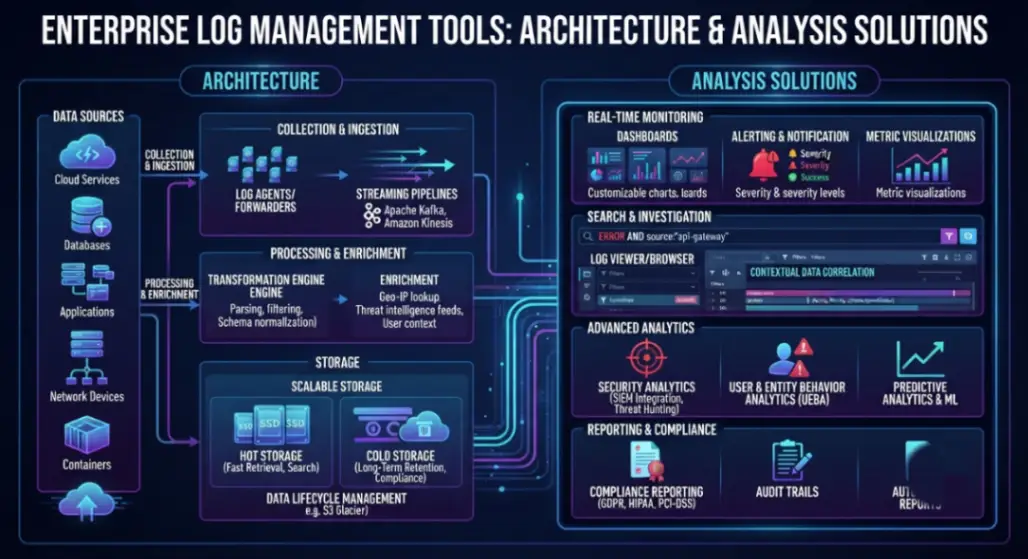
Designing scalable cloud observability pipelines requires strict adherence to standardized telemetry transmission and security controls. Frameworks established by NIST emphasize continuous audit log aggregation, encrypted transport layers (TLS 1.3), and tamper-evident retention policies for threat detection and forensic investigation. Selecting the optimal log management architecture balances real-time ingestion throughput against long-term object storage cost optimization.
1. Progress WhatsUp Gold
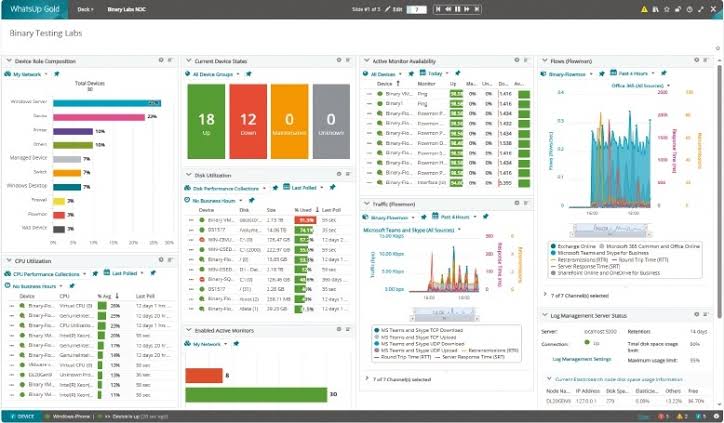
Progress WhatsUp Gold provides centralized log management integrated directly into its core infrastructure monitoring platform, collecting Windows Event Logs and Syslog streams via RPC and UDP protocols. It normalizes disparate log sources to enable real-time filtering, threshold-based alerting, and compliance reporting across hybrid networks.
- Multi-Protocol Ingestion Engine: Directly ingests Syslog over UDP/TCP and Windows Event logs via RPC/WMI without requiring heavy localized agent deployments.
- Integrated Topology Mapping: Automatically correlates log anomaly alerts with physical and virtual network dependency maps for rapid root-cause isolation.
- Compliance Archiving Pipelines: Exports structured log archives to tamper-evident storage repositories to fulfill PCI-DSS, HIPAA, and GDPR audit mandates.
2. Site24x7 Log Management
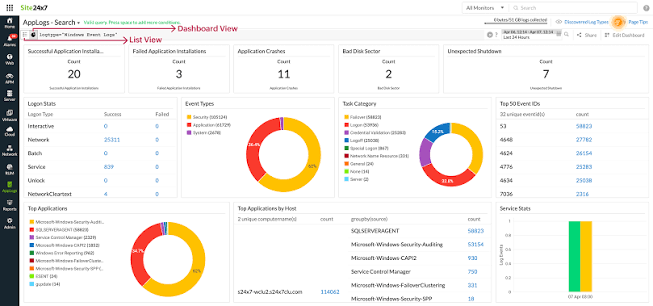
Site24x7 delivers a cloud-native log management service that ingests, parses, and indexes structured and unstructured log data across servers, cloud services, and applications. It operates an agent-based and agentless pipeline that correlates log telemetry directly with APM traces and infrastructure metrics.
- Automated Field Extraction: Features built-in parsers for over 100 log types (including NGINX, IIS, AWS CloudWatch, and Kubernetes) with custom Regex parsing rule builders.
- Hybrid Cloud Collector Architecture: Outbound HTTPS collectors forward log streams securely to Site24x7 SaaS clusters using TLS encryption without requiring inbound firewall openings.
- Cross-Signal Telemetry Correlation: Links log search results directly to APM execution traces and host performance metrics within unified operational dashboards.
3. ManageEngine EventLog Analyzer
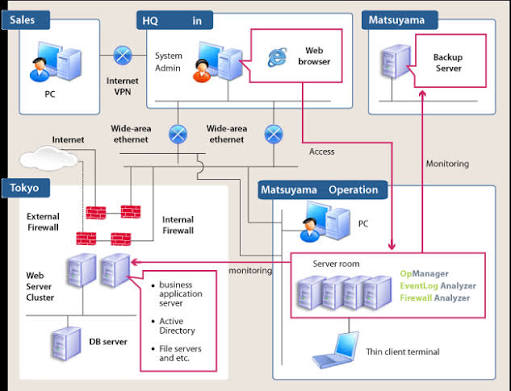
ManageEngine EventLog Analyzer operates as an enterprise Security Information and Event Management (SIEM) and log management platform designed for deep audit log analysis and forensic investigations. It collects, parses, and analyzes log streams from cross-platform endpoints, firewalls, and network switches.
- Agentless & Agent-Based Hybrid Aggregation: Utilizes WMI, Syslog, and custom agent collectors to aggregate event data from heterogeneous enterprise endpoints.
- Real-Time Correlation & Threat Intelligence: Features a built-in threat intelligence engine that cross-references log events against known malicious IPs and threat feeds.
- Out-of-the-Box Compliance Engines: Generates automated compliance audit reports for SOX, HIPAA, PCI DSS, FISMA, and ISO 27001 out of the box.
4. ManageEngine OpManager
ManageEngine OpManager unifies network performance monitoring with integrated log collection to deliver end-to-end visibility across IP-based devices and infrastructure. It standardizes system event logs and SNMP traps into a centralized database to streamline network fault detection.
- SNMP Trap & Rule Processing: Processes thousands of SNMP traps and Syslog messages per second against customizable severity and threshold rules.
- Unified Fault Telemetry Engine: Standardizes raw log data alongside interface bandwidth, CPU utilization, and packet loss metrics on a single console.
- Automated Script Triggers: Triggers automated REST API calls, SSH commands, or PowerShell scripts when log error thresholds are crossed.
5. Elastic Stack (ELK Stack)
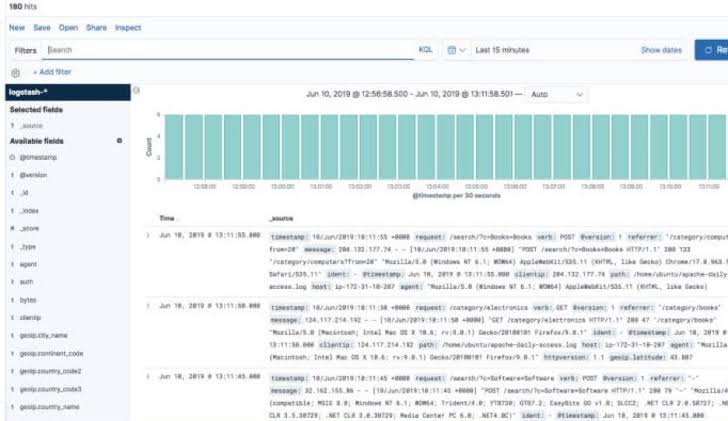
The Elastic Stack (Elasticsearch, Logstash, and Kibana) is an open-source log aggregation platform that provides full-text search, distributed indexing, and interactive data visualization. It parses raw log data using Logstash or Beats shippers before storing documents in distributed Elasticsearch indices.
- Distributed Inverted Index Engine: Built on Apache Lucene, enabling sub-second full-text searches across petabytes of JSON-formatted log documents.
- Lightweight Beats & Logstash Pipelines: Deploys dedicated edge shippers (Filebeat, Metricbeat) for low-overhead log forwarding with server-side Logstash enrichment filters.
- Index Lifecycle Management (ILM): Automates hot, warm, cold, and frozen storage tiering to optimize query performance while reducing long-term storage overhead.
6. Sematext Logs
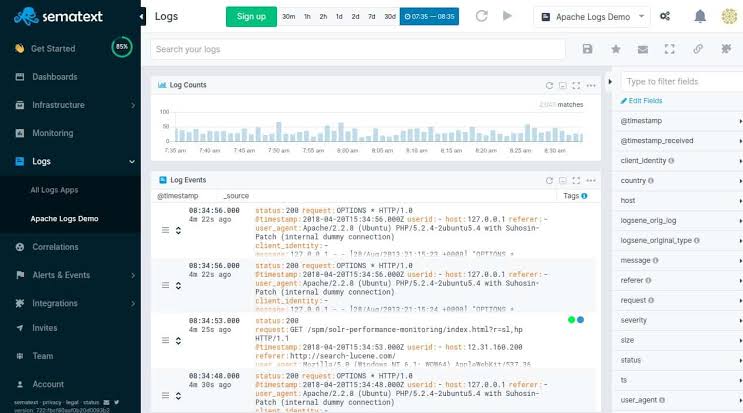
Sematext Logs is a cloud-based log management and analytics platform that offers real-time log search, anomaly detection, and correlation with infrastructure metrics. It provides Elasticsearch-compatible API endpoints, allowing seamless integration with existing logging shippers and pipelines.
- Elasticsearch API Compatibility: Serves as a drop-in cloud backend replacement for self-hosted ELK clusters without changing existing Logstash or Beats forwarders.
- Real-Time Anomaly Detection ML: Applies machine learning models to baseline log volumes and error frequencies, triggering proactive alerts on unusual spikes.
- Role-Based Field Masking: Features fine-grained data masking and encryption controls to automatically redact sensitive PII and credential data prior to indexing.
7. Splunk
Splunk is an enterprise data analytics platform that uses a schema-on-read architecture to index and query unstructured machine data at scale. Its proprietary Search Processing Language (SPL) enables security and operations teams to execute complex data transformations and statistical analysis across massive datasets.
- Schema-on-Read Ingestion Architecture: Indexes raw machine data without requiring upfront database schema definitions, allowing flexible query-time field extraction.
- Search Processing Language (SPL): Provides a robust, specialized query language for correlation, statistical analysis, and machine learning model invocation across multi-source logs.
- Splunk Universal Forwarders: Deploys lightweight, highly efficient forwarders that compress, encrypt, and buffer log data before transmission to indexer clusters.
8. Datadog Log Management
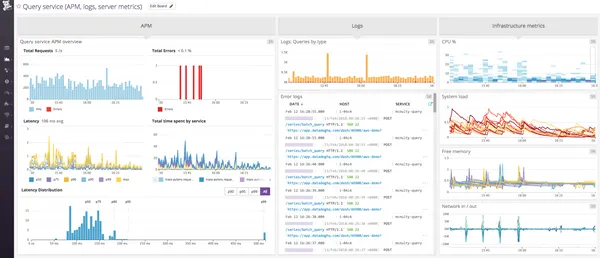
Datadog Log Management offers an enterprise SaaS observability solution that decouples log ingestion from log indexing using its Logging without Limits architecture. It processes, parses, and routes high-volume log streams into dynamic archives or hot index tiers based on user-defined retention policies.
- Logging without Limits Pipeline: Ingests 100% of raw logs for live stream parsing and routing while allowing teams to selectively index only critical log subsets.
- OpenTelemetry & Agent Integration: Ingests logs via the open-source Datadog Agent, FluentBit, or native Datadog API endpoints with automatic trace-to-log ID injection.
- Flex Logs Columnar Tiering: Leverages cloud object storage for low-cost, long-term log retention with ad-hoc querying capabilities.
9. SolarWinds Log Analyzer
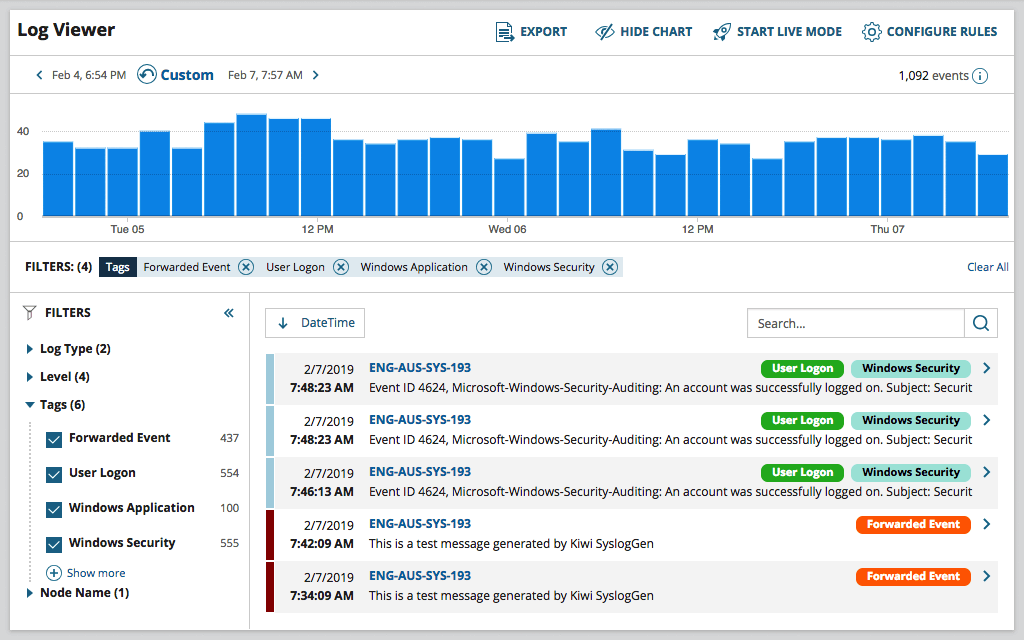
SolarWinds Log Analyzer integrates structured log management with IT infrastructure performance data, streaming real-time event logs directly into the SolarWinds Platform console. It provides fast log search, tagging, and visual log volume charts to accelerate troubleshooting.
- Real-Time Log Stream Viewer: Displays live Syslog, SNMP traps, and Windows Event logs with instant color-coded status highlighting and search filtering.
- Orion Platform Native Correlation: Automatically correlates log anomaly events with server performance metrics, virtual host health, and database performance.
- Out-of-the-Box Tagging Rules: Automatically tags incoming log events based on custom Regex matches to simplify incident categorization.
10. Graylog
Graylog is an open-source log management platform built on OpenSearch/Elasticsearch and MongoDB, designed to handle multi-gigabyte log ingestion with low operational overhead. It provides a flexible processing pipeline for transforming, enriching, and routing enterprise log streams in real time.
- Pipeline Processing Engine: Offers a programmatic rules engine to manipulate, enrich, route, or drop log messages prior to index storage.
- Fault-Tolerant Journal Architecture: Utilizes an internal disk-backed Kafka message journal on input nodes to prevent log loss during traffic spikes or backend outages.
- Granular RBAC & Audit Trail: Enforces strict role-based access control down to specific log streams, combined with comprehensive internal system audit logging.
Frequently Asked Questions
What is the architectural difference between schema-on-read and schema-on-write log management systems?
Schema-on-write systems (like standard relational databases or structured ELK pipelines) parse, format, and structure log data upon ingestion before writing to disk, which requires upfront schema management but provides fast query execution. Schema-on-read systems (like Splunk) index raw log strings directly upon ingestion and apply structure or field extraction dynamically at search time, providing maximum flexibility for unstructured logs at the cost of higher query-time compute requirements.
How do modern log management tools minimize cloud storage costs for high-volume log streams?
Modern platforms utilize multi-tier storage architectures and decoupled ingestion pipelines. They separate high-cost hot indexing tiers (in-memory or SSD-backed search nodes) from low-cost cold tiers (cloud object storage like AWS S3 or Azure Blob). Tools also employ log fingerprinting, field masking, compression algorithms (e.g., Zstandard), and selective indexing pipelines to archive raw logs cheaply while indexing only high-priority security and error events.
Why is OpenTelemetry integration important for enterprise log aggregation pipelines?
OpenTelemetry provides an vendor-agnostic, open standard framework for collecting, processing, and exporting telemetry data (logs, metrics, and traces). Standardizing on OpenTelemetry collectors prevents vendor lock-in, allowing organizations to route log streams to multiple log management backends simultaneously using unified agent configurations and standardized telemetry schemas.
Advertisement