Top Enterprise Splunk Alternatives for Log Analytics & SIEM
Advertisement
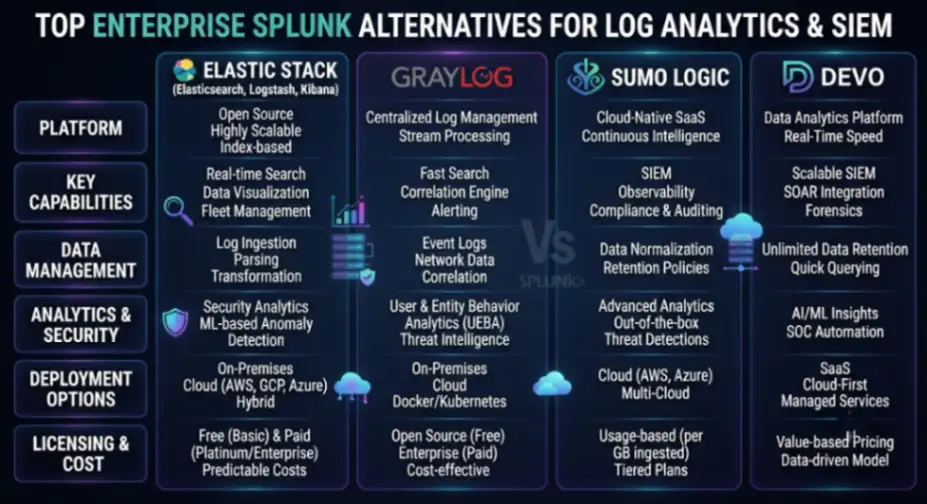
Top Enterprise Splunk Alternatives for Log Analytics & SIEM
As log volume scales rapidly across cloud workloads and microservices, traditional proprietary licensing models often result in unsustainable operational costs. Enterprise technology leaders are increasingly pivoting to decoupled analytics architectures and OpenTelemetry pipelines that align with data retention and governance standards established by bodies like W3C. Choosing an enterprise-grade Splunk alternative requires examining schema flexibility, real-time threat detection algorithms, storage tiers, and query performance under multi-terabyte daily ingestion rates.
1. Datadog Log Management
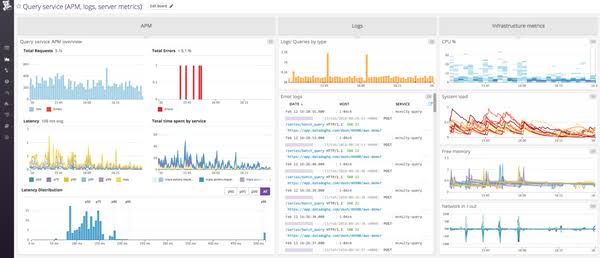
Datadog Log Management provides unified telemetry processing across logs, metrics, and traces within a single observability ecosystem. Its decoupled ingestion and indexing engine allows organizations to process high-velocity data streams dynamically while optimizing long-term retention costs.
- FlexLogs Storage Architecture: Separates real-time ingestion from long-term storage, enabling full stream processing alongside cost-effective historical re-indexing.
- Pipeline Edge Processing: Automatically normalizes unstructured logs, extracts JSON attributes, masks sensitive PII data, and maps fields using open standard telemetry formats.
- Deployment & Integrations: Delivered as a managed SaaS solution supporting OpenTelemetry collectors, Vector agents, and broad native cloud service integrations.
2. Elastic Stack (ELK / Elastic Security)
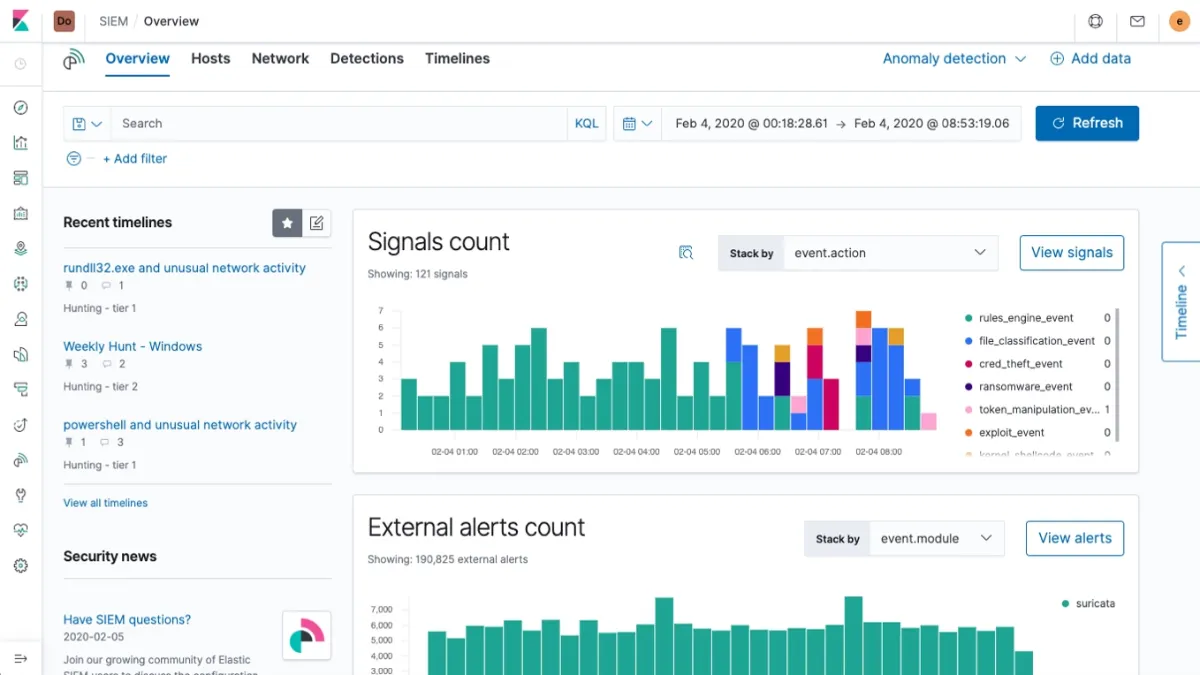
The Elastic Stack (Elasticsearch, Logstash, Beats, Kibana) delivers robust open-search capabilities paired with dedicated SIEM modules for enterprise security operations. It enables real-time search, interactive data visualizer dashboards, and machine-learning-driven threat detection across massive data stores.
- Lucene Indexing Engine: Utilizes inverted index structures to deliver ultra-fast full-text searches and schema-on-write field parsing.
- ML Threat Detection: Includes unsupervised machine learning modules for anomaly detection, behavioral profiling, and automatic alert scoring.
- Deployment Versatility: Available as a cloud-managed service via Elastic Cloud, self-hosted on-premises, or deployed inside Kubernetes clusters using ECK.
3. Sumo Logic
Sumo Logic is a cloud-native SaaS analytics platform engineered for automated log monitoring, security intelligence, and operational insight. It processes gigabytes of log telemetry per second using multi-tenant distributed clusters that auto-scale according to operational load.
- LogReduce & LogCompare Algorithms: Uses machine learning pattern recognition to group millions of log lines into distinct signatures and highlight structural delta changes automatically.
- Cloud SIEM Enterprise: Provides automated threat correlation, rule matching against STIX/TAXII feeds, and streamlined incident triage workflows.
- Deployment Model: Multi-tenant SaaS architecture with lightweight collector agents, Syslog endpoints, and native AWS/Azure/GCP service hooks.
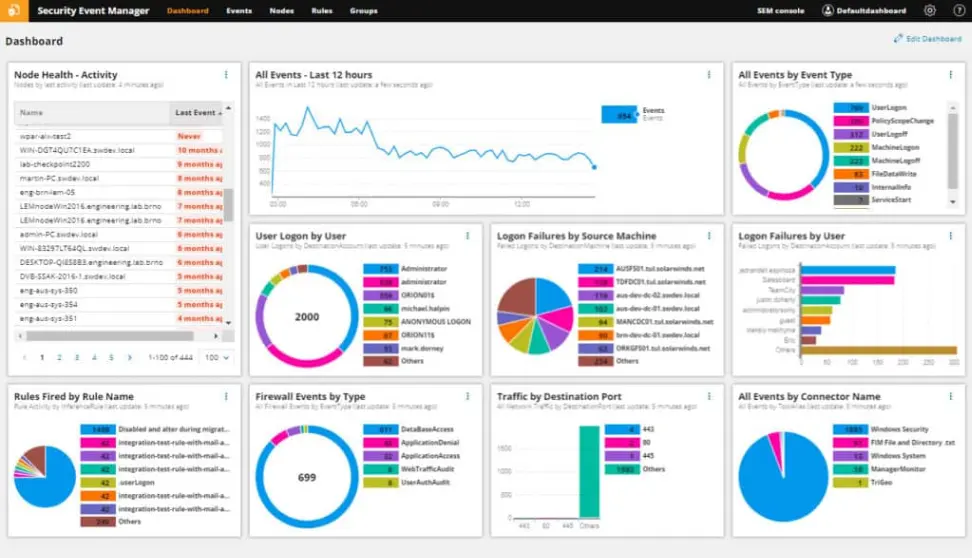
4. SolarWinds Security Event Manager (SEM)
SolarWinds Security Event Manager is a hardened, resource-optimized SIEM solution tailored for real-time threat detection and automated compliance enforcement. It inspects log data in-memory to trigger immediate defense protocols before events touch secondary disk storage.
- In-Memory Event Correlation: Real-time event evaluation engine capable of processing thousands of events per second to flag complex multi-stage attack vectors.
- Active Response Engine: Automatically executes remediation actions, such as shutting down compromised network ports, revoking Active Directory accounts, or killing rogue processes.
- Deployment Formats: Delivered as a pre-configured virtual appliance for VMware vSphere and Microsoft Hyper-V environments.
5. ManageEngine Log360
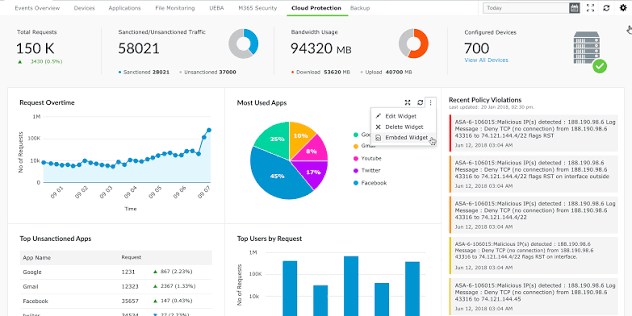
ManageEngine Log360 is an integrated SIEM solution that combines log management, Active Directory auditing, and User and Entity Behavior Analytics (UEBA). It delivers deep visibility into network perimeters, system changes, and internal threat vectors across complex hybrid environments.
- UEBA Engine: Integrates machine learning algorithms to map user baseline behavior and detect privilege escalations, off-hours access, and anomalous data movements.
- Compliance Reporting Engine: Generates automated compliance audit trails for PCI-DSS, HIPAA, GDPR, SOX, and FISMA.
- Deployment Model: On-premises Windows Server deployment with distributed agent architecture for enterprise infrastructure topologies.
6. LogRhythm Security Intelligence Platform
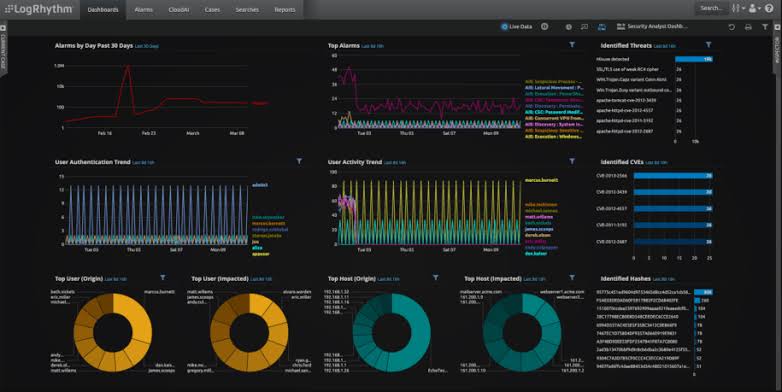
LogRhythm provides an enterprise SIEM framework built around its NextGen Security Information and Event Management architecture. It unifies log management, endpoint monitoring, network detection, and Security Orchestration, Automation, and Response (SOAR).
- MPE Engine (Message Parsing Engine): Normalizes unstructured log streams from thousands of disparate sources into a common metadata framework for rapid correlation.
- Integrated SmartResponse: Provides pre-packaged automated playbooks to accelerate incident response and reduce Mean Time to Respond (MTTR).
- Deployment Flexibility: High-performance hardware appliances, software deployments, virtual appliances, or LogRhythm Cloud SaaS.
7. Graylog Enterprise
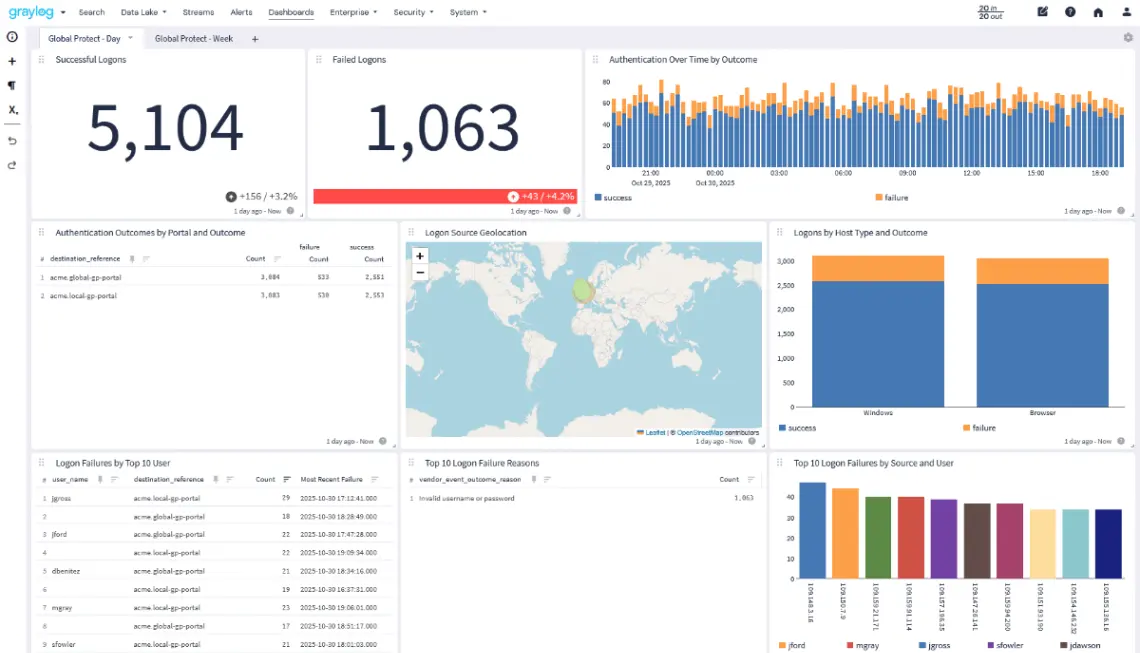
Graylog Enterprise is a flexible log analytics platform built on OpenSearch and MongoDB, designed for fast log parsing, centralized analysis, and threat hunting. It combines simple query syntax with customizable dashboards to support operational and security workflows.
- Processing Pipeline Engine: Allows administrators to route, transform, filter, and enrich log messages in real-time before indexing.
- Illuminate Content Enrichment: Provides pre-built parsing rules, alerts, and dashboards tailored for common enterprise vendors (e.g., Cisco, Palo Alto, Office 365).
- Deployment Formats: Self-managed enterprise software, containerized Docker/Kubernetes images, or fully managed Graylog Cloud service.
8. InsightOps (Rapid7)
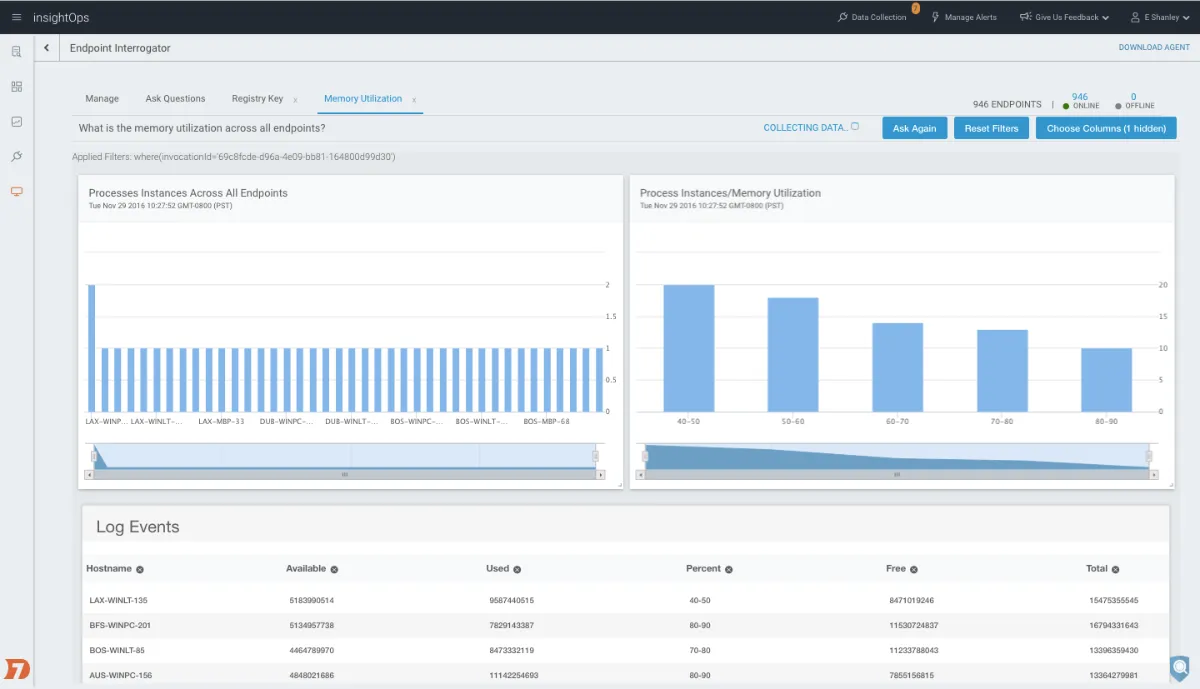
InsightOps by Rapid7 combines centralized log analytics with operational monitoring, offering fast search capabilities and endpoint visibility. Built on top of the Rapid7 Insight Platform, it simplifies complex log queries using natural language and custom parsing rules.
- LEQL Query Language: Utilizes Logentries Query Language (LEQL) to enable rapid visual aggregation, regex extraction, and dynamic field generation at search time.
- Unified Endpoint Agent: Leverages the multi-purpose Rapid7 Insight Agent to collect system logs, live process data, and endpoint state info simultaneously.
- Deployment Architecture: Fully hosted cloud SaaS platform integrated with automated alerting systems like PagerDuty, Slack, and webhooks.
9. IBM Security QRadar SIEM
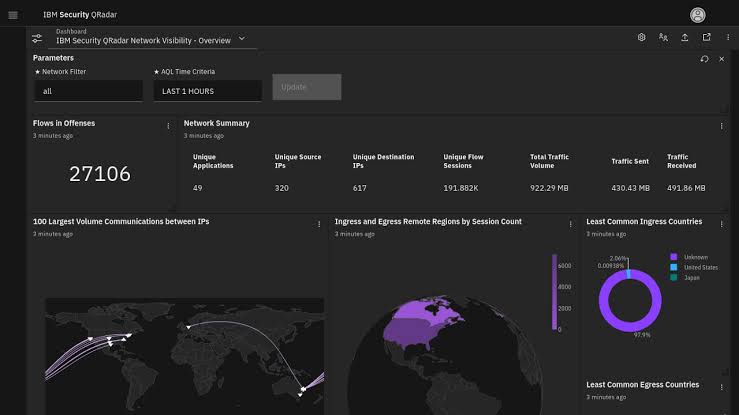
IBM Security QRadar SIEM is an enterprise-tier threat detection platform that aggregates network telemetry, log events, and vulnerability data to isolate security threats. It utilizes sophisticated correlation algorithms to group isolated events into prioritized security offenses.
- Sense Analytics Engine: Automatically correlates disparate event logs and network flow data (NetFlow, J-Flow, IPFIX) to reveal multi-hop attack sequences.
- X-Force Threat Intelligence: Continuously streams real-time threat intelligence updates to flag connections with malicious IP addresses and domains.
- Deployment Formats: Available as physical hardware appliances, virtual appliances, private cloud instances, or QRadar on Cloud (SaaS).
10. Exabeam Security Operations Platform
Exabeam focuses on AI-driven threat detection, investigation, and response (TDIR), providing a cloud-native analytics architecture that replaces traditional SIEM storage paradigms. It automates analyst workflows through advanced behavioral baselining and dynamic timeline creation.
- Smart Timelines: Automatically stitches scattered log events into unified, chronological timelines of user and machine behavior during security incidents.
- Out-of-the-Box Behavioral Models: Applies over 1,800 pre-configured ML behavior models to detect insider threats, credential misuse, and data exfiltration.
- Deployment Model: Modern cloud-native SaaS architecture featuring agentless cloud collectors and multi-cloud log integration pipelines.
Frequently Asked Questions
What is the primary cost driver when migrating away from Splunk?
The main cost driver in Splunk is typically its data ingestion volume model (gigabytes/terabytes per day). Migration target solutions often decouple ingestion from storage, allowing teams to ingest 100% of raw logs for real-time routing while paying reduced rates to index only critical security events or route raw data to cheap object storage (e.g., Amazon S3).
How do schema-on-read and schema-on-write architectures compare in log analytics tools?
Schema-on-write (used by platforms like Elasticsearch) parses fields during ingestion, resulting in faster query execution times and structured indexing at the cost of higher CPU overhead during ingestion. Schema-on-read (used by Splunk and LEQL-based engines) stores raw log strings and applies structural definitions dynamically during query execution, offering high ingestion speeds and total parsing flexibility at query time.
Can open-source architectures like OpenTelemetry replace proprietary Splunk agents?
Yes, OpenTelemetry (OTel) provides vendor-neutral APIs, SDKs, and collector agents that can gather metrics, logs, and traces from applications and hosts. Using OpenTelemetry collectors allows enterprises to forward telemetry data to multiple target backends simultaneously without being locked into vendor-specific agent software.
Advertisement