10 Best Low-Code Development Platforms (2026)
Advertisement
10 Best Low-Code Development Platforms (2026)
Crucially, the best low-code tools do not lock you into a proprietary ecosystem; they integrate flawlessly with modern tech stacks. Whether you are authenticating via GitHub, utilizing Vercel cloud infrastructure for frontend hosting, or connecting directly to a Supabase PostgreSQL backend, these platforms act as a highly robust presentation and logic layer. When developing enterprise applications rapidly, it is highly recommended to follow the software security principles outlined by the OWASP Foundation and ensure your data architecture complies with privacy frameworks established by the NIST Computer Security Resource Center.
We have rigorously evaluated the industry's top platforms to bring you the ten best low-code development tools available today, focusing on database connectivity, visual flexibility, and enterprise scalability.
1. Retool
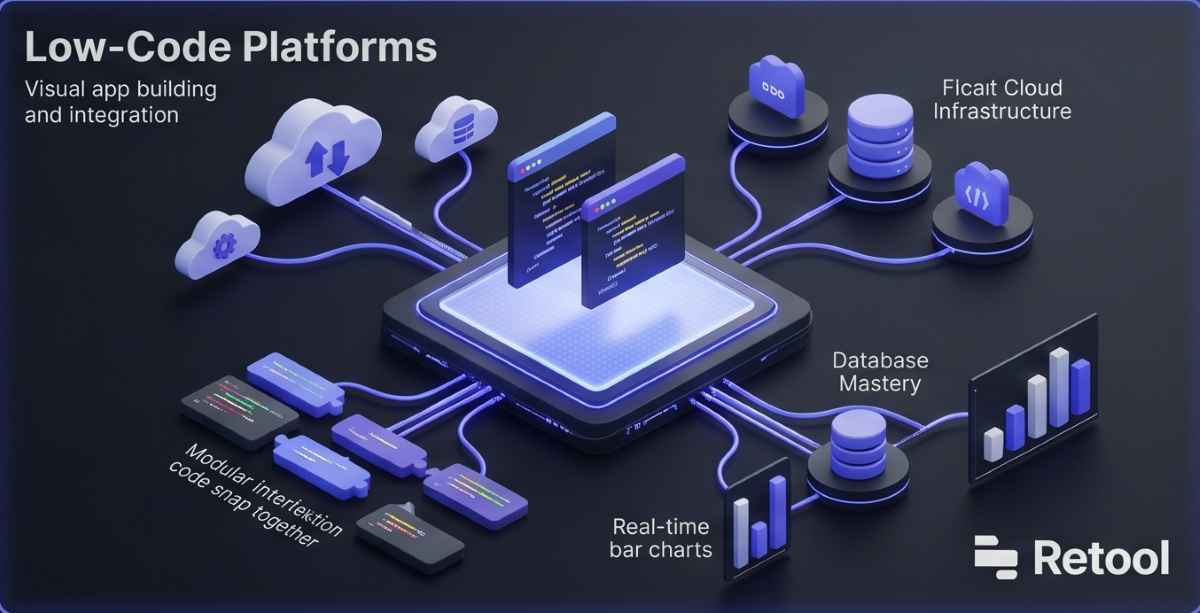
Retool is the undisputed king of building internal tools. It is heavily favored by developers because it allows you to write custom JavaScript and SQL statements anywhere within the visual interface.
- Database Mastery: Connects natively to almost any database or API, functioning perfectly as a frontend for a Supabase or traditional PostgreSQL backend.
- Developer-First: Offers granular control over UI components, allowing you to build complex CRUD applications, finance dashboards, and CRM extensions in hours instead of weeks.
- Product Link: Discover how developers accelerate internal tool building directly at Retool.
2. Bubble
Bubble is one of the most powerful visual programming platforms on the market. It allows entrepreneurs and developers to build fully functional, scalable web applications without writing a single line of traditional code.
- Complex Logic: Features an incredibly robust workflow engine capable of handling complex conditional logic, API integrations, and multi-step data processing.
- Responsive Design Engine: Ensures your application scales beautifully from desktop monitors to mobile screens without requiring separate codebases.
- Plugin Marketplace: Offers thousands of pre-built integrations for payment processors, AI tools, and analytics platforms.
3. OutSystems
OutSystems is an enterprise-grade low-code platform built for large organizations that need to deploy mission-critical applications at scale while maintaining strict governance.
- Full-Stack Development: visually model the entire application stack, from complex relational databases to frontend user interfaces and backend business logic.
- AI-Assisted Development: Features an AI copilot that suggests the next best logical step or code block based on millions of learned patterns.
- One-Click Deployment: Automates the entire CI/CD pipeline, pushing applications from development to production securely with a single click.
4. Mendix
Mendix (a Siemens business) bridges the gap between business analysts and professional developers, offering dual integrated development environments (IDEs) tailored to different technical skill levels.
- Mendix Studio & Studio Pro: Business users can prototype using the no-code Studio, while developers can add complex Java logic using Studio Pro.
- Cloud-Native Architecture: Applications are built on containerized microservices, making them incredibly scalable and ready for deployment on any cloud infrastructure.
- Offline Capabilities: Excellent for building Progressive Web Apps (PWAs) and native mobile apps that function flawlessly without an active internet connection.
5. Microsoft Power Apps
For organizations already operating within the Microsoft 365 and Azure ecosystems, Power Apps provides a seamless, highly integrated low-code development experience.
- Deep Integration: Connects natively to SharePoint, Excel, SQL Server, and Dynamics 365, turning existing corporate data into interactive mobile and web apps.
- Power Automate: Works hand-in-hand with Microsoft's automation engine to trigger complex, cross-platform workflows based on user input.
- AI Builder: Easily embed artificial intelligence models (like form processing or object detection) directly into your custom apps without data science expertise.
6. Caspio
Caspio specializes in building secure, database-driven business applications. It is heavily utilized in healthcare, government, and finance sectors due to its strict security compliance.
- Unlimited Users: Unlike many competitors that charge per-seat licenses, Caspio offers unlimited users, making it highly cost-effective for large-scale employee portals.
- HIPAA & SOC-2 Compliance: Runs on AWS infrastructure with enterprise-grade security protocols, making it safe for handling sensitive medical or financial data.
- Visual Report Builder: Instantly transform raw database entries into interactive charts, pivot tables, and secure reporting dashboards.
7. Quickbase
Quickbase is highly favored by operational teams in construction, manufacturing, and supply chain management. It excels at modernizing legacy processes and replacing complex spreadsheets.
- No-Code Agility: Project managers and operational leaders can easily build custom tracking applications without waiting for IT resources.
- Cross-System Orchestration: Features Quickbase Pipelines, a visual integration builder that syncs data automatically across third-party tools like Salesforce and Slack.
- Real-Time Visibility: Provides operational leaders with real-time dashboards to track resources, budgets, and project timelines across fragmented teams.
8. Appian
Appian is a leader in business process automation (BPA). It combines low-code development with powerful workflow orchestration to automate highly complex corporate operations.
- Process Modeling: Visually map out complex business processes, combining human tasks, AI decisions, and robotic process automation (RPA) into a single flow.
- Data Fabric: Connects disparate corporate databases virtually, allowing you to build applications that pull real-time data without actually migrating the data itself.
- Write Once, Run Everywhere: Build an application once and Appian automatically optimizes it for web, iOS, and Android simultaneously.
9. Glide
Glide revolutionized the no-code/low-code space by allowing users to turn simple spreadsheets into beautiful, functional mobile and web applications in literally seconds.
- Data-to-App: Connect a Google Sheet, Airtable base, or Excel file, and Glide automatically generates a polished, responsive application interface.
- Beautiful UI Defaults: Requires zero design skills; the platform enforces modern, clean design standards so your app looks professional immediately.
- Inventory & Directories: Perfect for rapidly spinning up employee directories, inventory management scanners, or conference event guides.
10. Betty Blocks
Betty Blocks bills itself as a "Citizen Development" platform. It is designed to empower non-technical employees to build enterprise-grade applications under the strict governance of the IT department.
- Block-Based Building: Applications are built by snapping together pre-configured, reusable "blocks" of functionality (like login portals or API connectors).
- IT Governance: IT administrators retain total control over the environment, determining exactly which databases and APIs citizen developers are allowed to access.
- Pro-Code Extensibility: Professional developers can build custom logic blocks using JavaScript and share them within the platform for citizen developers to use visually.
FAQs
What is low-code development?
Low-code development is a software creation approach that uses visual interfaces with simple logic and drag-and-drop features instead of extensive coding languages. It allows developers to build applications much faster by eliminating the need to write repetitive boilerplate code, while still offering the flexibility to inject custom code when complex functionality is required.
Is low-code different from no-code?
Yes. No-code platforms (like Glide) are designed for business users with zero programming knowledge, relying entirely on visual builders. Low-code platforms (like Retool or OutSystems) are designed primarily for developers and technical users, combining visual builders with the ability to write custom SQL, JavaScript, or Java to handle complex backend logic.
Are low-code applications secure?
Enterprise low-code platforms are highly secure and frequently comply with strict global standards like SOC-2 and HIPAA. Because the platform provider handles the underlying infrastructure and patching, the risk of deploying unpatched or vulnerable boilerplate code is often significantly lower than in traditional, ground-up development.
Advertisement