Architectural Comparison: Latency vs. Jitter in High-Performance Networks
Advertisement
Architectural Comparison: Latency vs. Jitter in High-Performance Networks
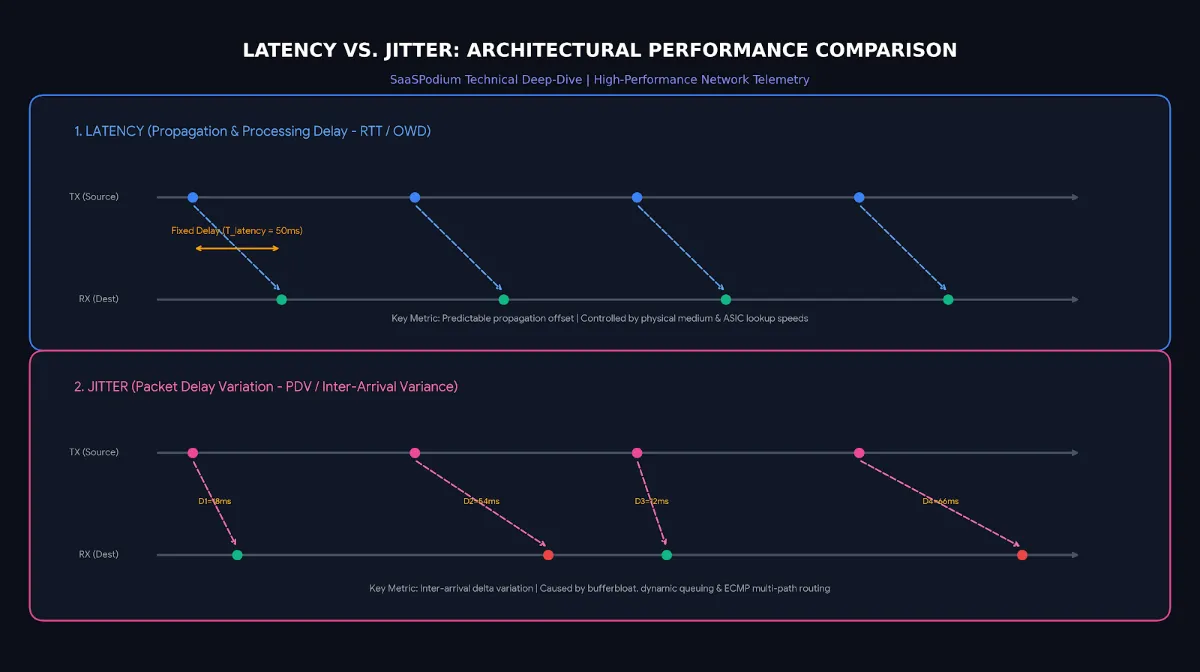
Optimizing real-time communications such as VoIP, video conferencing, and low-latency trading applications requires precise measurement and mitigation of both static propagation delays and transient queuing variations. RFC standards established by the Internet Engineering Task Force (IETF) define RFC 3393 metrics for packet delay variation to evaluate packet arrival consistency across complex network routing topologies. Enterprises often implement specialized telemetry tools such as SolarWinds Network Performance Monitor to continuously audit packet buffer behaviors and hop-by-hop latency metrics.
1. Network Latency Mechanics and Propagation Dynamics
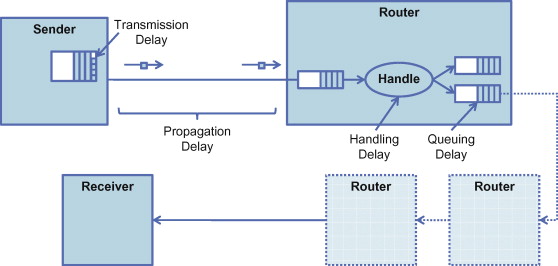
Latency encompasses four core structural components: propagation delay, serialization delay, processing delay, and queuing delay. The physical speed of light in optical fibers combined with switch ASIC packet inspection speeds determines the baseline delay threshold across modern enterprise backbones.
- Propagation and Serialization Constraints: Bound physically by medium refractive index (~200,000 km/s in fiber) and link clock rates (1Gbps vs. 100Gbps bit transmission time).
- Hardware-Level Processing: Driven by ASIC lookup overheads, TCAM memory lookups, and frame-check-sequence (FCS) verifications at ingress and egress switch ports.
- Buffer-Induced Queuing Overhead: Dynamic delay introduced when switch egress buffers fill during burst traffic, causing variable dwell times prior to frame transmission.
2. Jitter Mechanics and Packet Delay Variation (PDV)
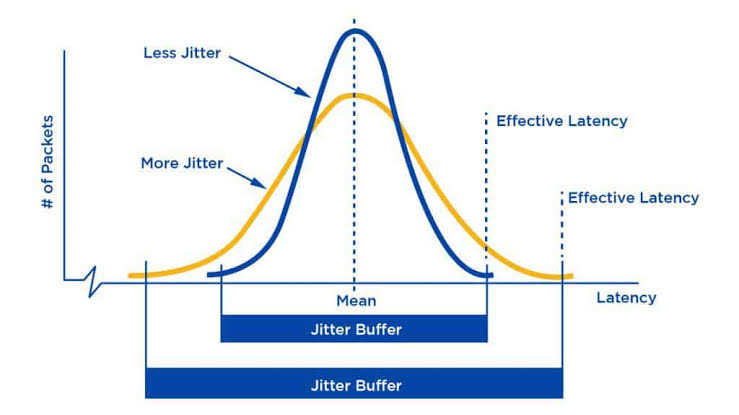
Jitter quantifies the variance in inter-packet arrival times caused by dynamic queuing shifts, asymmetric routing paths, and transient network congestion. High jitter degrades real-time stream reassembly buffers, leading to packet drops and synthetic audio or video artifacts.
- Inter-Arrival Jitter Calculation: Evaluated using RFC 3550 RTP algorithms, calculating the smoothed mean difference between consecutive packet arrival times ($\Delta D = |D(i-1) - D(i)|$).
- Bufferbloat and Queue Oscillations: Caused by oversized router drop buffers holding excessive packets during burst TCP window scaling, triggering extreme delay variances.
- Asymmetric Multi-Path Routing: Dynamic Equal-Cost Multi-Path (ECMP) load balancing sending successive packet flows down disparate physical links with variable latency profiles.
3. Architectural Mitigation Strategies for Enterprise Networks
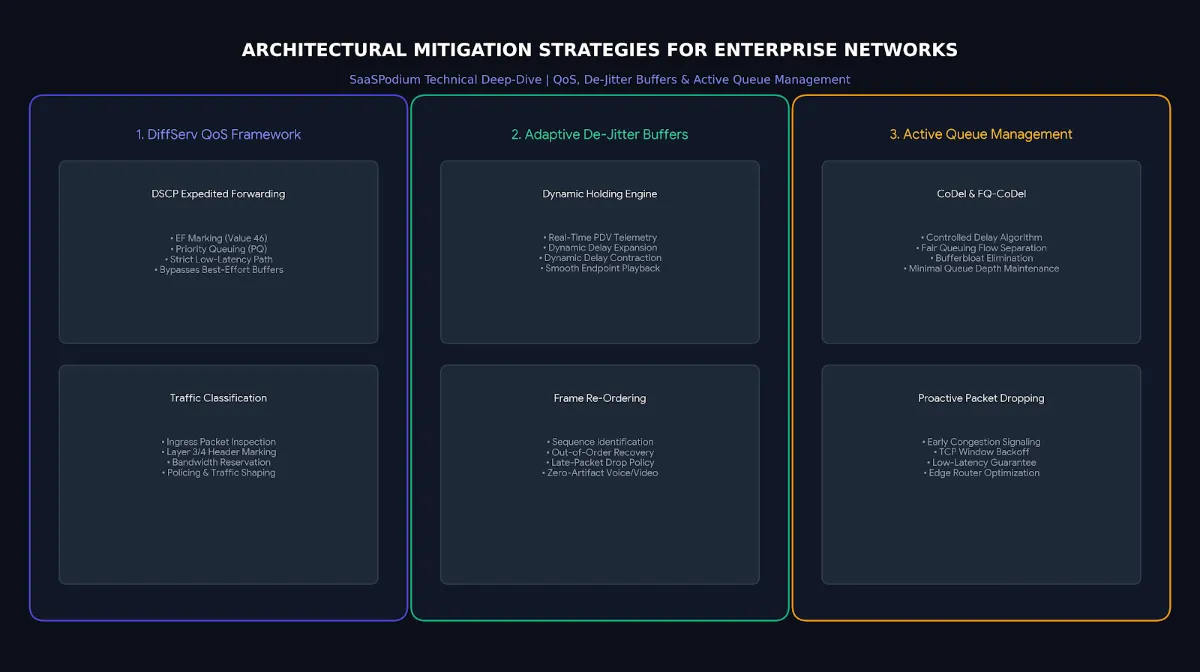
Remediating latency and jitter requires enforcing Quality of Service (QoS) frameworks, deploying adaptive de-jitter buffers, and optimizing routing topologies. Systemic traffic shaping prioritizes latency-sensitive payloads over bulk data flows across congested WAN boundaries.
- DiffServ QoS Configuration: Applying Expedited Forwarding (EF) DSCP marking (value 46) to guarantee low-latency Priority Queuing (PQ) for real-time media streams.
- Adaptive De-Jitter Buffer Engines: Implementing dynamic endpoint playback buffers that adjust holding thresholds based on real-time PDV telemetry to smooth out frame delivery.
- Active Queue Management (AQM): Deploying CoDel or FQ-CoDel algorithms on edge routers to eliminate bufferbloat and maintain consistent, minimal queue depth.
Frequently Asked Questions
What is the primary difference between network latency and network jitter?
Latency measures the absolute time taken for a packet to travel from source to destination (or round-trip), whereas jitter measures the variation or fluctuation in arrival times between consecutive packets in a stream.
How does high jitter impact VoIP and real-time video communications?
High jitter causes packets to arrive out of order or outside the playback buffer window, resulting in choppy audio, dropped video frames, delayed conversational sync, and degraded Quality of Experience (QoE).
What QoS settings best optimize jitter and latency for critical traffic?
Deploying Differentiated Services (DiffServ) with DSCP Expedited Forwarding (EF) for voice and interactive video ensures priority queuing (PQ) at switch/router interfaces, bypassing standard best-effort buffers.
Advertisement