Top 14 Event Log Monitoring and SIEM Platforms: Deep Technical Review
Advertisement
Top 14 Event Log Monitoring and SIEM Platforms: Deep Technical Review
As security operations teams face increasingly sophisticated attack vectors, basic text-based log collection is no longer sufficient. Enterprise security frameworks, standardized by organizations like the NIST, require continuous monitoring, log integrity validation, and real-time event correlation. Modern Security Information and Event Management (SIEM) architectures resolve these challenges by parsing unstructured log payloads into structured JSON schemas and feeding them to automated threat correlation engines.
Selecting the ideal event log monitor requires assessing ingestion performance, query latency, parsing flexibility, and deployment overhead. Below is an architectural breakdown of the 14 leading tools featured on the Site24x7 network and security diagnostic ecosystem, designed to scale across heterogeneous on-premises, cloud, and hybrid infrastructures.
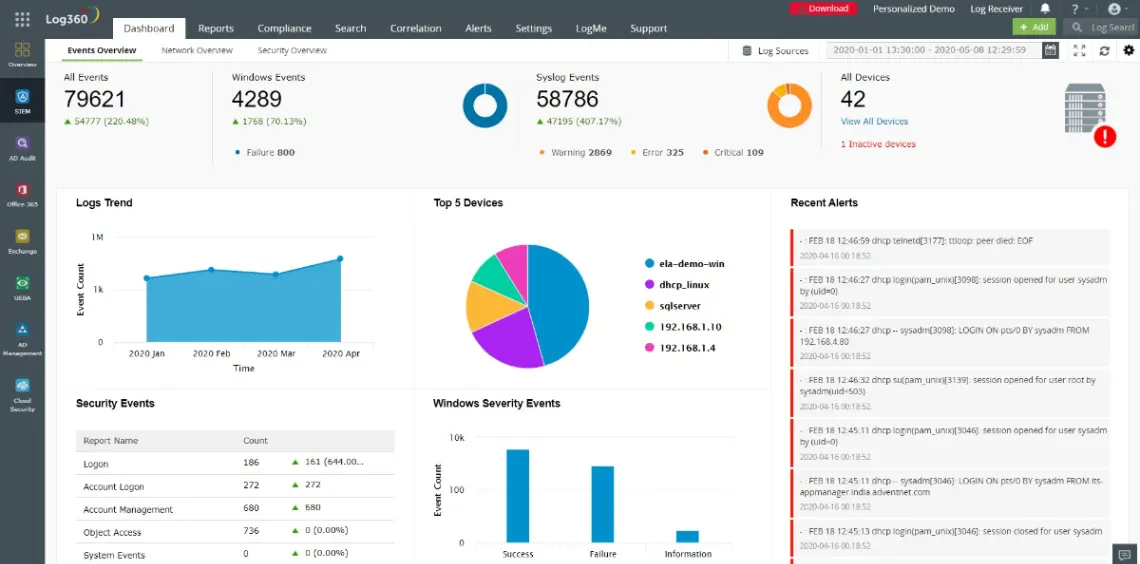
1. ManageEngine Log360
ManageEngine Log360 is a comprehensive on-premises SIEM architecture designed to collect, parse, and analyze event logs from Windows, Unix, Linux, and major cloud platforms. The software normalizes varied telemetry streams into a unified data structure to execute high-fidelity threat hunting and correlation.
- Active Threat Intelligence: Employs structured, real-time threat intelligence feeds to instantly cross-reference incoming event logs with known malicious IP addresses and domains.
- Unified Correlation Engine: Utilizes a drag-and-drop rule builder to construct complex security event correlation rules across disparate network layers.
- On-Premises to Cloud Integration: Collects and processes cloud audit trails natively from AWS (CloudTrail), Microsoft Azure, and Salesforce alongside on-premises infrastructure.
2. ManageEngine EventLog Analyzer
ManageEngine EventLog Analyzer focuses on end-to-end log lifecycle management, parsing Windows Event Logs, Syslog, and application-specific logs. It deploys localized, lightweight collection agents that compress and secure log data in transit before transmitting it to the central indexing node.
- File Integrity Monitoring (FIM): Tracks unauthorized structural changes to critical system directories, system binaries, and configuration files in real time.
- Automated Forensics Engine: Enables security teams to run deep, structured queries across raw and indexed log archives to build comprehensive incident timelines.
- Out-of-the-Box Compliance Reports: Generates automated compliance audit structures mapped to PCI-DSS, HIPAA, SOX, and GDPR frameworks.
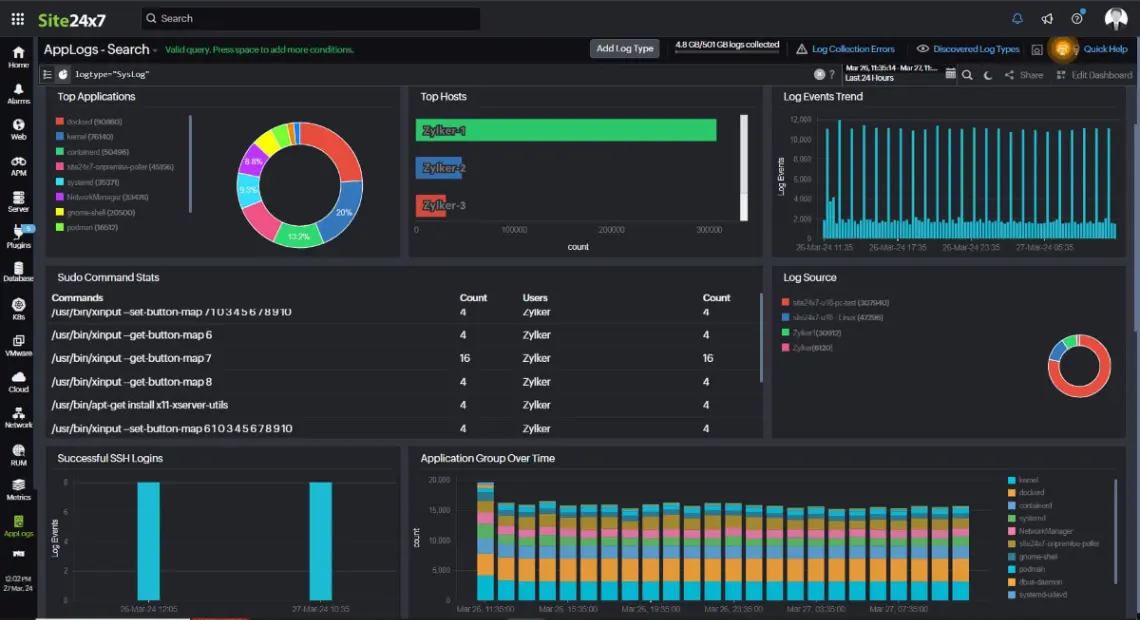
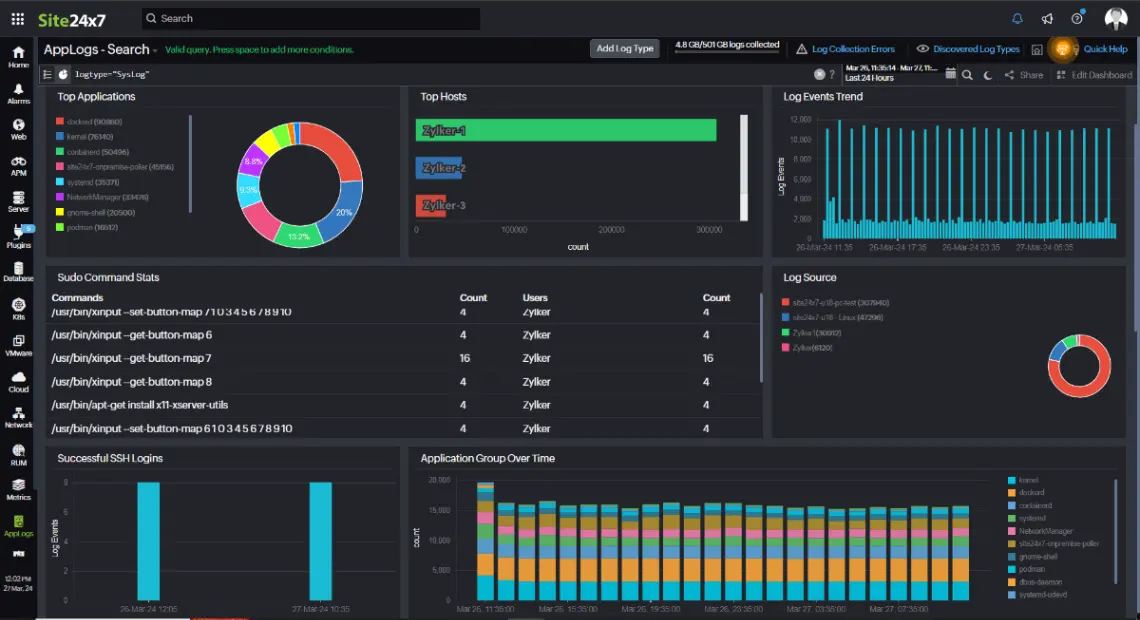
3. Site24x7 AppLogs
Site24x7 AppLogs is a SaaS-native log management service that aggregates and indexes logs from global cloud networks and local systems. It converts unstructured logs into structured analytics tables using a highly optimized, cloud-scale cloud parsing engine.
- Custom Query Language: Employs a robust search syntax allowing developers to run regular expressions, boolean filters, and statistical aggregations on raw logs.
- Automatic Format Parsing: Decodes common log structures (IIS, Apache, NGINX, Log4j, and Windows Event Logs) automatically upon initial ingestion.
- Real-Time Alert Routing: Integrates natively with ITSM tools, webhooks, and communication platforms to route anomaly detections to on-duty engineers.
4. Barracuda SKOUT Managed XDR
Barracuda SKOUT Managed XDR combines cloud-based security analytics with a 24/7 Security Operations Center (SOC) to review and remediate flagged security alerts. The platform ingests telemetry from network firewalls, endpoints, and identity providers to form a cohesive, multi-tenant detection layer.
- Managed Detection Strategy: Relies on human-led SOC analysis to review, triage, and validate automated alerts, eliminating false-positive alarm fatigue.
- Multi-Tenant Dashboards: Designed specifically for MSPs to monitor and coordinate security profiles across distinct enterprise customers from a single screen.
- Cloud Sandbox Correlation: Cross-references suspicious log actions with active sandboxing engines to test and quarantine malicious payloads.
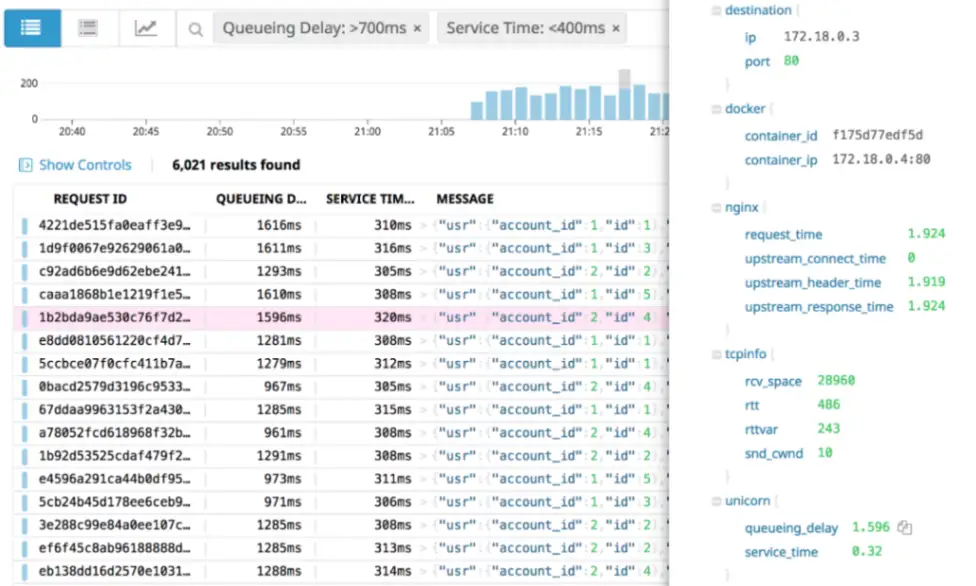
5. Datadog Log Management
Datadog Log Management provides high-scale ingestion, processing, and long-term archiving within an unified observability platform. It separates the log ingestion pipeline from storage systems, allowing engineers to parse logs without immediate index-cost commitment.
- Log Pipelines and Grog Parsers: Utilizes nested parsing pipelines to convert complex, multiline application stack traces into structured JSON attributes.
- Log-to-Metric Generation: Generates real-time timeseries metrics from raw log volume trends to power anomaly alerts and dashboards.
- Cold Storage Rehydration: Enables instant searchability of historical log files stored in low-cost cloud buckets without requiring continuous index overhead.
6. LogFusion
LogFusion is a lightweight, local log monitoring application designed for real-time text analysis on Windows environments. It is engineered to monitor active log files locally or via network shares with minimal system footprint.
- Real-Time Advanced Highlighting: Uses customizable text and background rules to automatically color-code warning or critical system event patterns.
- Custom Folder Monitoring: Scans targeted directories dynamically, instantly appending new log lines to active workspaces as they are written.
- Multi-Tab Workspace Layout: Allows operations teams to monitor multiple active log files simultaneously inside a single, tabbed user interface.
7. Netwrix Event Log Manager
Netwrix Event Log Manager is an enterprise utility built to consolidate, compress, and archive Windows Event Logs and Linux Syslog records. It focuses on reducing storage consumption while maintaining complete, tamper-proof audit trails for regulatory compliance.
- High-Ratio Log Compression: Compresses raw event log payloads up to 90% to minimize long-term archival footprint on physical and network storage.
- Alert Suppression Engine: Prevents alert storms by filtering out redundant noise events before they trigger notification chains.
- Tamper-Evident Long-Term Archiving: Signs archived files cryptographically to ensure historical records cannot be altered or deleted.
8. Splunk Enterprise
Splunk Enterprise is an industry-leading data platform that ingests, indexes, and visualizes raw log data from any source at massive scale. Its search processing language (SPL) allows complex correlation across disparate infrastructure datasets.
- Search Processing Language (SPL): Provides a powerful, declarative programming language specifically optimized for unstructured data querying.
- Machine Learning Tool Kit (MLTK): Implements dynamic statistical models to detect outliers, forecast capacity limits, and identify anomalous network behaviors.
- Extensive App Ecosystem: Offers over 2,000 pre-built integrations to parse, visualize, and map vendor-specific technologies.
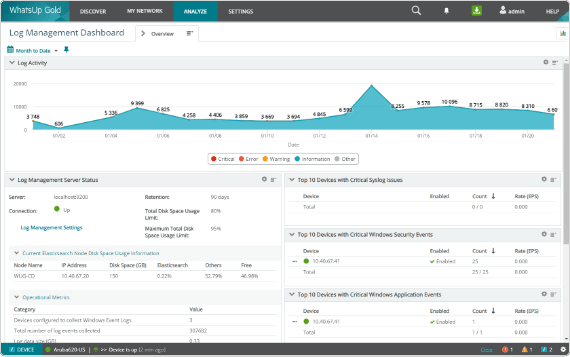
9. WhatsUp Gold Log Management Suite
WhatsUp Gold Log Management Suite integrates event log collection directly into its active network monitoring software. This integration allows administrators to view physical switch status and log metrics on a single, unified topological map.
- Topological Correlation: Maps log errors directly to physical infrastructure nodes, highlighting switches or servers experiencing failure states.
- Unified Dashboard Reporting: Consolidates log volume spikes, interface availability, and device temperature readings onto a single canvas.
- Granular Event Filtering: Leverages custom exclusion rules to drop noisy, non-critical logs prior to final database storage.
10. Tripwire Log Center
Tripwire Log Center delivers secure log collection and automated normalization optimized for high-security environments. It integrates with Tripwire Enterprise configuration monitoring to match log modifications against active host changes.
- Active Host Correlation: Matches real-time event logs with physical file integrity monitoring data to verify authorization.
- Cryptographic Ingestion: Secures all transport paths using mutual TLS, ensuring log frames cannot be sniffed or altered in transit.
- Dynamic Event Filtering: Implements hierarchical filtering to route critical alerts to active SIEM systems while archiving routine events.
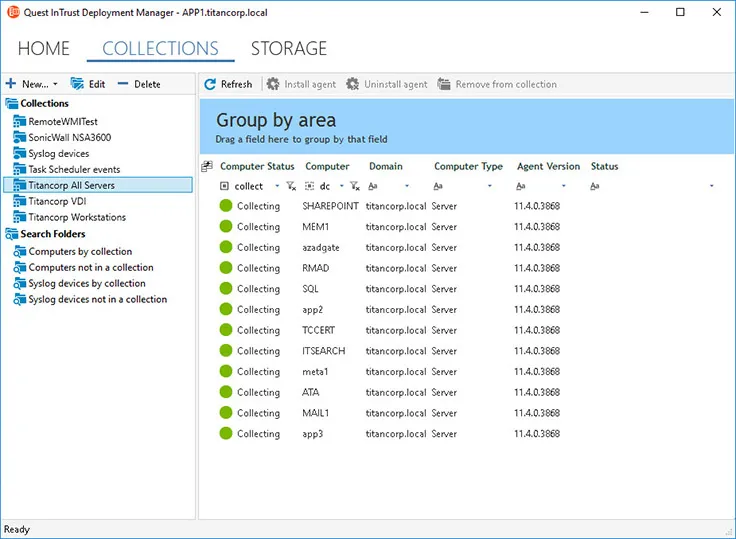
11. Quest InTrust
Quest InTrust is an enterprise-scale log management utility optimized for high-speed log ingestion and aggressive database compression. It is engineered to process thousands of events per second from complex Active Directory infrastructures.
- Active Directory Auditing: Tracks account lockout sources, schema changes, and GPO modifications with precise timing markers.
- Smart Compression Indexes: Employs proprietary compression algorithms that allow lightning-fast search queries across terabytes of compressed logs.
- Agent-Based Failover Protection: Caches event data locally on monitored hosts if central network connection issues occur, avoiding data loss.
12. Corner Bowl Server Manager
Corner Bowl Server Manager is a compact, robust network utility that manages Syslog, Windows Event Logs, and Azure Active Directory telemetry. It is built to serve compliance-driven organizations requiring straightforward audit storage and reporting.
- Multi-Protocol Aggregation: Merges on-premises Syslog, Windows Event Logs, and cloud Azure AD audit logs into a unified storage system.
- Compliance Mapping: Offers pre-configured, automated auditing templates tailored for HIPAA, PCI-DSS, and NIST configurations.
- Local Script Execution: Configures automated system actions, running recovery scripts when specific event IDs are detected.
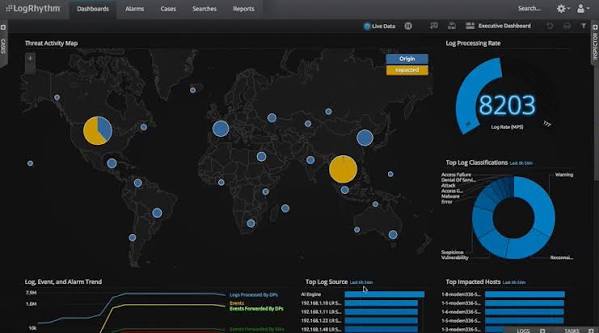
13. LogRhythm SIEM
LogRhythm SIEM utilizes a structured, high-performance architecture built around its patented Machine Data Importer (MDI) engine. It normalizes unstructured raw data at the point of ingestion to enable near-zero latency searching and security monitoring.
- Advanced Machine Data Importer: Normalizes raw machine logs dynamically, turning chaotic metadata into organized contextual databases.
- User and Entity Behavior Analytics (UEBA): Profiles user accounts and active assets to establish security baselines and catch insider threats.
- Automated SOAR Playbooks: Integrates threat response workflows directly, enabling automated firewall blocking and service isolation.
14. Sumo Logic
Sumo Logic is a native SaaS analytics platform designed to analyze millions of logs across complex multi-cloud and Kubernetes workloads. It leverages machine learning to automatically cluster log lines and reduce diagnostic trouble-shooting cycles.
- LogReduce and LogCompare: Leverages machine learning algorithms to cluster repeating log lines into structured categories, isolating rare errors instantly.
- Cloud-to-Cloud Integration: Uses serverless collectors to securely pull events from AWS, Google Cloud Platform, and Microsoft Azure without managing agents.
- Secure Multi-Tenant Partitioning: Isolates log pools cryptographically to provide secure multi-tenancy and partition administrative access control.
Frequently Asked Questions
What is the difference between log aggregation and SIEM?
Log aggregation focus primarily on collecting, indexing, compressing, and archiving raw log files from multiple hosts into a central repository for searching. SIEM (Security Information and Event Management) builds on this baseline by normalising data, running real-time event correlation, analyzing user behavior, and triggering security alerts based on active patterns.
How does Syslog differ from Windows Event Logs?
Syslog is a standardized, text-based log forwarding protocol widely utilized by Unix-like systems and network appliances, consisting of priority, facility, and message fields. Windows Event Logs, by contrast, are structured XML files containing specific event IDs, security identifiers (SIDs), and dynamic data fields that require specialized APIs (like Event Log API or WEF) to extract and forward.
What is Windows Event Forwarding (WEF) and why is it used?
Windows Event Forwarding (WEF) is a built-in Microsoft architecture that enables enterprise administrators to collect event logs from multiple source computers and forward them to a centralized collector server. WEF operates natively without installing third-party agent software, leveraging standard WS-Management protocols and Kerberos encryption to transmit logs securely.
Advertisement