Enterprise Guide: Best Automated Browser Testing Frameworks & Platforms
Advertisement
Enterprise Guide: Best Automated Browser Testing Frameworks & Platforms
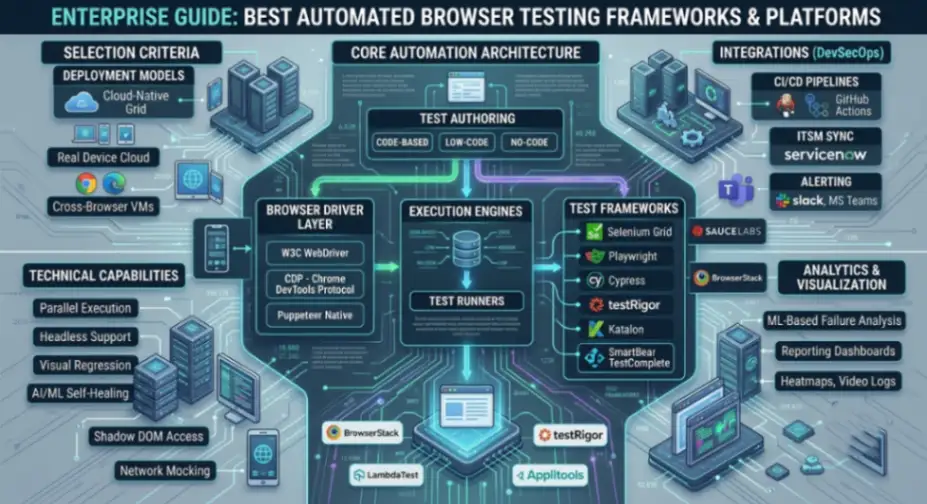
Scaling automated web application testing across heterogeneous enterprise environments requires robust architecture, cross-browser consistency, and seamless integration with DevOps pipelines. Adhering to standards established by the W3C ensures cross-platform compatibility and reliable DOM manipulation via standard driver protocols. Modern browser testing frameworks leverage low-latency communication primitives to achieve high-throughput parallel execution while maintaining strict test isolation and data security.
1. Sauce Labs
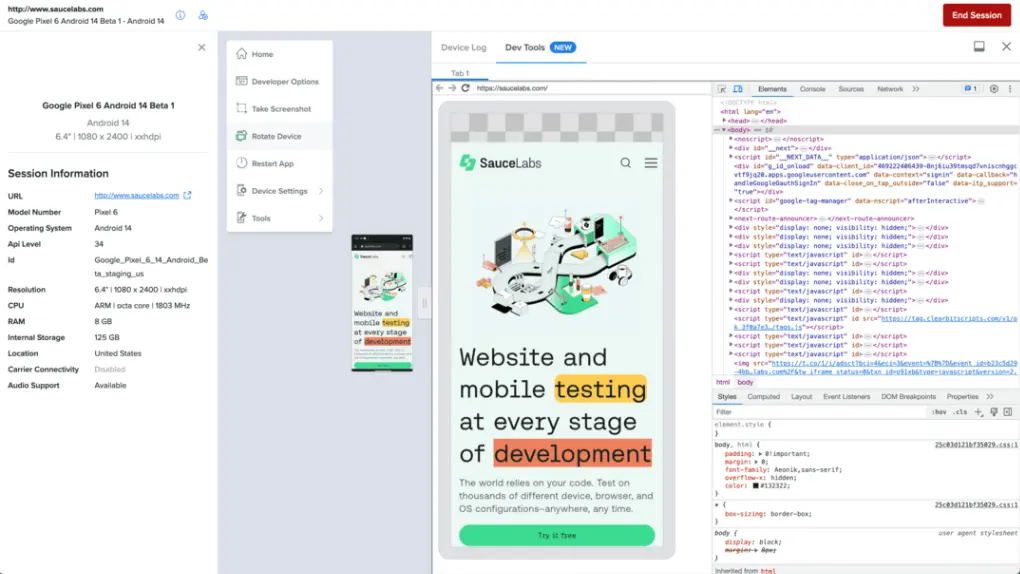
Sauce Labs provides a comprehensive cloud-based testing grid for automated cross-browser, mobile app, and API testing across thousands of browser-OS combinations. It abstracts infrastructure management by offering scalable parallel execution environments backed by continuous real-device and emulator networks.
- Unified Testing Infrastructure: Supports Selenium, Appium, Playwright, and Cypress tests executed across real mobile devices and cloud-hosted virtual machines.
- AI-Driven Test Analytics: Features ML-based failure analysis that categorizes flaky tests, environment errors, and genuine application bugs automatically.
- Secure Enterprise Tunneling: Implements Sauce Connect Proxy to securely tunnel traffic from cloud runners into firewalled enterprise development environments.
2. BrowserStack
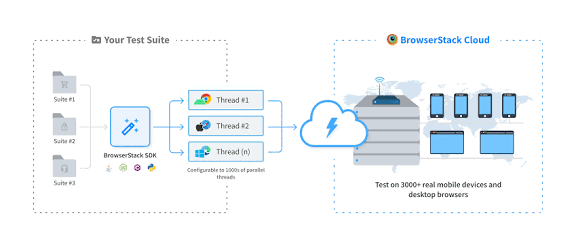
BrowserStack delivers an instant, cloud-based testing cloud enabling parallel test execution across 3,000+ real mobile devices and desktop browsers. Its infrastructure is designed to integrate directly into continuous deployment pipelines for zero-latency feedback loops.
- Real-Device Cloud Infrastructure: Runs automated tests on physical iOS and Android devices without emulation overhead or frame rate throttling.
- Low-Latency Local Testing: Employs binary-level secure tunneling to allow automated scripts to test staging and localhost environments seamlessly.
- CI/CD Orchestration Plugins: Native integrations with Jenkins, GitHub Actions, GitLab CI, and CircleCI for dynamic parallel grid provisioning.
3. LambdaTest
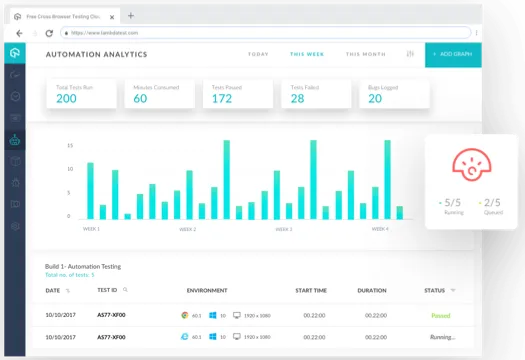
LambdaTest is an AI-powered test execution platform offering a high-performance cross-browser testing cloud with hyper-execute capabilities. Designed for modern QA teams, it splits test suites intelligent across distributed containers to drastically cut build runtimes.
- HyperExecute Smart Grid: Uses AI-driven dependency mapping to intelligently group and run test cases in parallel across containerized nodes.
- Smart Visual Regression: Built-in visual AI engines compare pixel-by-pixel rendering across different browser viewports to catch layout shifts.
- Multi-Framework Compatibility: Full protocol support for Selenium, Puppeteer, Playwright, Cypress, and WebdriverIO test scripts.
4. Selenium Grid
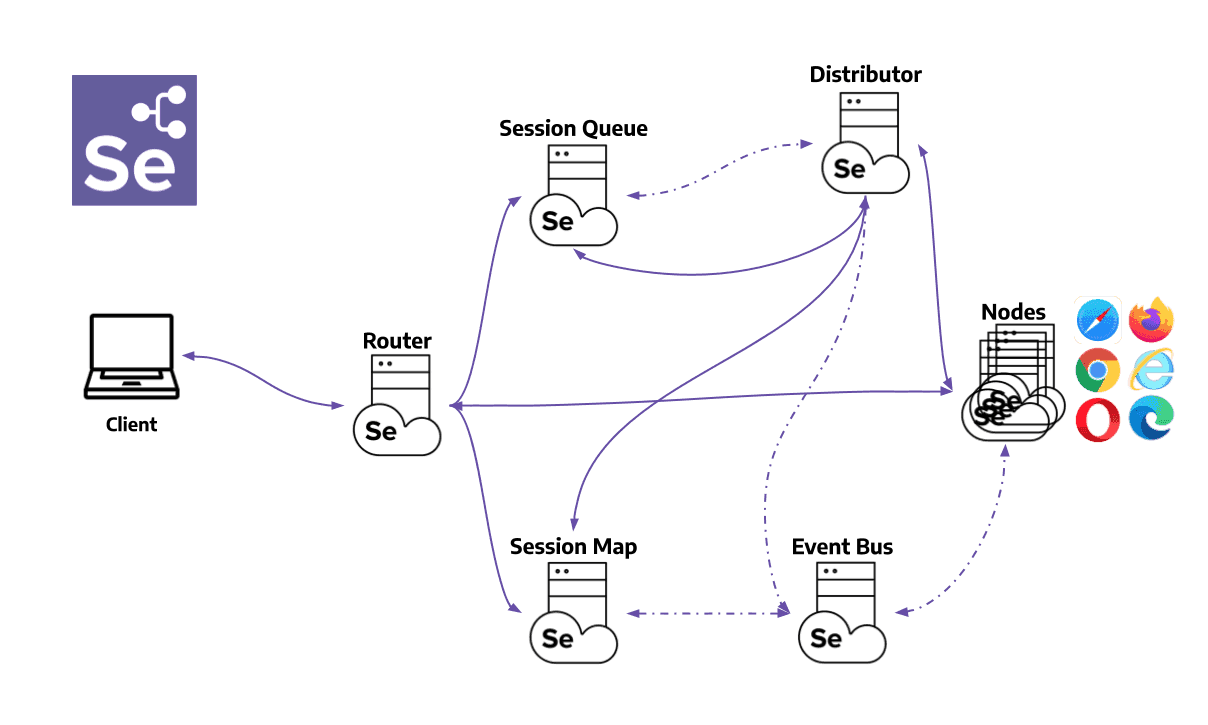
Selenium Grid is the open-source industry standard for distributed, cross-browser test execution adhering strictly to the W3C WebDriver specification. It routes test commands from a centralized Hub to multiple Node instances executing across disparate operating systems.
- W3C WebDriver Native Protocol: Direct bi-directional browser automation via standardized HTTP/REST endpoints across Chrome, Firefox, Safari, and Edge.
- Fully Distributed Architecture: Modular architecture featuring separate Router, Distributor, Session Map, and Node microservices for cloud deployment.
- Dynamic Docker Provisioning: Integrates seamlessly with Kubernetes and Docker containers to spawn disposable browser instances on demand.
5. Playwright
Playwright is an open-source, Node.js-based web automation framework developed by Microsoft that provides fast, reliable, and multi-browser execution. It bypasses traditional WebDriver overhead by communicating directly with browser rendering engines via Chrome DevTools Protocol (CDP) and native browser debugging channels.
- Single-API Multi-Browser Support: Controls Chromium, WebKit, and Firefox with a single API interface without requiring driver binaries.
- Auto-Waiting and Network Interception: Automatically waits for DOM elements to be actionable and allows dynamic API/network mocking.
- Isolated Browser Contexts: Executes tests in isolated browser contexts within a single process to eliminate session leakage and maximize speed.
6. Cypress
Cypress is a developer-centric, JavaScript-based testing framework operating directly inside the browser run-time loop alongside application code. This architecture provides fast, reliable execution with deep access to DOM structures, network requests, and application state.
- In-Browser Architecture: Operates natively inside the browser context, eliminating network latency between test runner and execution target.
- Time-Travel Debugging: Snapshots DOM states during execution, allowing developers to step through test actions in real-time.
- Automatic Flakiness Detection: Provides built-in test retry logic and network stubs to prevent asynchronous state synchronization failures.
7. Katalon Platform
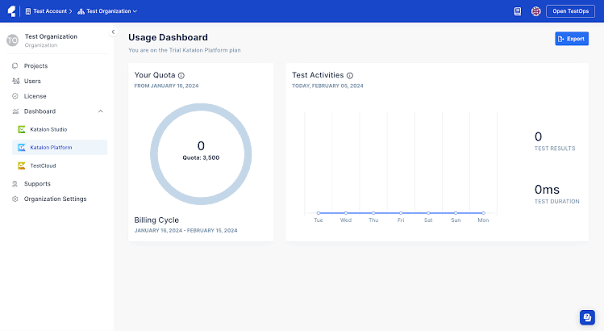
Katalon Platform is an end-to-end, low-code test automation solution that simplifies test authoring, execution, and reporting for web, API, and desktop applications. It integrates open-source frameworks into an enterprise platform with advanced visual object repositories.
- Dual-Interface Test Authoring: Switch seamlessly between script-based editing in Groovy/Java and low-code drag-and-drop recording.
- Self-Healing Object Locators: Uses machine learning algorithms to update broken XPath and CSS selectors during runtime execution dynamically.
- Centralized Analytics Engine: Provides unified reporting dashboards with AI-driven execution insights and enterprise traceability matrix mapping.
8. SmartBear TestComplete
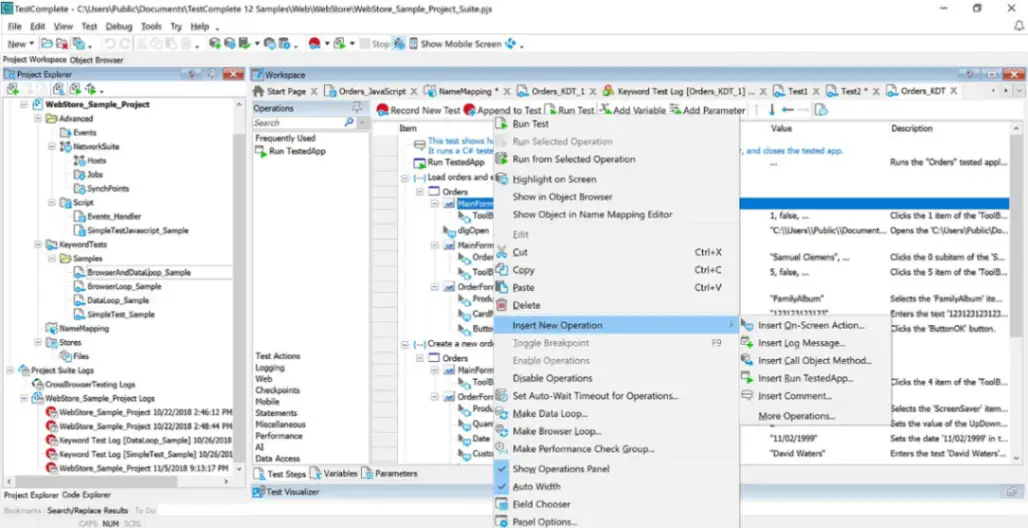
SmartBear TestComplete is an enterprise automated GUI testing tool supporting cross-browser, desktop, and mobile application test automation. Its hybrid object recognition engine combines visual AI with DOM property parsing for robust element identification.
- AI Visual Object Recognition: Identifies dynamic web elements using hybrid machine learning and computer vision models.
- Data-Driven Testing Framework: Built-in support for parameterizing tests against external database tables, CSVs, and Excel files.
- Enterprise CI/CD Pipelines: Native plugins for Azure DevOps, Jira, Jenkins, and Git for end-to-end quality gate enforcement.
9. testRigor
testRigor is an AI-driven, no-code test automation platform designed to allow non-technical stakeholders to build end-to-end browser tests using plain English commands. Its AI engine translates plain-language directives into robust browser interaction sequences.
- Generative AI Script Authoring: Converts natural language requirements into fully functional cross-browser automation scripts automatically.
- Zero-Maintenance Element Locators: Interacts with elements based on screen position and user perception rather than fragile DOM XPaths.
- Full-Stack End-to-End Testing: Validates web, mobile web, SMS authentication flows, and backend API responses within a single execution sequence.
10. Applitools
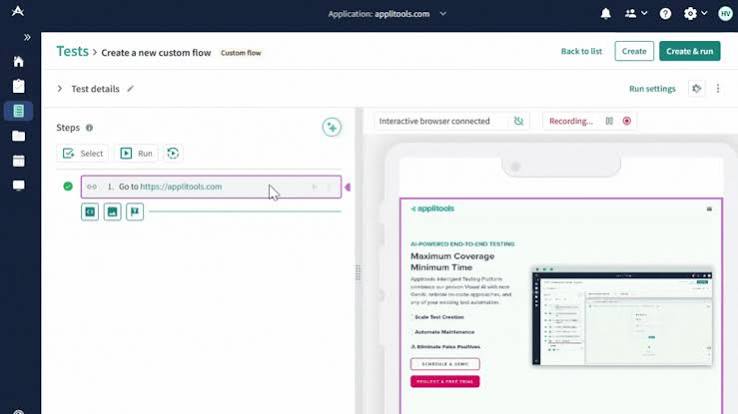
Applitools is an automated visual testing platform that integrates with existing browser testing frameworks to validate UI visual layout consistency. Powered by Visual AI, it mimics human vision to detect visual bugs across disparate viewports and browser engines.
- Visual AI Engine: Uses deep learning models trained on millions of UI layouts to eliminate false positives caused by pixel rendering variations.
- Ultrafast Grid Architecture: Renders visual snapshots across hundreds of browser/viewport combinations concurrently in parallel cloud nodes.
- Framework Agnostic Integration: Seamless SDKs for integration with Playwright, Cypress, Selenium, Appium, and Storybook workflows.
Frequently Asked Questions
What is the primary difference between W3C WebDriver and Chrome DevTools Protocol (CDP) for browser automation?
The W3C WebDriver protocol relies on standard HTTP REST communication between driver binaries and browsers, offering multi-vendor standardization. Conversely, CDP uses low-latency WebSockets to communicate directly with browser rendering engines, enabling faster execution, event interception, and network mocking, though it is limited primarily to Chromium-based browsers.
How do AI-driven self-healing mechanisms reduce test maintenance overhead?
Self-healing mechanisms monitor test execution failures caused by modified element attributes (e.g., dynamic IDs, altered CSS classes). When a failure occurs, the AI analyzes alternative element properties, visual cues, and historical DOM trees to locate the target element, dynamically updates the locator, and completes test execution without failing the build.
Why is parallel execution critical for enterprise continuous integration pipelines?
Parallel execution distributes large test suites across concurrent browser containers or virtual machines simultaneously. This reduces total build runtimes from hours to minutes, providing rapid feedback to developers, reducing deployment bottlenecks, and ensuring rapid CI/CD deployment cycles.
Advertisement