10 Best Automated Phone Systems for Small Business (2026)
Advertisement
10 Best Automated Phone Systems for Small Businesses (2026)
Modern VoIP (Voice over Internet Protocol) solutions have completely revolutionized business telephony. Instead of bulky on-premise PBX hardware, today’s systems live entirely in the cloud, offering seamless mobile apps, AI-powered call transcriptions, and deep integrations with your CRM. For a technical understanding of the standardized SIP (Session Initiation Protocol) that powers these modern calls, you can refer to documentation by the IETF Official Site.
We have carefully evaluated the leading unified communications platforms to bring you the ten best automated phone systems available today, focusing on affordability, ease of use, and advanced routing features.
1. RingCentral
RingCentral is arguably the most comprehensive unified communications platform on the market. It combines enterprise-grade VoIP, video conferencing, and team messaging into a single, intuitive application, making it ideal for collaborative remote teams.
- Multi-Level Auto Attendant: Build highly customized call routing flows to ensure callers always reach the right department or voicemail box.
- AI-Powered Insights: Includes real-time call transcriptions, automated meeting summaries, and advanced analytics on employee call performance.
- External Reference: Explore their full small business feature set directly at RingCentral.
2. Nextiva
Nextiva is famous for its exceptional reliability and award-winning customer support. It is designed to be incredibly user-friendly, making it a favorite for small business owners who don't have a dedicated IT department to manage complex phone systems.
- Visual Flow Builder: Features a drag-and-drop interface that makes setting up an automated greeting and routing rules incredibly simple.
- Unified Communications: Seamlessly brings voice, video, SMS, and built-in sales CRM tools together into one cohesive platform.
- Threaded Conversations: Displays all customer interactions (calls, texts, and emails) in a single timeline, providing total context before you even pick up the phone.
3. Ooma Office
Ooma Office consistently ranks as one of the best budget-friendly automated phone systems for small businesses. It offers plug-and-play simplicity and is equally effective for retail shops using desk phones as it is for contractors working entirely from mobile devices.
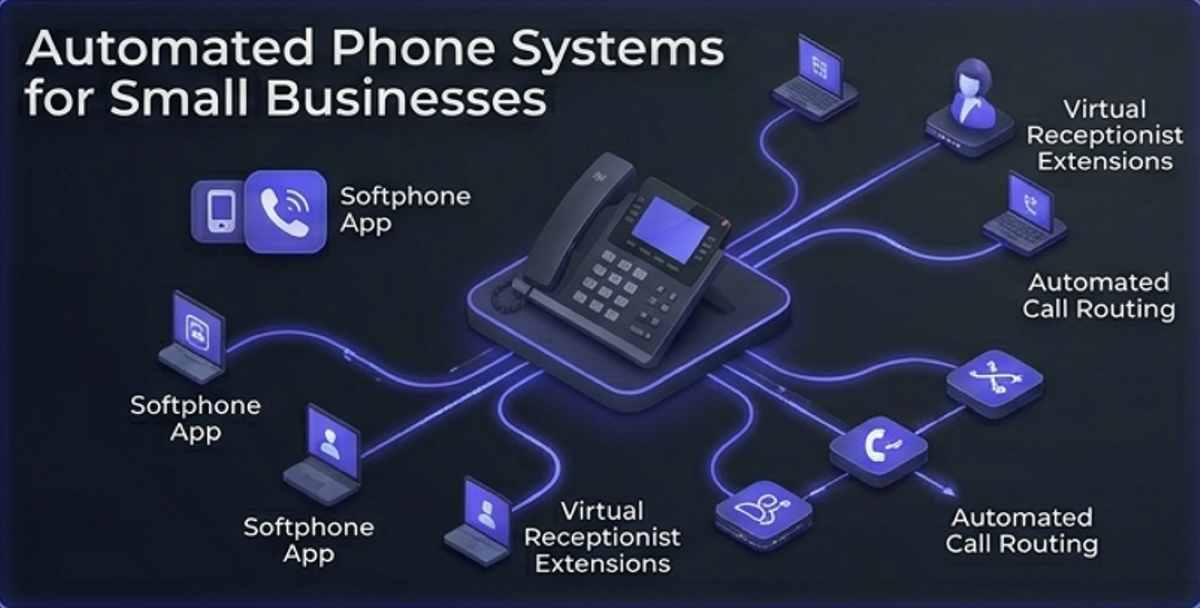
- Virtual Receptionist: Automatically greets callers with customized messages and routes them to extensions, reducing the need to hire a full-time operator.
- Ring Groups: Group multiple extensions together (like "Sales" or "Support") so phones ring simultaneously, ensuring calls are answered faster.
- Easy Setup: Hardware is pre-configured before shipping; simply plug in your base station and start making calls within minutes.
4. Dialpad
Dialpad is a forward-thinking communications platform that leans heavily into Voice Intelligence (Vi). It is built entirely on the Google Cloud platform, making it incredibly fast, secure, and infinitely scalable.
- Real-Time AI Transcriptions: Automatically transcribes calls as they happen and highlights action items and key takeaways in real-time.
- Agent Assist: AI listens to customer queries and automatically pops up helpful knowledge base articles on your screen to help you answer complex questions.
- Seamless Device Switching: Flip an active call from your laptop to your smartphone instantly without the caller experiencing a drop in connection.
5. Aircall
Aircall is designed specifically for high-growth sales and customer support teams. It acts as an integration powerhouse, syncing flawlessly with virtually every major Helpdesk and CRM software on the market.
- Deep CRM Integrations: Logs calls, triggers automations, and displays caller data automatically in platforms like Salesforce, HubSpot, and Zendesk.
- Smart Call Routing: Route calls based on time zones, skill levels, or VIP customer status to optimize your support queues.
- Live Call Coaching: Managers can monitor active calls, "whisper" advice to agents without the customer hearing, or jump in to take over difficult situations.
6. Grasshopper
Grasshopper targets a very specific audience: solopreneurs, freelancers, and micro-businesses who need to separate their personal and business communications without purchasing a dedicated physical phone.
- Mobile-First Design: Operates entirely as an app on your existing smartphone, adding a professional business number on top of your personal device.
- Custom Greetings: Record professional studio-quality greetings to make your one-person operation sound like a Fortune 500 company.
- Instant Response: Automatically sends an SMS text message to callers if you miss their call, ensuring leads do not abandon you for a competitor.
7. GoTo Connect
GoTo Connect (formerly Jive) provides a flexible, robust phone system known for its highly visual Dial Plan Editor. It is highly favored by schools, medical offices, and distributed remote teams.
- Dial Plan Editor: Easily map out exactly how calls should flow during business hours versus after hours using a simple drag-and-drop canvas.
- Included Video Conferencing: Access secure, high-definition video meetings directly from the same application used for voice calls.
- Paging & Intercom: Supports overhead paging systems and desk phone intercoms, making it excellent for large offices or retail environments.
8. Vonage Business Communications
Vonage is one of the most flexible unified communication providers available, largely due to its robust API platform. It allows businesses to deeply embed voice and SMS capabilities directly into their own custom applications.
- API Integration: Build highly customized communication workflows tailored to your specific software stack using Vonage's developer-friendly APIs.
- Unlimited SMS: Offers unlimited business text messaging within the US and Canada, perfect for companies running heavy SMS marketing campaigns.
- Spam Shield: Includes advanced caller ID and native spam blocking technology to keep annoying robocalls out of your queues.
9. 8x8
For small businesses that deal heavily with international clients, suppliers, or outsourced talent, 8x8 offers unparalleled global reach. Their platform provides unlimited calling to more countries than any other competitor on this list.
- Global Calling: Depending on the tier, plans include unmetered international calling to up to 48 different countries without surprise per-minute fees.
- Cross-Platform Analytics: Generates unified reports detailing call quality, employee performance, and network health across global branch offices.
- End-to-End Encryption: Ensures strict security and compliance standards (including HIPAA) for sensitive international data transmission.
10. CloudTalk
CloudTalk is a specialized cloud call center software explicitly built for outbound sales teams and inbound support desks that handle high volumes of daily calls.
- Power Dialer: Automatically dials the next number on a sales list the second a call finishes, drastically reducing manual dial time and increasing agent efficiency.
- International Numbers: Easily purchase local phone numbers from over 160 countries to establish a local presence for offshore clients.
- Skill-Based Routing: Automatically identifies the caller's needs through IVR and routes them specifically to the agent best trained to solve their issue.
FAQs
What is an automated phone system?
An automated phone system is a telephony technology that answers incoming calls without a human operator. It typically uses an auto-attendant or IVR (Interactive Voice Response) to play a recorded greeting and present the caller with a menu of options (e.g., "Press 1 for Sales"), routing them automatically to the correct department.
What is the difference between an Auto-Attendant and an IVR?
An Auto-Attendant is a simple menu system that uses keypad inputs (touch-tone) to route calls to extensions. An IVR is a more advanced system that can understand spoken voice commands and interact with databases (like allowing a customer to check their bank balance or track a package without speaking to an agent).
Do I need to buy new desk phones to use these systems?
No. Almost all modern automated phone systems operate via "Softphones"—software applications installed on your computer, laptop, or smartphone. If you prefer physical desk phones, you can purchase specific IP phones, but they are not strictly required.
Advertisement